
The Death of Stalin: Somehow, the Death of a Dictator Is Hilarious
The Death of Stalin: Somehow, the Death of a Dictator Is Hilarious
We didn't exactly go into The Death of Stalin with a carefully researched plan. We watched about half of a preview, saw Steve Buscemi, Jeff Tambor and the guy who played the villain in The Patriot, and figured, “Yeah, we're watching this.”
Honestly, that turned out to be a pretty damn good decision.
The Death of Stalin is a dark political comedy about what happens when Joseph Stalin dies and the people surrounding him immediately start trying to figure out who is in charge, who is safe, and, most importantly, who is about to get themselves killed.
And somehow, that premise works.
The movie's humor comes largely from watching Stalin's cronies completely lose their shit while trying to maintain the appearance that they know exactly what they're doing. Everyone is terrified of everyone else, everyone is testing everyone else, and absolutely nobody seems to know what the hell is happening.
It's funny.
It's also horrifying.
And occasionally, it's both at exactly the same time.
Steve Buscemi Steals It
Steve Buscemi playing Nikita Khrushchev was probably our favorite part of the movie.
Buscemi brings exactly the right kind of energy to the character. Khrushchev is surrounded by people who are either terrifying, completely insane, or both, and Buscemi manages to make him feel like the one guy who realizes just how ridiculous the whole situation is.
The movie's cast is stacked, but Buscemi's Khrushchev kept pulling our attention back.
And the humor itself definitely has a dry, distinctly British feel to it. There are plenty of jokes where the funniest part isn't necessarily what someone says, but the completely ridiculous situation everyone is calmly participating in.
One of our favorite examples happens right at the beginning.
A symphony is being broadcast on the radio when a call comes in. The manager is told to call someone back in 17 minutes.
That immediately creates a completely unnecessary argument over when the 17-minute countdown actually started, followed by the even more ridiculous question of how long ago someone said the 17 minutes had started.
Then comes the actual problem: Stalin wants a recording of the night's performance.
There isn't one.
So the manager has to figure out how to record the performance while it's already happening.
He hangs up the phone and immediately asks his partner if they're recording the event. They aren't. The performance is ending. So the manager runs out and tries to stop everyone from leaving so they can start the entire thing over.
Meanwhile, secret police are dragging people out of their homes.
And one poor guy who thinks he's being arrested is actually being taken to the radio station because the original conductor has fainted and injured himself.
That sequence had us thinking, “Holy shit, this entire movie is going to be like this.”
It isn't.
And that's actually one of our criticisms.
The Humor Has a Shelf Life
The movie is at its funniest when we're watching the absurdity happening around ordinary people.
The population is terrified. Secret police are everywhere. People disappear. Guards don't know whether they're supposed to stay at their posts or run for their lives.
And then someone gets shot.
Or someone gets dragged away.
Or someone is suddenly expected to perform a completely impossible task because Stalin said so.
There are some absolutely incredible dark-comedy moments in that environment.
One of the funniest and darkest running elements is hearing people inside the prison shouting “Hail Stalin!” followed by a single gunshot.
Again.
And again.
And again.
It's the kind of joke where you laugh, pause for a second and think:
“Oh fuck...”
There are several moments like that.
At one point, guards are afraid to leave their posts. Then they're excused. Then they're chased through the house and shot by the secret police anyway.
It gets to the point where it seems like the entire household staff is being loaded into trucks to be taken away and killed.
Then, as the last truck is being closed up, the officer closing the tailgate gets shot in the head.
That's the kind of movie this is.
We found ourselves doing those little single laughs “Ha.” “Ha-ha.” followed immediately by, “Oh, Jesus Christ.”
History Makes It Better
We're both history fans, so we had enough background knowledge to understand the general situation, but there were plenty of names and personalities we didn't recognize.
Naturally, we started Googling.
And holy shit, Lavrentiy Beria.
We were actually glad we looked him up before his trial in the movie because knowing just how awful this man was made everything surrounding his character even more disturbing.
The movie takes some truly evil people and lets us see them as human beings petty, insecure, jealous, ambitious, frightened and occasionally ridiculous.
That's what makes the movie work for us.
It's not trying to convince us these people were secretly good. Far from it.
Instead, it shows the human side of people who were capable of doing absolutely horrific things.
And there's something fascinating about watching what absolute power does to people. These men have enormous authority, but the second Stalin is gone, suddenly they're all scrambling, testing each other and wondering who is going to be next.
Power doesn't just corrupt.
It makes everyone around you wonder what they need to do to survive.
And Then They Leave the Country House
This is where we think the movie loses a little steam.
Once the story moves from the country house to Moscow, the comedy takes a bit of a dive.
The premise is still good. The political maneuvering is still interesting. And the story itself continues to work.
But we wanted more of the scared population.
More of the absurdity happening outside the inner circle.
More of those “this is absolutely insane” moments involving regular people trying to survive a government where the wrong word could get you killed.
The first portion of the movie establishes that tone incredibly well, and we were hoping the entire movie would continue at that level.
It doesn't quite get there.
The Ending
If you don't know the history, Khrushchev coming out on top could actually be a pretty surprising ending.
Especially considering how he's treated by the other committee members throughout the movie.
One particularly great moment comes when Beria essentially tells everyone that he has dirt on all of them.
And you're sitting there thinking, “Okay... somebody is going to shoot this guy.”
When nobody immediately does, it becomes almost surprising.
Eventually, though, Beria is accused, subjected to the sham trial process and found guilty.
Knowing where history goes makes the ending less surprising, but the movie still manages to make the political maneuvering entertaining.
Our Verdict
8/10.
The Death of Stalin was better than we expected.
It's dry, uncomfortable, absurd and occasionally brutal. The humor definitely leans toward that British style where the situation itself is the joke, and when that style is working, it's fantastic.
We do wish the movie had maintained more of the humor surrounding the terrified population after the story moved to Moscow. That's where we felt the biggest drop-off.
But if you're familiar with history, especially this particular period, there's a lot to enjoy.
And if you've actually studied Stalin, Beria, Khrushchev and the Soviet power structure, you'll probably get even more out of it.
For everyone else, it's still worth watching just be prepared to occasionally laugh before realizing what you're actually laughing at.
Because The Death of Stalin might be the only movie where you can laugh at a guy getting shot, immediately realize you're laughing at a guy getting shot, and respond with:
“Jesus Christ... that actually happened.”
Definitely worth the watch.
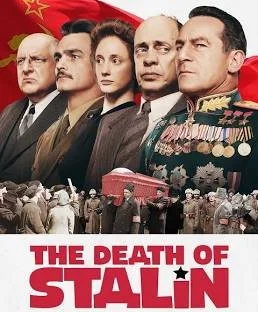
Death of Stalin Poster