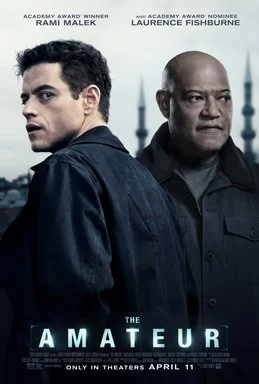
The Amateur Review: Did We Just Watch the Origin Story of The Mechanic?
The Amateur Review: Did We Just Watch the Origin Story of The Mechanic?
There are movies you watch and immediately know what they are trying to be.
Then there are movies that accidentally feel like they belong to an entirely different franchise.
Watching The Amateur, we couldn’t shake one thought:
Are we watching Arthur Bishop before he became The Mechanic?
Not literally, of course. The Amateur isn’t officially connected to The Mechanic. Charlie Heller and Arthur Bishop are completely separate characters originating from completely separate stories.
But forget the names for a second.
Look at the man.
Look at how he thinks.
Look at what happens to him.
And most importantly, look at what he learns to do.
Suddenly, The Amateur starts looking like one hell of an unofficial prequel.
Meet Charlie Heller.
James Hawes’ The Amateur, based on Robert Littell’s novel, stars Rami Malek as Charlie Heller, a brilliant CIA decoder whose natural habitat is about as far removed from the stereotypical action hero as possible.
He’s not Jason Bourne.
He’s not John Wick.
He’s not even particularly good with a gun.
Charlie works in the basement at CIA headquarters, analyzing information rather than kicking down doors. He’s introverted, methodical and extraordinarily intelligent. His greatest weapon isn’t strength.
It’s his brain.
Then his wife, Sarah, played by Rachel Brosnahan, is killed during a terrorist attack in London.
Charlie’s world collapses.
When the CIA won’t respond the way Charlie believes it should, he decides he’s going to find the people responsible himself.
There’s just one fairly significant problem:
Charlie Heller doesn’t know how to kill anybody.
That’s where The Amateur becomes much more interesting than another revenge thriller.
This isn’t really a movie about watching a killer get revenge.
It’s about watching someone figure out how to become capable of revenge without becoming someone else entirely.
That Cast Is Ridiculous.
Rami Malek is surrounded by a cast that could carry several different movies on its own.
There’s Rachel Brosnahan as Sarah Heller, Laurence Fishburne as Robert Henderson, Caitríona Balfe as Charlie’s mysterious contact, Michael Stuhlbarg as Horst Schiller, Holt McCallany as CIA Special Activities Center director Alex Moore, Julianne Nicholson as CIA director Samantha O’Brien, Adrian Martinez as Charlie’s colleague Carlos, Danny Sapani as Caleb Horowitz and Jon Bernthal as CIA operative Jackson O’Brien “The Bear.”
That last one almost feels like the movie showing off.
You have Jon Bernthal walking around inside a revenge thriller and somehow resist simply turning the movie into two hours of Jon Bernthal murdering everybody.
Instead, the movie stays with Charlie.
That’s important.
Because Rami Malek doesn’t suddenly transform Charlie into a conventional action star.
He maintains the character.
Don’t Turn the Nerd Into Rambo.
This might be the smartest decision The Amateur makes.
A lesser movie would give Charlie a training montage.
Twenty minutes later he’d suddenly be sliding across car hoods, firing two pistols and snapping necks.
The Amateur understands that would destroy the entire reason Charlie is interesting.
Laurence Fishburne’s Henderson can teach him.
The CIA can prepare him.
Charlie can learn.
But Charlie Heller is still Charlie Heller.
His advantage isn’t suddenly becoming the toughest man in the room.
It’s figuring out how to beat the toughest man in the room without having to become him.
And that’s where Arthur Bishop enters our heads.
Before The Amateur, There Was The Mechanic.
In 1972, Charles Bronson starred as Arthur Bishop in Michael Winner’s The Mechanic.
Bishop isn’t simply a hitman.
He’s essentially an engineer who happens to engineer deaths.
The original film establishes this immediately. Bishop meticulously studies targets, routines and environments before constructing killings designed to appear accidental. The movie famously spends roughly its first 16 minutes watching Bronson prepare and execute an assignment without dialogue.
That’s the character.
Charles Bronson’s Bishop doesn’t need to explain how dangerous he is.
He observes.
He calculates.
He prepares.
Then something happens.
The original also stars Jan-Michael Vincent as Steve McKenna, Keenan Wynn as Harry McKenna and Bronson’s real-life wife and frequent co-star Jill Ireland. Bishop eventually takes Steve under his wing and begins teaching him the profession, creating the mentor/student relationship at the center of the story.
Nearly four decades later, Hollywood rebuilt Arthur Bishop for a different generation.
Then Jason Statham Picked Up the Tools.
The 2011 remake casts Jason Statham as Arthur Bishop, alongside Ben Foster as Steve McKenna, Donald Sutherland as Harry McKenna and Tony Goldwyn as Dean.
It’s an almost absurdly good collection of actors for this kind of movie.
And Statham’s Bishop retains the defining characteristic of Bronson’s version.
Precision.
He’s an elite assassin who specializes in making murders resemble accidents, suicides or otherwise explainable deaths. He studies his assignments, constructs the scenario, executes it and disappears.
Statham obviously brings considerably more physicality to Bishop than Bronson did.
But underneath all the punching, shooting and Jason Statham doing Jason Statham things, Bishop remains fundamentally cerebral.
The violence is the last part of the equation.
The plan is the weapon.
And that’s Charlie Heller.
So What If The Amateur Is Really “The Mechanic: Year One”?
Imagine stripping away the names.
A highly intelligent man works within the intelligence community.
He’s analytical rather than physical.
Someone he loves is killed.
The institutions surrounding him prove incapable or unwilling to deliver the resolution he needs.
He learns enough fieldcraft to operate independently.
But conventional violence isn’t his strength.
So he studies people.
He studies buildings.
He studies systems.
He identifies vulnerabilities.
He manipulates circumstances.
And eventually he discovers that the most effective way for him to eliminate someone isn’t necessarily to walk up and shoot them.
It’s to construct the situation in which they die.
Congratulations.
You just invented Arthur Bishop.
That’s what makes The Amateur such an unexpectedly perfect spiritual prequel to The Mechanic.
Charlie isn’t Arthur Bishop yet.
He’s learning why someone like Arthur Bishop would exist.
The Emotional Difference Makes It Better.
There is one enormous difference.
Arthur Bishop is already emotionally isolated when we meet him.
Charlie isn’t.
That’s why The Amateur could almost supply the missing emotional chapter The Mechanic never needed to show us.
Charlie begins with love.
His relationship with Sarah matters because his journey isn’t motivated by money, ideology or professional obligation.
It’s grief.
And Rami Malek plays that grief without abandoning Charlie’s awkwardness or vulnerability.
Charlie doesn’t become cool because his wife dies.
He becomes focused.
There’s a difference.
Every step forward carries the feeling that he isn’t merely chasing people.
He’s trying to understand what he’s supposed to do with the enormous empty space Sarah’s death created.
Revenge gives that grief somewhere to go.
That’s considerably more interesting than simply watching another unstoppable action hero erase a list of bad guys.
Laurence Fishburne Is the Bridge.
Fishburne’s Henderson becomes particularly interesting through the Mechanic lens.
He recognizes Charlie’s weakness immediately.
Charlie may understand how operations work intellectually, but understanding violence isn’t the same thing as committing it.
Henderson therefore represents the bridge between Charlie the analyst and Charlie the operator.
And even after that training, Charlie doesn’t simply become Henderson.
That’s crucial.
He takes what Henderson can teach him and filters it through what he already understands.
Information.
Patterns.
Systems.
Planning.
Engineering.
That is exactly how an amateur becomes something else.
Rami Malek Is Why the Idea Works.
Casting Rami Malek might be the secret ingredient.
Malek already proved with Mr. Robot that he can make intelligence visually interesting.
He can sit quietly while making you believe his character is processing twenty different variables.
That ability matters here.
Charles Bronson’s Bishop projected danger through stillness.
Jason Statham’s Bishop projects danger through absolute physical confidence.
Rami Malek’s Charlie projects something different:
calculation.
You can almost see the machinery running behind his eyes.
Put those performances next to each other and they start resembling three evolutionary stages of the same archetype.
Charlie Heller figures out the problem.
Bronson’s Arthur Bishop perfects the methodology.
Statham’s Arthur Bishop turns the methodology into a weapon.
And That’s Why the Buildup Works
The Amateur isn’t trying to race toward its kills.
It’s interested in the process.
That slower buildup is actually essential.
We need to watch Charlie struggle.
We need to watch him discover his limitations.
We need to understand that knowing how something should work and actually standing in front of someone you’re prepared to kill are very different experiences.
Every mistake becomes part of his education.
Every success changes him slightly.
Yet the movie resists turning him into a completely different human being.
By the end, you’re not looking at Rambo.
You’re looking at a smarter, harder and considerably more dangerous version of the same awkward CIA decoder we met at the beginning.
That’s character development rather than character replacement.
And if somebody told us that guy spent another ten years refining what he learned until criminals began referring to him as a “mechanic”?
We’d buy it.
Immediately.
The F’nAround Verdict!
The Amateur works as a revenge thriller because it understands that Charlie Heller’s greatest limitation is also what makes him interesting.
He isn’t a killer.
At least not initially.
He’s a thinker forced into a world normally occupied by killers.
Rather than changing the character to fit that world, the movie gradually forces Charlie to figure out how to make that world fit him.
Rami Malek anchors it beautifully, Laurence Fishburne gives him exactly the kind of formidable mentor the story needs, and an unnecessarily stacked supporting cast makes even smaller pieces of Charlie’s journey feel consequential.
But we’ll probably never be able to watch it again without thinking about Charles Bronson and Jason Statham.
Because The Mechanic gives us Arthur Bishop after the transformation is complete.
The professional.
The artist.
The man who studies a target until he can make murder look like circumstance.
The Amateur gives us something those movies never really did:
What would have to happen to an ordinary, extraordinarily intelligent man before he ever became capable of doing that?
Change Charlie Heller’s name to Arthur Bishop.
Let the credits roll.
Jump forward ten years.
Cue Charles Bronson.
And suddenly The Amateur isn’t just a damn good revenge thriller.
It’s the Mechanic origin story we never knew we wanted.