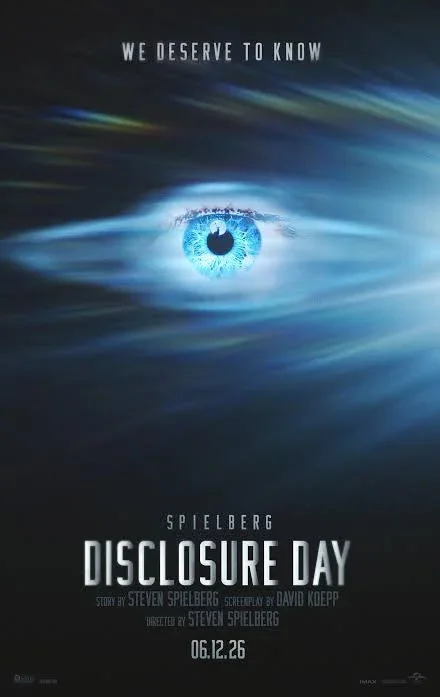
Disclosure Day Review: Spielberg Pulled the Ozymandias Move and It Mostly Works
We need to clear something up first. For about a week, we kept calling this movie Discovery Day, which sounds like a corporate retreat where they make you do trust falls in a parking lot. It’s Disclosure Day. We’re not apologizing. The titles are one word apart and our version sounds more fun.
Anyway. Steven Spielberg made a UFO movie in 2026, and if that sentence doesn’t do anything for you, check your pulse.
The man has now directed a science fiction movie in every single decade of his career. Firelight in the ’60s. Close Encounters in the ’70s. E.T. in the ’80s. Jurassic Park in the ’90s. A.I., Minority Report, and War of the Worlds in the 2000s. Ready Player One in the 2010s. At this point it’s not a filmography, it’s a longitudinal study on how humans react to things falling out of the sky.
So what does the old master do with his 37th film? He asks the biggest question in the genre, and he asks it straight: if you found out we weren’t alone if someone showed you, proved it to you would that frighten you?
Then he spends 145 minutes answering it.
The Setup: A Meteorologist Starts Speaking in Clicks
Emily Blunt plays Margaret Fairchild, a TV meteorologist in Kansas City doing a completely normal weather broadcast. Then, live on the air, something happens to her. She stops speaking English and starts speaking in clicks. Alien clicks. In front of an audience that reportedly includes nuns.
The clip goes everywhere, because of course it does. It’s 2026. A woman speaking in extraterrestrial on live television is going to outperform everything on every platform within the hour.
Enter Josh O’Connor as Daniel Kellner, a cybersecurity analyst who admits out loud, on the record that he stole secrets about non-humans that he was hired to hide from the world. He says he can understand what Fairchild is communicating. His position is refreshingly simple: eight billion people have the right to know the truth, and he’s going to tell them.
Standing in the way: Colin Firth as a government contractor whose entire job is making sure that doesn’t happen. Firth spends a lot of the movie looking like a man watching his pension evaporate in real time.
That’s the engine. And the engine works.
The Cast Actually Shows Up
Emily Blunt is doing the heaviest lifting here, and she knows it. Fairchild could have been a plot device with a weather map — the woman the phenomenon happens to while the men argue about what it means. Blunt doesn’t let that happen. The possession scenes are genuinely unnerving, and the human scenes are better. She’s been on a run Oppenheimer, and now this where she keeps taking roles that require her to be the smartest person in the room while the room is on fire.
Josh O’Connor plays Kellner like a whistleblower who has already done the math on what this costs him and decided to pay it anyway. There’s a quiet stubbornness to the performance that sells the whole movie. If you don’t believe this guy would burn his life down to tell the truth, nothing else works. We believed him.
Colin Firth is the government contractor trying to keep the lid on, and he’s excellent at being the most reasonable-sounding unreasonable man in the film. Every scene he’s in, you understand his argument. That’s what makes him scary. The people who bury the truth never think they’re the villain. They think they’re the adult in the room.
Then there’s the bench: Eve Hewson, Colman Domingo, Wyatt Russell, Elizabeth Marvel, Henry Lloyd-Hughes. Nobody is wasted. Domingo in particular does that thing where he walks into three scenes and makes you wish the movie was about him instead.
The Ozymandias of It All
Okay. Here’s the part we actually wanted to talk about.
If you’ve read Watchmen the comic, not the movie, although the movie gets this part right too you know the Ozymandias play. Adrian Veidt looks at a world about to nuke itself into oblivion and decides the only thing that will stop it is a common enemy. So he fakes an alien invasion. Teleports a genetically engineered psychic squid into the middle of New York. Kills millions. The US and the Soviet Union stop pointing missiles at each other and start pointing them at the sky. Peace through shared terror. It works, and it’s monstrous, and that’s the point.
Disclosure Day is Spielberg running the Ozymandias experiment without the body count.
The film’s thesis and Spielberg has said this out loud, so we’re not projecting is that disclosure itself would do what Veidt’s squid did. His words: “How will Disclosure change us? I believe for the better. It will remind us of our capacity for empathy, and that there is something bigger out there than just ourselves.”
Read that again. That’s the Ozymandias argument with the mass murder removed. Ozymandias believed humanity needed a lie and three million corpses to stop killing each other. Spielberg believes the truth might be enough.
That’s a hell of a thing for the most commercially successful director in history to put on screen in 2026. And the movie commits to it. The infighting doesn’t stop because the aliens show up and lecture us. It stops because the secret stops. The wars, the cover-ups, the contractor with the filing cabinet all of it runs on the same fuel, which is ordinary people not being allowed to know what’s actually happening. Disclosure doesn’t just reveal the aliens. It breaks the machine that needed them hidden.
Whether you buy it depends on how cynical you are. We’re pretty cynical, and the movie almost got us.
How Spielberg Actually Pulled It Off
Here’s the thing about watching a master work: the craft is so smooth you almost miss how deliberate it is.
David Koepp wrote the screenplay from Spielberg’s story, and Koepp has said he was going for a ’70s conspiracy thriller Three Days of the Condor with aliens. That structure is doing enormous work here. Conspiracies are onions. You peel a layer, you find another layer, and every layer makes the characters and the audience a little less sure who the good guys are. It keeps a 145-minute movie moving like it’s 100.
Janusz Kamiński shot it, because of course he did. The man has shot nearly everything Spielberg has made for thirty years, and the visual language here is doing quiet storytelling: the ordinary made uncanny. A weather broadcast. A lab. A car chase. Everything looks normal until it very much doesn’t.
And John Williams wrote the score. His thirtieth collaboration with Spielberg. Thirty. At some point the question stops being whether the music is good it’s John Williams, it’s good and becomes whether there’s anything left for these two to prove to each other. Apparently there is, because the score is doing some of the heaviest emotional lifting in the third act.
There’s also the Close Encounters connection, which Emily Blunt confirmed: “There are definitely questions posed by Close Encounters that are answered in Disclosure Day.” We won’t spoil which ones. But if you’ve ever watched Close Encounters and thought “okay, but then what?” this is the “then what,” fifty years later, from a director who says he’s much more inclined to believe we’re not alone than he was in 1977.
What Didn’t Land
It’s not perfect. 145 minutes is long, and there’s a stretch in the middle where the conspiracy onion has so many layers you start to lose track of which layer you’re on. A couple of the supporting characters exist mostly to deliver exposition while looking concerned.
And the Firth character’s arc resolves a little too neatly for our taste. A man who has spent his entire career burying the biggest secret in human history doesn’t just… reconsider… because the third act needs him to. We wanted one more scene of him being wrong on purpose.
Also, fair warning: if you go in expecting War of the Worlds, recalibrate. This is not an invasion movie. The aliens are barely the point. The point is us. Some people are going to find that boring. Those people are wrong, but they’ll be bored.
Our Verdict
8/10.
Disclosure Day is Spielberg doing what he does best: taking the biggest possible idea what if everybody knew? and making it about ordinary people instead of the spectacle. The cast is excellent, the conspiracy engine hums, and the Ozymandias thesis gives the whole thing a philosophical backbone most blockbusters wouldn’t dare attempt.
It’s not Close Encounters. It’s not trying to be. It’s the movie Close Encounters was always going to become once its director spent fifty years thinking about the question it asked.
Go see it. Then argue about the ending with someone. That’s the point.