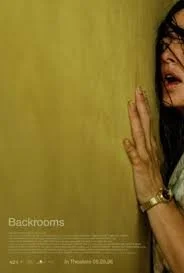
Backrooms Review: Rick and Morty With a Spin of Stranger Things
Let us tell you the most impressive thing about Backrooms, and it has nothing to do with what’s on screen.
The director was 20 years old when this came out.
Kane Parsons was 17 when A24 announced he was making it. He was 19 when they hired him off the strength of YouTube videos he started making in high school. His first Backrooms short has over 73 million views. He couldn’t legally drink at his own premiere afterparty. And he just directed the highest-grossing movie in A24’s history over $210 million worldwide.
Read that again if you need to. We’ll wait.
Okay. The movie.
The Setup: There’s a Door in the Basement
The official synopsis is one sentence: “A strange doorway appears in the basement of a furniture showroom.” That’s it. That’s the pitch. And honestly, that’s all it needs.
Chiwetel Ejiofor plays Clark, a struggling furniture store owner interior designer, architect, guy with a basement full of inventory and problems. He goes downstairs to check a power glitch and noclips out of reality. For the non-gamers: he falls through the world. One second he’s in his store, the next he’s standing in an endless maze of yellow wallpaper, damp carpet, and fluorescent hum.
He doesn’t come back.
So his therapist, Dr. Mary Kline played by Renate Reinsve goes in after him. Which, as a therapeutic approach, we have questions about. But as a movie premise, it’s perfect: the one person whose entire job is telling people their fears aren’t real, walking into a place that is nothing but the fear.
The Cast Actually Shows Up
Ejiofor is doing what Ejiofor does grounding the unbelievable by treating it like it’s Tuesday. Clark isn’t a hero. He’s a tired small-business owner who found something impossible in his basement and got curious at exactly the wrong moment. You believe every bad decision he makes, because you’d make them too.
Reinsve, an Oscar nominee, plays Mary as the skeptic who runs out of skepticism about forty minutes in. There’s a great arc here: a therapist trained to find the rational explanation, slowly realizing the rational explanation is that the place is real and it doesn’t care about her credentials.
Mark Duplass plays Phil, an Async scientist — Async being the shadowy research outfit from Parsons’ web series, the people who were poking at the Backrooms before it was cool. His presence means the movie keeps the series’ best idea: someone was already here. This place has a history. Somebody was taking notes.
Finn Bennett and Lukita Maxwell play Bobby and Kat, Clark’s employees the young people who treat the Backrooms like content until the Backrooms treat them like prey. Avan Jogia rounds things out as a researcher who knows just enough to be dangerous.
And then there’s Robert Bobroczkyi as Captain Clark an entity in the Backrooms that copies Clark’s appearance. In a pirate suit. We’re not going to explain that further because explaining it would ruin it, but it’s the single most unsettling image in the movie, and this is a movie full of unsettling images.
The Stranger Things of It All
Here’s the thesis, and it’s the reason we can’t stop thinking about this movie.
Stranger Things starts with a lab. Hawkins National Laboratory, Dr. Brenner, experiments nobody approved, and a gate ripped open into the Upside Down a dark, rotting copy of Hawkins where the air is full of ash and something is always hunting. Then Will Byers vanishes into it, and his mother goes in after him, because that’s what you do when the lab loses your kid.
Backrooms starts with the same shape, minus the government budget.
Async is Hawkins Lab with the serial numbers filed off: researchers who found a door between worlds and turned it into a program. Studies. Notes. Protocols. The Backrooms are their Upside Down not a rotting copy of a small town, but an emptied copy of office America. Yellow wallpaper instead of ash. Fluorescent hum instead of spores. Same principle: a parallel place running alongside ours, wrong in ways you feel before you understand.
And the missing-person engine is identical. Will goes into the Upside Down; Joyce goes in after him. Clark goes into the Backrooms; his therapist goes in after him. In both stories, the professionals with the clipboards caused the problem, and the amateurs with nothing but love for the missing person have to walk into the nightmare to fix it.
The difference and it’s the difference that makes this a horror movie instead of an adventure is that Hawkins Lab at least pretended it could close the gate. Async just keeps taking notes while people disappear into the yellow.
The Rick and Morty of It All
Now the other half, and this is where the scientist angle really pays off.
Rick and Morty’s entire premise is that the multiverse is a workshop. Rick Sanchez genius, alcoholic, war criminal of science treats dimensions the way a mechanic treats a junkyard: open a portal, poke the dimension, grab what you need, leave it running, deal with the consequences never. Froopy Land, the pocket world he built for Beth as a kid, is the thesis in miniature: a custom-made dimension, abandoned, left running, and the things inside kept evolving until the wonderland curdled into something feral.
Async is Rick with an HR department.
Think about it. Somebody found a hole in reality a place you reach by noclipping, by clipping through the world like it’s a buggy video game and instead of sealing it, they studied it. They gave it levels. They catalogued the entities. They built a research program around a hole in the universe and acted like it was a lab instead of a warning. That is the most Rick Sanchez thing an organization can do. The show’s joke is that Rick is always fine and everyone around him pays the price. Backrooms removes the joke: nobody’s fine. That’s what makes it horror instead of comedy.
And the entities copying you? That’s the multiverse pushing back. In Rick and Morty, every dimension Rick trashes eventually sends something back through the portal. Here, the Backrooms absorb the people the scientists feed into them and make something that looks like them and isn’t. Captain Clark, wearing Clark’s face like a pirate costume, is what happens when you treat a dimension like a petri dish for long enough. The dish starts growing things.
So that’s the movie: Stranger Things’ lab-opened-a-door-and-lost-a-guy, crossed with Rick and Morty’s scientists-treat-the-multiverse-like-a-workshop. The horror isn’t the monsters. The horror is the research continuing.
How a 20-Year-Old Pulled It Off
Here’s what shouldn’t work and does: A24 built 30,000 square feet of actual Backrooms. Real yellow wallpaper. Real damp carpet. Real fluorescent hum. In an era where most horror is shot on a green screen the size of a garage, Parsons insisted on physical space — because liminal horror only works if your body believes the room goes on forever.
The film mixes traditional cinematography with found footage, which is exactly the right call. The found footage gives you the YouTube-series dread the fans came for. The traditional coverage gives the actors room to actually act, which is what turns a creepy concept into a movie.
And the sound design deserves its own review. The hum. That fluorescent buzz that sits just under every scene in the Backrooms until you realize your shoulders have been up around your ears for twenty minutes. Whoever mixed this understands that the scariest thing in the movie isn’t an entity. It’s the absence of anything, amplified.
Credit where it’s due behind the camera too: Parsons co-wrote with Will Soodik, and the producing bench James Wan’s Atomic Monster, Shawn Levy’s 21 Laps, Chernin clearly knew enough to hand a generational internet-horror mind the keys and get out of the way.
What Didn’t Land
It’s not perfect. There’s a stretch in the middle where the movie starts explaining the Backrooms the levels, the Async research, the rules and every explanation makes the place slightly less scary. Liminal horror runs on the unknown. The more the film tells you, the more you want it to stop telling you.
A couple of the entity encounters lean on loud noises in ways the rest of the movie is too smart for. When your whole aesthetic is dread-through-emptiness, a jump scare feels like a cheat code.
And the Async thread raises questions the movie doesn’t fully answer which is either sequel bait or a deliberate mystery, and we’re choosing to believe it’s the latter because the alternative annoys us.
Our Verdict
9/10.
Backrooms is what happens when the Stranger Things lab guys meet the Rick and Morty school of dimensional science: a door gets opened, a guy goes missing, the scientists keep taking notes, and the place on the other side starts learning your face.
Parsons didn’t just adapt a creepypasta. He proved that the kid from YouTube understood the assignment better than a studio ever could: the scariest place isn’t hell. It’s the office supply room that never ends and the lab coats who won’t stop studying it.
It’s on digital now. Watch it with the lights on. Then check your basement. You know, just in case.