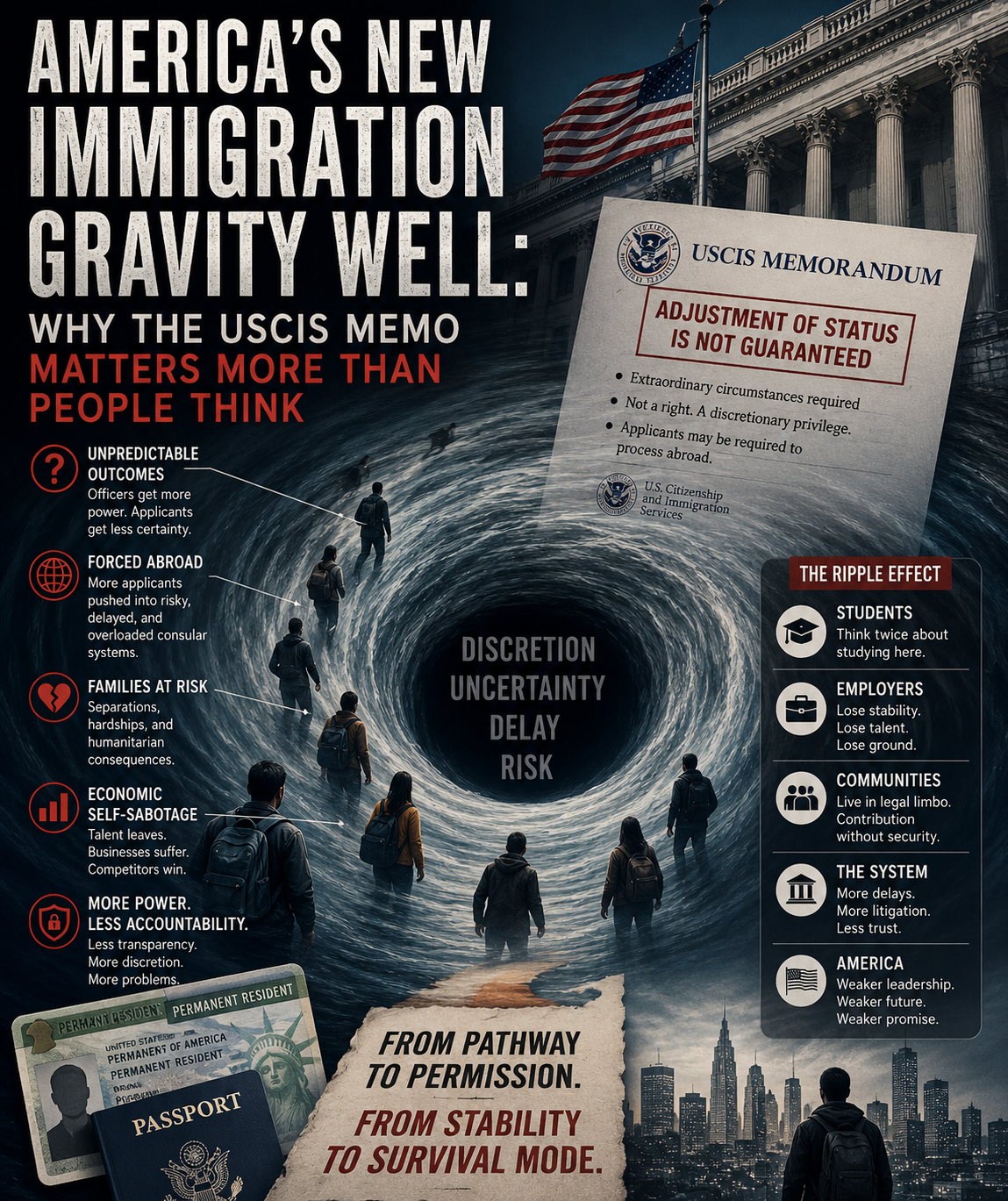
America’s New Immigration Gravity Well: Why the USCIS Memo Matters More Than People Think
America’s New Immigration Gravity Well: Why the USCIS Memo Matters More Than People Think
The USCIS memo controversy is dangerous not simply because of immigration policy itself, but because of what it reveals about how modern administrative systems expand discretionary power during periods of political instability and public anxiety around migration. The memo essentially reframes adjustment of status — historically one of the most important mechanisms allowing immigrants already lawfully inside the United States to obtain permanent residency without leaving as an “extraordinary” privilege rather than a normalized administrative pathway.
That sounds subtle on paper.
It is not subtle in practice.
For decades, adjustment of status functioned as a stabilizing mechanism within the American immigration system. Highly skilled workers, spouses of U.S. citizens, students transitioning into employment-based categories, refugees, trafficking victims, and countless others could build lawful lives while their cases progressed domestically. The entire economic architecture surrounding employment visas, tech recruitment, higher education, healthcare staffing, and multinational labor planning quietly evolved around the assumption that lawful adjustment inside the U.S. remained a viable path.
The memo destabilizes that assumption.
And the first major downfall is uncertainty itself.
Even immigration attorneys are publicly disagreeing about how aggressively USCIS intends to apply the memo because the language simultaneously claims this is merely a “reminder” of existing law while agency messaging frames it as closing a loophole and pushing applicants back toward consular processing abroad.
That ambiguity is not politically accidental.
Modern administrative systems increasingly govern through discretionary uncertainty rather than direct prohibition. Instead of outright banning adjustment of status, the government expands officer discretion while signaling a presumption against approval. That creates a chilling effect without requiring Congress to formally rewrite immigration law.
Structurally, this is one of the most important shifts in modern governance:
systems no longer need to prohibit behavior outright if they can make outcomes unpredictable enough that people self-regulate through fear.
The memo’s second major weakness is economic self-sabotage.
The United States spent decades constructing entire industries dependent upon skilled immigrant labor while simultaneously creating enormous green card backlogs. Tech companies, hospitals, universities, engineering firms, research institutions, pharmaceutical companies, and multinational corporations all built workforce models assuming many employees would eventually transition from temporary status into permanent residency.
Now imagine telling those same workers:
“You may need to leave the country and restart your final immigration stage abroad.”
That creates enormous operational instability.
Employers suddenly face risks involving: interrupted employment, visa denials abroad, consular delays, geopolitical instability, travel bans, family separation, lost workers, and recruitment hesitancy.
The irony is that the memo arrives at a time when the United States is simultaneously competing globally for highly educated labor. Countries like Canada, Australia, Germany, and parts of Europe increasingly market themselves specifically as stable immigration destinations for skilled professionals frustrated with U.S. uncertainty.
That is where this policy becomes strategically dangerous beyond politics.
The U.S. economy historically benefited because immigrants accepted procedural difficulty in exchange for predictability. If the process becomes both difficult and unpredictable, the competitive advantage erodes.
And uncertainty is contagious.
Once high-skilled immigrants perceive the American immigration system as structurally unstable, they begin making long-term calculations differently:
where to study,
where to invest,
where to buy homes,
where to build companies,
where to raise families.
That type of reputational damage compounds quietly over years.
The third downfall is the expansion of administrative subjectivity.
The memo repeatedly emphasizes that adjustment of status is discretionary and dependent on “extraordinary circumstances.”
That language matters because discretionary systems naturally increase interpretive inconsistency.
One officer’s “positive equities” become another officer’s “insufficient justification.”
One office grants relief.
Another denies it.
One applicant receives flexibility.
Another receives removal exposure.
The result is not merely stricter enforcement.
The result is procedural unpredictability.
Historically, discretionary-heavy systems create three downstream effects: fear, forum shopping, and politicization.
People stop trusting rules because outcomes appear dependent on interpretation rather than standards.
That becomes particularly volatile when combined with recent expansions of “good moral character” reviews, ideological screening concerns, and increased scrutiny around social media and political expression.
At that point, immigration stops feeling like a legal process and starts feeling like an interpretive loyalty system.
Another major weakness is family destabilization.
The public conversation often frames immigration through employment categories, but millions of adjustment cases involve marriages, children, mixed-status families, and humanitarian protections. Critics immediately raised concerns that forcing people abroad for processing could separate families or expose vulnerable individuals to danger in unstable countries.
This creates a paradox: the government claims to be restoring procedural order while potentially increasing humanitarian instability. And that instability carries political consequences.
Historically, Americans tolerate immigration enforcement most comfortably when it appears orderly, targeted, and clearly tied to security or fraud prevention. Public support weakens significantly when policies begin affecting families, long-term residents, healthcare workers, researchers, students, or individuals viewed as culturally integrated.
That is why the messaging rollout around the memo was so controversial.
Even immigration lawyers described widespread panic after the announcement because the administration communicated maximal disruption before clarifying how broadly the policy would actually apply.
Which leads to another structural issue:
governance through fear signaling.
Increasingly, federal agencies appear to use intentionally aggressive messaging to create deterrence effects larger than the actual legal changes themselves. The public announcement often becomes psychologically more important than the technical rule.
That strategy may succeed politically in the short term by signaling toughness, but administratively it erodes trust in system stability.
And once trust in procedural stability erodes, compliance becomes harder because people stop believing rules will remain consistent long enough to plan around them.
The broader systems-analysis problem is even deeper.
The memo reflects a larger transformation occurring across multiple Western governments:
temporary legal status is increasingly being treated not as a bridge toward integration, but as a permanently conditional state.
That changes the philosophical meaning of immigration entirely.
Historically, the American model implicitly encouraged transition: student to worker to resident to citizen.
This memo weakens the predictability of that ladder.
And when upward mobility pathways become uncertain, societies often experience increased social fragmentation because large populations begin living in long-term legal limbo.
That is institutionally dangerous.
Stable societies generally require pathways that convert temporary populations into invested long-term stakeholders. Systems that maximize uncertainty create populations that feel economically necessary but politically disposable.
From a governance perspective, that can generate long-term legitimacy problems.
The final major downfall is that the memo likely increases bureaucratic pressure rather than reducing it.
Consular systems abroad are already overloaded.
Visa backlogs already exist.
Administrative processing delays already stretch months or years in some regions.
Shifting more applicants outward does not eliminate complexity. It redistributes it geographically while adding:
travel logistics,
international coordination,
security vetting,
document risks,
and embassy dependency.
In practice, this may create exactly the opposite of what policymakers publicly claim to want: more delays, more confusion, more litigation, and more administrative inconsistency.
Which is why many legal analysts believe the memo’s greatest significance is not the literal text itself, but the signal it sends about the future direction of immigration governance in the United States.
The signal is that immigration benefits are increasingly being reframed not as structured legal pathways, but as extraordinary discretionary privileges subject to shifting political interpretation.
And historically, once governments move toward that framework, administrative discretion tends to expand far faster than formal law itself.