AI Safety, Cannabis Safety, and the Illinois Compliance Machine
AI Safety, Cannabis Safety, and the Illinois Compliance Machine
Illinois lawmakers just passed what many are calling a landmark AI accountability bill.
Supporters describe Senate Bill 315 as a necessary step toward transparency, safety, and oversight for powerful artificial intelligence systems. The bill would require major AI developers to publish safety frameworks, disclose how they evaluate risk, and submit to third-party audits designed to verify compliance. OpenAI and Anthropic supported the legislation, and lawmakers framed it as a way to prevent catastrophic harms before they happen. (Capitol News Illinois)
On paper, that sounds reasonable.
Nobody wants unregulated AI causing chaos.
Nobody wants technology advancing faster than accountability.
Nobody wants the digital equivalent of dumping chemicals into a river and hoping for the best.
But in Illinois, there is always a second question worth asking:
Who gets paid to keep everyone “safe”?
Because Illinois has a long history of turning regulation into an industry of its own.
Not just in AI.
Not just in technology.
In everything.
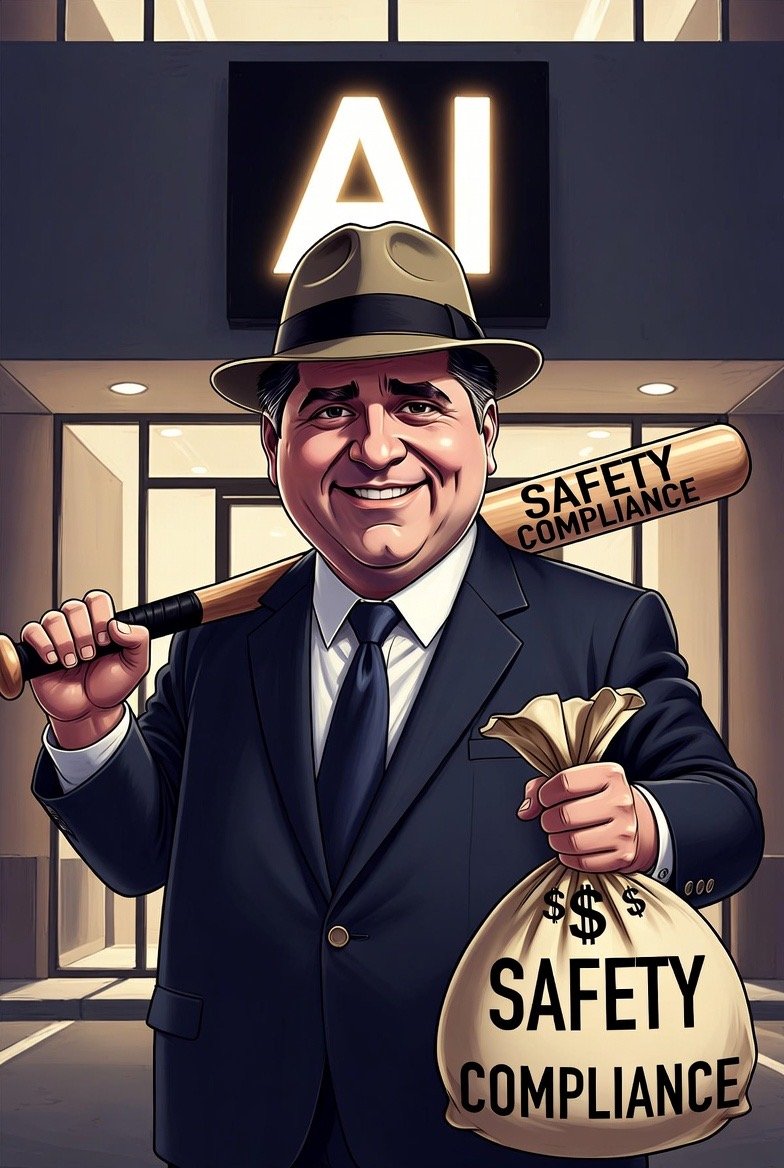
Years ago, movies used to show a certain kind of business arrangement.
A guy would walk into a neighborhood store and explain that for a small weekly payment, he could make sure nothing unfortunate happened.
Pay the insurance.
Keep the windows.
Miss a payment?
Suddenly somebody throws a brick.
The fire department arrives a little late.
A problem appears that didn’t exist yesterday.
Everybody watching understood the joke.
The payment wasn’t really for protection.
The payment was for participation.
The payment was for access.
The payment was for peace.
The payment was for permission.
Today, that model looks different.
Nobody walks into your business wearing a fedora and carrying a baseball bat.
Instead, they arrive carrying compliance manuals.
Safety certifications.
Audit requirements.
Consulting agreements.
Mandatory reporting frameworks.
Oversight committees.
Regulatory software.
Industry-approved vendors.
Government-approved solutions.
The language changed.
The incentives often remain surprisingly familiar.
That’s why AI regulation raises an interesting question.
Not whether oversight should exist.
It should.
The question is who ultimately benefits from the oversight structure.
Because history shows that oversight systems frequently develop ecosystems around themselves.
Auditors need contracts.
Consultants need clients.
Compliance firms need recurring revenue.
Software providers need mandatory adoption.
Industry groups need seats at the table.
Political stakeholders need experts.
Experts need funding.
Funding creates relationships.
Relationships create influence.
Influence creates access.
Access creates power.
And eventually the people writing the rules, interpreting the rules, enforcing the rules, and profiting from the rules can begin orbiting the same circles.
That doesn’t mean corruption.
It doesn’t automatically mean misconduct.
It does mean incentives deserve examination.
Cannabis provides a useful example.
For years Illinois officials justified increasingly complex compliance requirements as necessary for public safety, consumer protection, and market integrity.
Those sound like good goals.
But critics have repeatedly questioned whether the practical result was a highly concentrated market dominated by a relatively small group of operators and insiders while barriers to entry continued to rise.
Other states are actively facing lawsuits and investigations concerning alleged market concentration, cartel-like behavior, licensing concerns, and regulatory favoritism.
Illinois meanwhile often appears more interested in defending the structure than questioning it.
The pattern is familiar.
A problem is identified.
A compliance regime is built.
A class of approved experts emerges.
The cost of participation rises.
The people already inside the system gain advantages.
The public is told the arrangement exists for safety.
Maybe sometimes it does.
Maybe sometimes it doesn’t.
The problem is that “safety” has become one of the most politically useful words in America.
Everything is safety.
Data collection is safety.
Monitoring is safety.
Restrictions are safety.
Reporting is safety.
Audits are safety.
More regulation is safety.
More spending is safety.
More oversight is safety.
The word itself has become almost impossible to challenge because nobody wants to be the person arguing against safety.
But real accountability requires asking uncomfortable questions.
Who audits the auditors?
Who oversees the oversight?
Who benefits financially from compliance?
Who receives access to information that others do not?
Who gains market advantages from the rules?
Who helped write them?
Who funded the organizations supporting them?
Who profits when compliance becomes more expensive?
These questions matter just as much in AI as they do in cannabis.
Because the danger isn’t necessarily artificial intelligence.
The danger is assuming that any system becomes trustworthy simply because someone labeled it “safe.”
Illinois politicians often speak about transparency.
Illinois agencies often speak about accountability.
Illinois regulators often speak about public trust.
The real test is not what they say.
The real test is whether the same standards apply when scrutiny turns toward the institutions themselves.
If the answer is yes, then the AI bill may become a genuine accountability measure.
If the answer is no, then it risks becoming another chapter in a very Illinois story:
A state where the word “safety” sometimes means protection.
And sometimes means permission.
The challenge is figuring out which one you’re paying for.
And maybe that’s the real lesson hidden inside every new regulatory crusade.
The question is never whether oversight should exist.
The question is who is being protected.
Because if history teaches anything, it’s that systems rarely reveal their true purpose through their stated mission. They reveal it through their outcomes.
Who gains access?
Who gets excluded?
Who receives funding?
Who receives enforcement?
Who receives exemptions?
Who receives silence?
If artificial intelligence truly represents the next industrial revolution, then the fight won’t simply be about algorithms.
It will be about power.
Who controls the data.
Who controls the infrastructure.
Who controls the capital.
Who controls the narrative.
And perhaps most importantly:
Who gets to decide what is considered safe.
Because in Illinois, we’ve heard that word before.
We heard it when industries needed regulating.
We heard it when licenses needed issuing.
We heard it when markets needed protecting.
We heard it when transparency somehow produced less transparency.
We heard it when competition somehow produced less competition.
We heard it whenever another layer was added between the public and the people making decisions.
Maybe this AI bill becomes exactly what its supporters promise.
Maybe it creates transparency.
Maybe it creates accountability.
Maybe it prevents genuine harm.
Everyone should hope that’s true.
But if the pattern continues, then the biggest risk may not be artificial intelligence at all.
The biggest risk may be natural intelligence doing what it has always done:
Building systems that concentrate power, calling them protection, and acting surprised when the public eventually notices the difference.
Because technology changes.
Industries change.
Buzzwords change.
The sales pitch changes.
The players change.
But the game?
The game is usually the same.
And in Illinois, we’ve all seen enough seasons to recognize a rerun when it starts playing again.
But what do I know?
I’m just a guy who somehow turned exposing corruption into a doctorate and then decided the logical next step was a PhD on a collapse theory I created studying the same systems.
Maybe Illinois is perfectly normal.
Maybe everything is working exactly as intended.