The Timestamp Is Part of the Record: Why Procedural System Mapping Matters
The Timestamp Is Part of the Record: Why Procedural System Mapping Matters
In ordinary transparency work, people look for the document.
In systems analysis, the document is only one fragment of the signal.
The timestamp matters.
The signatory matters.
The exemption language matters.
The delay matters.
The shift from staff response to counsel response matters.
The phrase repeated three times matters.
The phrase avoided entirely matters even more.
That is the difference between filing requests and mapping a procedural orbit.
A normal requester asks for records and waits for an answer. An adversarial systems analyst tracks how an institution behaves under pressure. Every response becomes telemetry. Every deadline becomes measurable motion. Every late-day release, especially one transmitted before a weekend or holiday window, becomes part of the gravitational record.
That does not automatically prove misconduct.
It does something far more important.
It reveals curvature.
When an institution is confident, responses tend to move cleanly through the system. Earlier. Shorter. Direct. The denial is stronger because the orbit is stable. The language does not need to bend around itself.
But when a request approaches a procedural singularity, the response often changes character. It arrives later in the cycle. It becomes narrower. More lawyered. More exemption-heavy. The sender changes. The language becomes increasingly defensive while simultaneously trying to appear procedural and neutral.
The institution stops merely answering.
It starts stabilizing.
That is when the timeline itself becomes evidence.
Because in adversarial procedural analysis, timing is never isolated from language. Delay is never isolated from escalation. The response cannot be separated from the orbit that produced it.
In one records sequence, an Office did not simply state “no responsive records.” Instead, it partially complied, partially denied, escalated the response through counsel, and acknowledged certain categories while withholding others under proprietary or confidential exemptions.
That matters.
Not because it conclusively answers the underlying question, but because it signals that the matter has crossed from administrative processing into interpretive containment. The response is no longer just informational. It becomes doctrinal. The institution begins constructing a protected procedural narrative around the issue itself.
Then an inspector general report quietly established something even more important: the agency’s interpretive gravity model.
Certain agreements were required to be disclosed, but the report simultaneously clarified that such structures were not prohibited by statute. It further established that centralized operational management across multiple facilities was not automatically viewed as a violation, provided ownership remained technically “separate and distinct.”
That is where the curvature appears.
Not necessarily illegality.
Not automatically fraud.
Not even necessarily bad faith.
But structurally, it becomes a gravitational hinge point where operational reality and paper reality begin orbiting differently.
The paper may describe separation.
The public branding may describe unity.
The agreement may centralize operations.
The regulator may define all of this as permissible until some undefined threshold is crossed.
So the systems question becomes simple:
Where is the event horizon?
Because institutions are often comfortable enforcing rules that remain undefined at the edge. The less precise the threshold, the more flexible the interpretation becomes. And flexible interpretation creates procedural mass.
That is why timelines matter.
Not because timelines are decorative.
Not because they make articles look investigative.
But because timelines expose orbital behavior over time.
A single late response can be coincidence.
A single exemption-heavy denial can be ordinary.
A single escalation to counsel can be routine.
But when the same procedural distortions appear repeatedly across multiple departments, agencies, jurisdictions, and regulatory environments, the pattern begins to resemble an unwritten standard operating rhythm.
The orbit becomes recognizable.
First, the request is treated as ordinary.
Then the request identifies a definitional ambiguity.
Then the institution responds narrowly.
Then the requester follows the language into the unresolved gap.
Then the response cycle lengthens.
Then the signatory changes.
Then exemptions increase.
Then the answer becomes less about producing records and more about preserving the interpretive architecture surrounding the records.
That is procedural systems mapping.
It is not guessing motives behind closed doors. It is observing how institutional gravity bends process in real time. Large bureaucratic systems behave predictably under pressure. The greater the procedural mass accumulated around an unresolved issue, the more visible the distortions become to anyone tracking the orbit carefully enough.
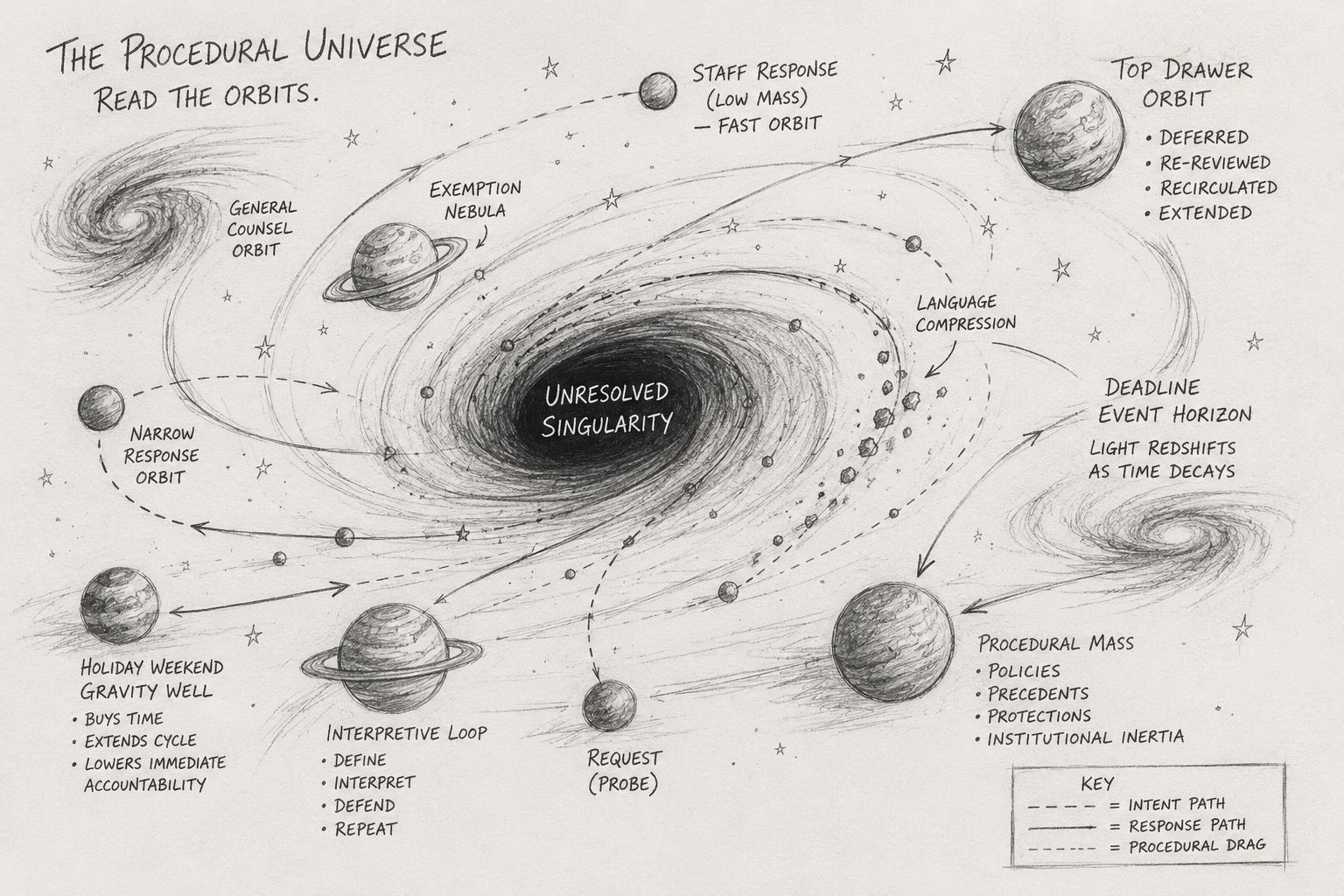
This is why certain records seem to drift into what observers jokingly call “top drawer orbit.” Not denied. Not fully released. Not forgotten. Merely slowed. Deferred. Re-circulated. Re-reviewed. Extended. Held in procedural suspension long enough for momentum itself to become part of the response.
The delay becomes informational.
In adversarial analysis, the strongest signal is rarely the loudest answer. It is the non-confident answer. The answer that arrives at the edge of the cycle. The answer transmitted late on a Friday before a holiday window. The answer that cites process instead of substance. The answer that technically responds while carefully avoiding gravitational contact with the real question underneath it.
That is where the next request goes.
Because the unresolved singularity is usually not hidden inside what the institution said.
It is hidden inside the linguistic orbit they used to avoid saying it.
That is the point of the timeline.
It is not merely chronology.
It is a procedural star map.
It reveals where institutional gravity remains stable.
It reveals where responses begin bending around unseen mass.
It reveals where counsel suddenly enters orbit.
It reveals where language compresses.
It reveals where procedural light begins disappearing beyond the event horizon.
And once you learn how to read those distortions, the system starts mapping itself.
And eventually, if you track enough timestamps, enough delays, enough procedural orbit changes, something strange begins to happen.
The system stops looking random.
Throw the timeline into the air of your mind for a moment.
Not as dates.
Not as emails.
Not as agencies.
But as mass.
Align the timestamps.
Watch the responses rotate.
Watch which requests accelerate directly through the system and which suddenly begin drifting into elongated procedural orbit.
Add gravity.
Segment the responses by timing, signatory, exemption language, escalation level, and delay cycle. Suddenly the universe underneath the procedure becomes visible.
You start seeing the same constellations everywhere.
A request approaches too close to unresolved mass and the orbit bends.
A deadline nears and procedural light begins redshifting toward the end of the business day.
A simple staff response suddenly collapses inward and emerges from counsel instead.
A clean denial transforms into an interpretive nebula dense enough to obscure the actual question beneath it.
That is when Gravitas Satanae starts making uncomfortable sense.
Not as mysticism.
Not as conspiracy.
But as procedural astrophysics.
Large institutions accumulate administrative mass over time. Unresolved contradictions create gravity wells. Deferred disclosures create orbital drag. Interpretive loopholes behave like black holes: everything around them bends while the institution insists nothing moved at all.
And the funniest part?
Once you learn to read the orbital mechanics, the system starts predicting itself.
You can almost tell which requests are going to arrive at 9:14 AM with a confident denial and which ones are going to mysteriously appear at 4:57 PM before a holiday weekend wrapped in exemption language dense enough to collapse a small moon.
At some point you stop reading responses.
You start reading curvature.
And once you can see the curvature, you realize the records were never the whole map.
The orbit was.
Follow the orbits.