The Hammond Bears and Chicago 2.0?
The Hammond Bears and Chicago 2.0?
How AI Infrastructure, Data Centers, Energy Expansion, and Institutional Capital Are Quietly Reshaping Hammond, Indiana Into One of the Midwest’s Most Important Emerging Corridors
By F’nAround Media and F’nResearch
For decades, Hammond, Indiana existed in the shadow of Chicago in the same way many industrial Midwest cities have existed in the shadow of larger economic centers: close enough to matter, but rarely important enough to dominate national headlines. Did you know when you ask google the most famous thing about Hammond, Indiana the first this is “The most famous thing about Hammond, Indiana, is its close connection to the author Jean Shepherd and the iconic holiday film A Christmas Story”. Though most people associated Hammond and Northwest Indiana with steel mills, casinos, highways, rail yards, aging industrial corridors, and the occasional conversation about whether somebody from Illinois could save money buying cigarettes, gas, or fireworks by crossing the state line for twenty minutes.
That was the public narrative.
But behind the scenes, something very different appears to have been developing over the last several years. Quietly. Systematically. Structurally.
What originally started as research into one project unexpectedly opened the door to a much larger pattern involving AI infrastructure, hyperscale data centers, institutional real-estate acquisitions, utility-scale power expansion, redevelopment authorities, Chicago-connected investment groups, opportunity-zone-style redevelopment strategies, and even renewed discussions surrounding the Chicago Bears and a potential multibillion-dollar stadium project near Hammond’s Lost Marsh area.
Individually, none of these stories seem extraordinary.
Together, they begin to resemble something much larger than coincidence.
Not a conspiracy. Not a secret billionaire plot to replace Chicago with a futuristic AI megacity in Indiana while everyone is distracted watching TikTok and arguing about stadium financing. Reality is almost always more practical and less cinematic than internet culture wants it to be.
But what does appear to be happening is potentially more important in the long run: the slow emergence of Northwest Indiana as a major strategic expansion corridor for the next era of Chicago-area economic growth.
And once you begin looking at Hammond, Indiana through the lens of infrastructure systems, energy demand, logistics, institutional capital flow, and metropolitan expansion theory, the region suddenly starts looking a lot less like “forgotten Rust Belt spillover” and a lot more like one of the most strategically positioned redevelopment zones in the Midwest.
The biggest mistake people make when discussing artificial intelligence infrastructure is assuming the story is about software.
It is not.
The real story is electricity.
AI runs on compute power, and compute power runs on massive amounts of energy. Modern hyperscale data centers consume astonishing amounts of electricity compared to traditional commercial developments. The public often imagines AI as a cloud-based abstraction floating invisibly through the internet, but in reality, artificial intelligence infrastructure is intensely physical. It requires land, cooling systems, substations, transmission infrastructure, fiber connectivity, transportation access, water systems, construction capacity, and most importantly, reliable large-scale power generation.
That is where this story becomes genuinely fascinating.
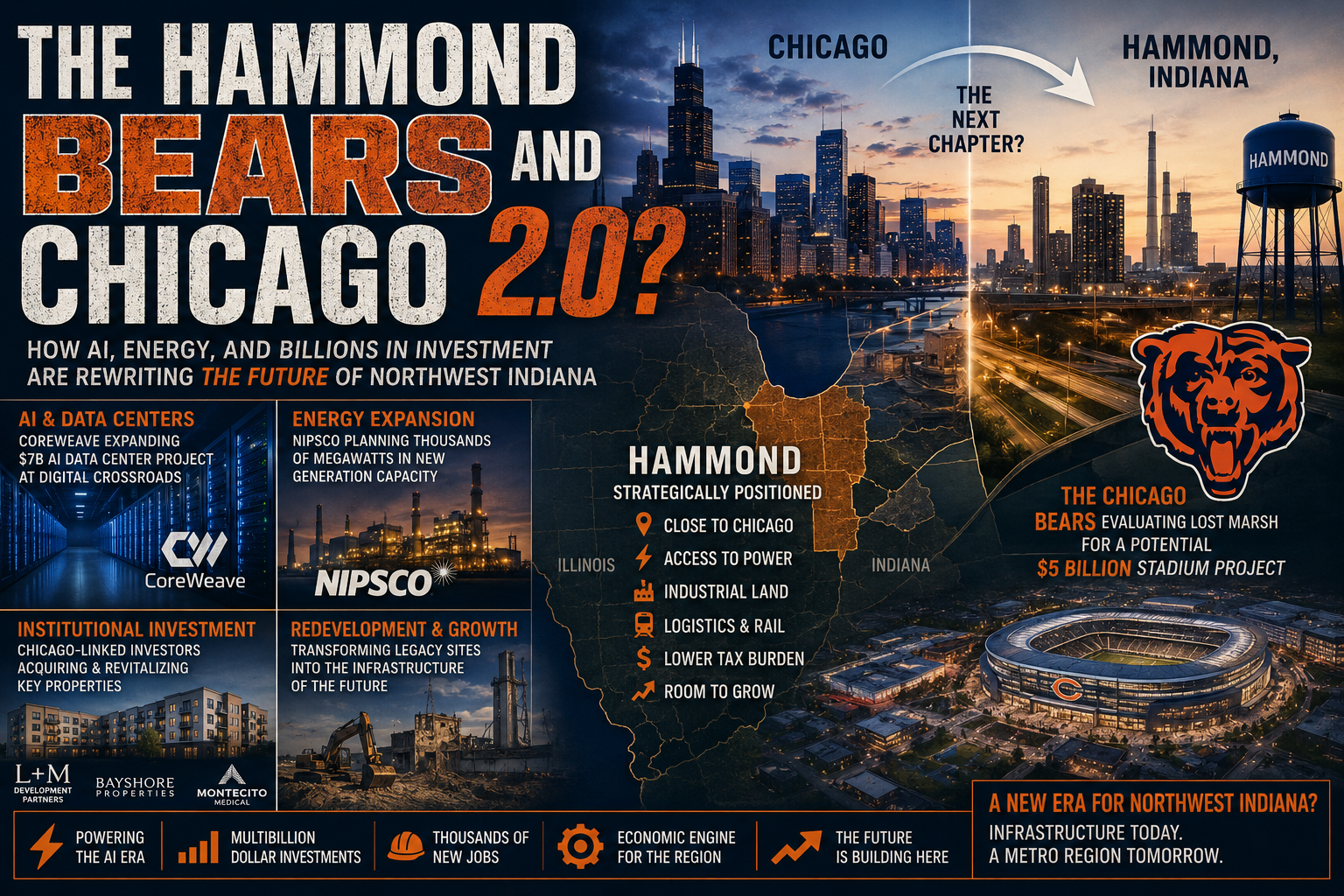
While researching data-center expansion tied to CoreWeave and redevelopment activity connected to Decennial Group in Hammond, broader infrastructure patterns began surfacing involving Northern Indiana Public Service Company, better known as NIPSCO. Public reports and filings now show a region preparing for extraordinary future electrical demand. NIPSCO’s current generation capacity sits around 3,430 megawatts, but the proposed future expansion plans are what truly stand out.
These include discussions involving a proposed 2,300-megawatt natural-gas generation facility, additional partnership goals targeting up to 3,000 megawatts of future generation capacity, utility-scale renewable projects, battery-storage deployments, and delayed coal retirements tied directly to concerns over future grid reliability and regional energy demand.
That is not typical regional utility planning.
That is hyperscale infrastructure planning.
And once those energy-expansion discussions are viewed alongside the simultaneous explosion of AI-related data-center development occurring throughout Northwest Indiana, the pattern becomes difficult to ignore.
One of the most notable projects involves CoreWeave, an AI cloud-computing company expanding operations in Hammond through a multibillion-dollar development tied to the Digital Crossroads campus. Public reports surrounding the project describe plans for a 450,000-square-foot AI-focused data-center facility expected to involve approximately $7 billion in total investment between construction and equipment costs. Decennial Group is connected to the broader development structure surrounding the site, which itself occupies the former location of the State Line Energy Plant near Hammond’s lakefront corridor.
That detail matters symbolically as much as economically.
Former coal-burning industrial infrastructure is now being converted into the physical backbone of artificial-intelligence infrastructure. The same industrial corridors that once powered twentieth-century manufacturing are increasingly being repositioned to power twenty-first-century machine-learning systems and cloud-computing operations. In many ways, the Midwest’s old industrial economy is not disappearing. It is mutating.
Steel corridors are becoming compute corridors.
And once large-scale compute infrastructure enters a region, secondary systems begin forming around it automatically.
That is one of the core principles of infrastructure gravity. Capital attracts infrastructure. Infrastructure attracts labor demand. Labor demand attracts housing expansion. Housing expansion attracts healthcare investment, hospitality growth, transportation upgrades, retail development, entertainment projects, and eventually broader metropolitan spillover.
That appears to be exactly what may now be unfolding across Hammond and Northwest Indiana.
Recent property acquisitions strengthen this theory significantly because they show the pattern extending well beyond technology infrastructure alone. Multiple Chicago-connected investment groups and institutional developers have been acquiring or renovating residential and commercial properties throughout Hammond in recent years. L+M Development Partners acquired the Renaissance Apartments and Towers, one of Indiana’s largest affordable-housing complexes, alongside plans for a substantial renovation project. Bayshore Properties previously purchased the large Tanglewood Apartments complex near the Illinois border. Montecito Medical acquired medical-office property connected to the Williams Eye Institute as part of its regional Chicago-area expansion strategy.
None of these acquisitions alone prove anything dramatic.
But together they reveal a broader reality: institutional capital increasingly appears to view Hammond and Northwest Indiana as long-term growth territory rather than merely legacy industrial land.
That distinction changes everything.
Historically, urban redevelopment follows predictable sequences. First comes infrastructure positioning. Then comes institutional capital. Then comes residential stabilization. Then comes secondary ecosystem growth involving healthcare, hospitality, retail, transportation, and entertainment. Public perception shifts last.
Most people assume cities expand through political announcements and ribbon cuttings. In reality, cities usually expand through utility upgrades, land acquisition, redevelopment authorities, zoning adjustments, logistics corridors, and infrastructure investment years before the average person notices anything happening at all.
That is why the Chicago Bears rumors surrounding Hammond suddenly become more interesting than they initially appear.
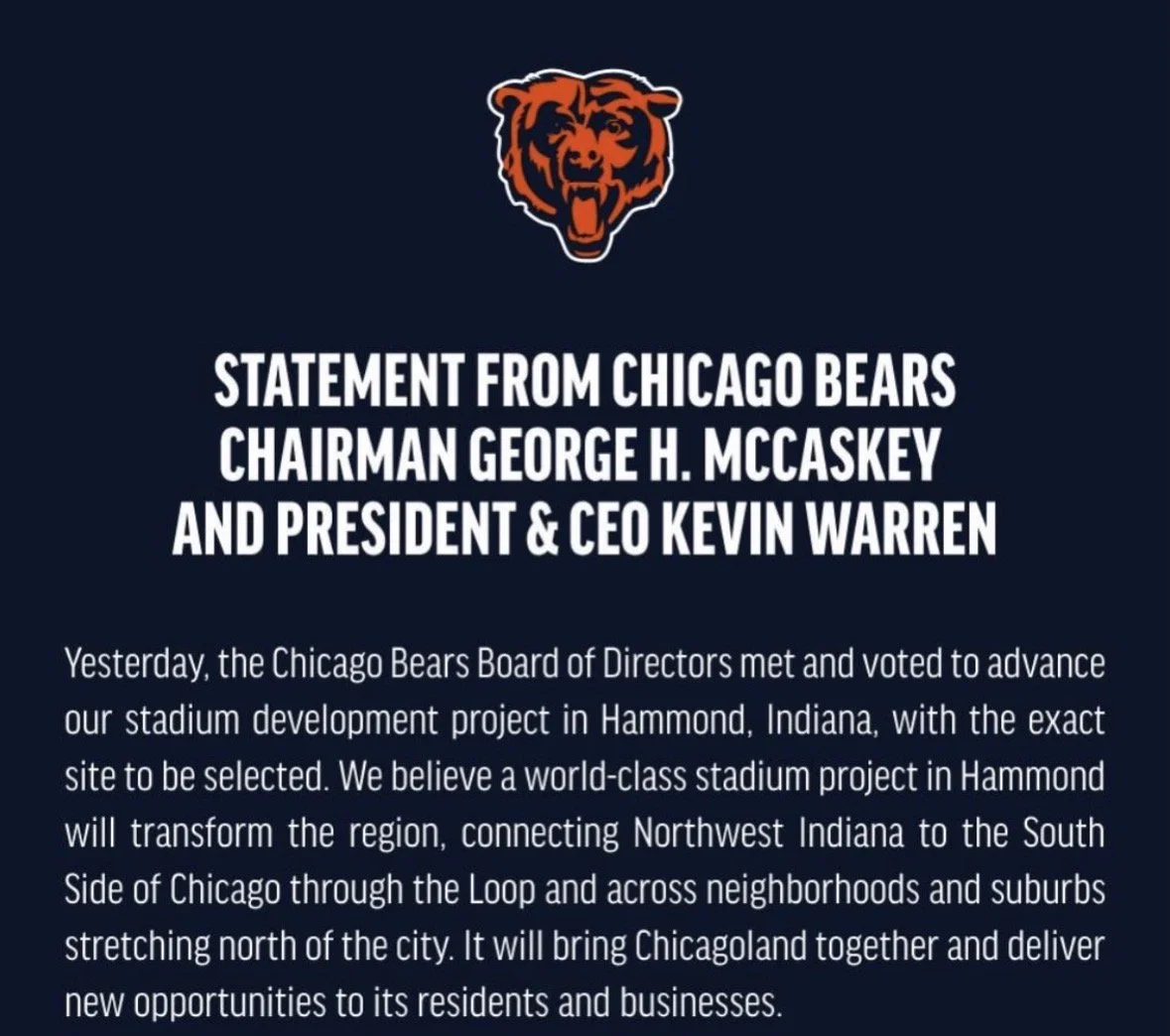
To be clear, there is no evidence that the Bears are secretly relocating to Hammond tomorrow. But the existence of serious public discussion involving a potential multibillion-dollar stadium project near Lost Marsh Golf Course changes the psychological map of the region regardless of whether the project ultimately materializes.
Modern stadium projects are no longer simply sports facilities. They are urban economic engines. They create entertainment districts, hospitality ecosystems, residential redevelopment opportunities, transportation upgrades, tourism corridors, retail expansion, and massive long-term real-estate appreciation. Entire sections of cities can transform around major sports developments.
Even speculation surrounding a possible Bears-related project signals that Northwest Indiana is no longer being viewed solely through the lens of legacy manufacturing decline. It is increasingly being discussed as future development territory connected to the broader Chicago metropolitan ecosystem.
That may ultimately be the most important insight hidden inside this entire story.
Chicago itself is not collapsing. Despite endless social media doom narratives, Chicago remains one of the most economically important and strategically valuable cities in America. But large metropolitan systems evolve over time, especially under new technological and economic pressures. The modern AI era increasingly rewards regions capable of supporting massive energy consumption, rapid infrastructure deployment, scalable industrial land use, and lower friction development environments.
Northwest Indiana offers many of those advantages simultaneously.
It provides proximity to Chicago’s workforce, transportation networks, rail infrastructure, interstate systems, lakefront shipping access, and consumer base while also offering cheaper industrial land, less regulatory friction, lower taxes, and greater expansion flexibility than many parts of Illinois itself.
That creates what systems theorists sometimes describe as an overflow corridor: a geographically adjacent region capable of absorbing economic functions that become increasingly expensive or difficult to scale inside the original urban core.
This phenomenon is not unique to Chicago. Similar distributed metropolitan evolution can already be seen surrounding Dallas-Fort Worth, Northern Virginia’s data-center corridor, the Research Triangle region, and logistics expansion zones surrounding Atlanta and Phoenix. Modern economic systems increasingly operate as interconnected mega-regions rather than isolated central cities.
In that sense, the “Chicago 2.0” theory may not really be about replacing Chicago at all.
Instead, it may describe the emergence of a secondary infrastructure corridor extending outward from Chicago into Northwest Indiana as energy demand, AI infrastructure, logistics growth, and institutional capital begin reorganizing around the next generation of economic incentives.
And importantly, none of this requires a conspiracy to explain.
The observable facts alone are already extraordinary enough.
Massive power-generation expansion.
AI-focused hyperscale data-center development.
Multibillion-dollar redevelopment agreements.
Institutional apartment acquisitions.
Healthcare real-estate expansion.
Sports-development speculation.
Redevelopment authorities.
Transportation advantages.
Industrial conversion zones.
Large-scale utility modernization.
When enough of those systems begin converging in the same geographic corridor at the same time, the corridor itself changes.
That does not mean Hammond becomes “the new Chicago.” That framing oversimplifies what may actually be occurring. But it does suggest that Northwest Indiana increasingly occupies a strategic position within the future evolution of the broader Chicago economic ecosystem.
Ironically, the most fascinating part of this entire transformation is how quietly it is happening.
Because history rarely announces itself while it is forming.
Most of the time, the future first appears disguised as utility filings, redevelopment meetings, land purchases, and infrastructure upgrades that seem boring until enough of them accumulate to reveal the shape of something much larger underneath.
And right now, Hammond, Indiana increasingly looks like one of those places where the underlying structure of the future may already be forming long before most people fully realize what they are looking at.
NIPSCO power https://www.govtech.com/artificial-intelligence/power-is-a-question-in-hammond-ind-data-center-expansion
L+M Development Partners affordable housing
Hammond Bears or Chicago Bears or Arlington Heights Bears
CoreWeave digital crossroads campus
The Chicago Quantum Exchange, University of Chicago, “Impact Lab”, and Purdue
Mayor Thomas McDermott Jr., GenCo, and Indiana Utility Regulatory Commission
The key players according to Google and company websites: CoreWeave, Inc., Decennial Group, LLC, David Pavlik, Digital Crossroad (DX) Hammond, Tom Dakich, Mayor Thomas M. McDermott Jr., Anne Taylor, NIPSCO(Northern Indiana Public Service Company), fifth third bank, Scott Goodman, John Krappman, Joe Kreeger, Sara E. Mongerson, Perpetual Grid, Audrey Simpson, Steven Glickman, Robert Clark, Shawn Clark, Malcolm Weems, Paul Rambo, Goodman Holdings LLC, Star America Infrastructure partners, Energy Solutions Group, Bank Street, and many others.