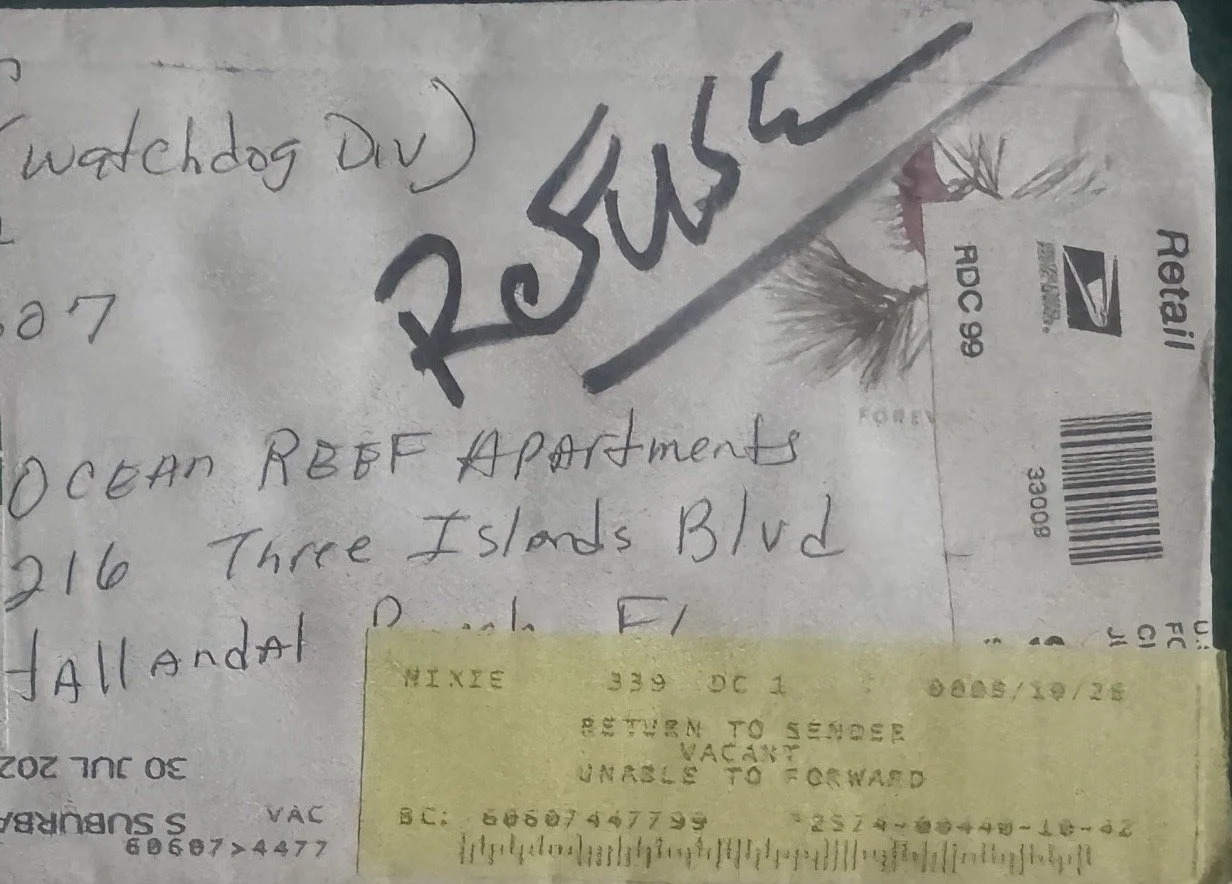
Florida Gives Tenants 15 Days After Receipt to Object. So What Happens When the Objection Comes Back Marked “REFUSE”?
Florida Gives Tenants 15 Days After Receipt to Object. So What Happens When the Objection Comes Back Marked “REFUSE”?
A F’nAround look at Ocean Reef at Seawalk Pointe, a $600 security deposit, a $1,868.74 move-out bill, one deceased tenant, and a certified objection that somehow found its way back to the sender.
There are stories you go looking for.
Then there are stories that arrive in the mail.
And occasionally, apparently, there are stories you send through the mail only for the mail itself to come back and become part of the story.
Welcome to Florida landlord-tenant law.
This one starts at Ocean Reef at Seawalk Pointe Apartments in Hallandale Beach, Florida, a waterfront apartment complex whose website describes it as “South Florida’s finest waterfront community.”
The property advertises pools, a spa, tennis courts, a remodeled clubhouse, waterfront views and a private boardwalk.
Sounds relaxing.
Our particular journey involves substantially fewer cocktails by the pool and substantially more Florida Statutes.
And it begins with a death.
A Tenant Dies. The Lease Ends Nine Days Later.
According to documents reviewed by F’nAround, the named tenant died unexpectedly in May 2026.
The Move Out Statement subsequently issued by Ocean Reef identifies the lease period as June 1, 2025, through May 31, 2026.
That means the tenant died days before the stated expiration date of the lease.
His surviving spouse was then dealing with exactly the sort of things human beings generally deal with when a spouse unexpectedly dies: funeral arrangements, government paperwork, legal and administrative matters, and arrangements involving his remains.
According to the information and documents provided to F’nAround, the apartment was ultimately vacated on July 15.
Then came the accounting.
And this is where things get interesting.
From a $600 Security Deposit to a Claimed $1,868.74 Balance
Ocean Reef issued a Notice of Intention to Impose Claim on Security Deposit dated July 22, 2026.
The notice states that the landlord intends to impose a $600 claim against the security deposit and directs the recipient to “see ledger” for the reason.
Okay.
So we saw the ledger.
The accompanying Move Out Statement contains a series of July charges and credits and ultimately reflects a claimed balance of:
$1,868.74.
Among the entries appearing on the statement are:
$2,672 in July rent;
$1,603.20 labeled “Month to Month (07/2026)”;
a $150 garage charge;
a $50 late fee;
water;
sewer;
stormwater;
trash;
utility billing fees;
and subsequent prorated credits.
The statement also reflects application of the $600 security deposit.
The arithmetic is one thing.
The contractual and legal basis for each charge is another.
And that distinction matters because Florida residential landlord-tenant law contains actual procedures governing security deposits, holdover occupancy and possession.
“It’s on the ledger” is an accounting statement.
It is not, standing alone, an explanation of why the money is legally owed.
Florida Actually Has Rules for This
Florida Statute §83.49 establishes the procedure governing residential security deposits.
When a landlord intends to impose a claim against a security deposit, §83.49(3)(a) requires the landlord, within 30 days after termination of the rental agreement, to provide written notice to the tenant by certified mail to the tenant’s last known mailing address or by e-mail when the statutory requirements for electronic delivery are satisfied.
The Florida Legislature even supplies the substance of the notice.
The statutory language tells a tenant that the tenant has 15 days after receipt of the notice to object in writing to the landlord’s claim and directs the objection to the landlord at the address specified in the notice.
That distinction matters.
It isn’t simply “15 days from whenever.”
It is 15 days after receipt of the notice, under the statutory procedure.
Ocean Reef’s July 22 notice supplied an address for objections:
Ocean Reef
216 Three Islands Blvd.
Hallandale Beach, FL 33009
Remember that address.
It becomes important.
So She Objected
A written objection was prepared disputing the security-deposit deduction and additional move-out charges.
Among other things, the objection challenged the basis for the charge labeled “Month to Month,” requested identification of the lease provisions supporting the charges, requested supporting documentation for utility assessments, explained the circumstances surrounding the tenant’s death and requested a complete accounting.
Then she did something rather radical.
She followed the instructions.
The objection was sent by USPS Certified Mail to the address Ocean Reef itself supplied for objections:
216 Three Islands Blvd.
Not an address found on Reddit.
Not an address pulled from a decade-old Yelp review.
Not somebody’s cousin’s condo.
The address printed on the notice.
And then the envelope came back.
Across the returned certified-mail envelope, in large black marker, appears a word that deserves its own paragraph:
REFUSE.
The envelope also contains postal return markings.
And this is where precision matters.
F’nAround cannot determine from the handwritten word alone who physically wrote “REFUSE,” who made any decision concerning acceptance of the mailing, or whether USPS’s underlying tracking records separately classify the delivery as “Refused.”
We therefore are not reporting as an established fact that Ocean Reef deliberately refused the objection.
That requires additional evidence.
What the documents presently establish is narrower:
A certified objection was mailed to the address Ocean Reef supplied for objections.
The envelope was returned.
And the returned envelope bears a conspicuous handwritten notation reading:
REFUSE.
That is something worth asking about.
Welcome to the Administrative Möbius Strip
Here is the process from the tenant’s perspective:
Landlord: We are making a claim against your deposit.
Florida law: You have 15 days after receiving the notice to object.
Landlord’s notice: Send the objection here.
Tenant: Okay.
Certified Mail: Here is the objection.
Returned envelope: REFUSE.
At some point administrative procedure starts looking suspiciously like performance art.
But beneath the humor is a legitimate procedural question:
What is a tenant supposed to do when a written objection is timely mailed to the address designated by the landlord and the certified correspondence is returned without being accepted?
Section 83.49 requires the objection to be made in writing.
The statutory notice directs the tenant to send the objection to the landlord at the address provided.
The statute does not give a tenant the ability to physically compel someone at the destination to accept an envelope.
There is another important provision in §83.49.
Even if a tenant fails to make a timely objection to the landlord’s claim, Florida law expressly preserves the tenant’s ability to bring a separate action for damages.
And if litigation ultimately becomes necessary to determine entitlement to the security deposit, §83.49 provides for the prevailing party to receive court costs and reasonable attorney’s fees.
So that little Certified Mail receipt?
Keep it.
The USPS tracking history?
Keep it.
The returned envelope?
For the love of discovery, do not throw that thing away.
Then There’s the “Month to Month” Question
This part requires more legal precision than simply saying:
“There wasn’t another signed lease, so there couldn’t be month-to-month rent.”
Florida law is not that simple.
Section 83.575 specifically contemplates what can happen when someone remains in possession after a fixed-duration residential rental agreement expires.
Under §83.575(3), when a tenant remains after expiration with the landlord’s permission, particular consequences can arise when the tenant fails to provide notice required under §83.57(3).
Section 83.57, meanwhile, addresses termination of tenancies without a specific duration and generally requires at least 30 days’ written notice before the end of a monthly period for a month-to-month residential tenancy.
And then there is §83.58.
That statute addresses the different situation in which a tenant remains without the landlord’s permission after the rental agreement expires. Under circumstances covered by that provision, a landlord may recover possession and may potentially recover double rent for the period during which the tenant refuses to surrender possession.
In other words:
Permission matters.
Notice matters.
The lease language matters.
Possession matters.
And the factual circumstances surrounding continued occupancy matter, even when difficult personal circumstances do not automatically eliminate contractual obligations.
F’nAround is therefore not concluding that Ocean Reef’s $1,603.20 charge labeled “Month to Month (07/2026)” was unlawful.
The documents instead raise a straightforward question:
What provision of the operative lease and applicable Florida law generated this particular $1,603.20 charge?
That’s something the underlying documentation should be able to answer.
Florida Law Even Addresses Possession Following a Tenant’s Death
Florida residential landlord-tenant law expressly contemplates circumstances involving the death of a tenant.
Section 83.59(3)(d) addresses a particular situation involving the death of the last remaining tenant, personal property remaining in the premises, unpaid rent, the passage of at least 60 days and whether the landlord has received specified notice concerning a probate estate or personal representative.
But this provision needs to be understood for what it is.
It concerns circumstances under which a landlord may recover possession without bringing the ordinary action for possession.
It does not, by itself, establish that rent or other charges disappear following a tenant’s death.
Nor does it determine whether the particular charges appearing on this Ocean Reef ledger are valid.
It establishes something much narrower but still relevant to understanding Florida’s statutory framework:
The Legislature expressly contemplated what can happen to possession of residential property following the death of the last remaining tenant.
Here, the chronology deserves careful examination.
The tenant died in May.
The lease period identified on Ocean Reef’s own Move Out Statement ended May 31.
The apartment was ultimately surrendered July 15.
Ocean Reef’s accounting then included July rent, a $1,603.20 charge labeled “Month to Month (07/2026),” a garage charge, utilities and a late fee, followed by various credits.
Maybe every penny has a contractual basis.
That’s what documents are for.
Show us.
Florida Has Separate Rules Governing Landlord Remedies After a Tenant Breaches
Section 83.595 separately establishes remedies available when a tenant breaches a rental agreement and the landlord obtains possession, or when the tenant surrenders or abandons the premises.
Depending upon the circumstances, Florida law gives a landlord several potential options, including terminating the rental agreement and retaking possession, retaking possession for the tenant’s account while attempting in good faith to relet, standing by and holding the tenant liable for rent as it becomes due, or utilizing an agreed early-termination or liquidated-damages provision where the statutory requirements are satisfied.
When possession is retaken for the tenant’s account, the statute also addresses good-faith efforts to relet and appropriate credits from reletting.
But there is an important qualification here.
The documents reviewed by F’nAround identify May 31 as the expiration date of the lease, while possession continued afterward.
That potentially implicates Florida’s laws concerning expiration and holdover occupancy rather than simply presenting a conventional early-termination situation.
Whether §83.595 governs any portion of this particular accounting therefore depends upon facts we are not going to pretend have already been resolved: the operative lease, the nature and permission status of the post-expiration occupancy, what communications occurred between the parties, and the circumstances under which possession was surrendered.
Which brings us back to the boring questions that suddenly become fascinating when somebody wants $1,868.74:
What contractual provision generated each charge?
What was the legal status of the occupancy after May 31?
Was continued occupancy permitted?
When did management consider possession surrendered?
Which statutory or contractual remedy did management believe applied?
Documentation can answer those questions.
We Looked Up Ocean Reef Too.
Public records provide additional context.
Florida’s Department of Business and Professional Regulation currently identifies the licensed apartment operation as:
THREE ISLAND ASSOC RESIDENTIAL
doing business as:
OCEAN REEF AT SEAWALK POINTE
DBPR identifies license NAP1620114 as current and active and lists the licensed location as:
216 Three Island Blvd.
Hallandale, Florida 33009
DBPR separately lists a main/license mailing address in O’Fallon, Missouri.
That matters for a very specific reason.
The Hallandale location appearing in the state’s licensing record is also the location Ocean Reef itself identified on the July 22 security-deposit notice as the address to which the tenant should send an objection.
Again, that does not establish who handled the returned envelope or why it came back.
It does make the return worth explaining.
What We Are Not Going to Do?
This is the part where Internet investigations frequently go sideways.
A negative review is not proof.
A complaint is not a judicial finding.
A returned envelope does not establish an institutional policy.
A disputed ledger does not establish fraud.
And one tenant’s experience does not establish a pattern.
So we’re not going to turn one returned certified letter into a sweeping allegation about Ocean Reef or its management.
If there is a broader pattern involving disputed move-out charges, security deposits or collection practices, that is something that should be established through evidence rather than adjectives.
Court records can be researched.
Prior lawsuits can be reviewed.
Complaints can be counted and categorized.
Former tenants can be interviewed.
Lease forms can be compared.
Public records can be requested where applicable.
That is how you determine whether an event is isolated or systemic.
Until then, this story is about this transaction, these documents and this envelope.
The $600 Number
There is another interesting number in the documents.
Ocean Reef’s current public floor-plan listings advertise a $600 deposit across multiple apartment configurations.
The security-deposit credit appearing on this Move Out Statement?
$600.
The amount identified in the July 22 Notice of Intention to Impose Claim?
$600.
That doesn’t demonstrate misconduct.
It actually helps explain something important about the paperwork.
The statutory notice concerns the landlord’s claim against the security deposit.
The Move Out Statement, meanwhile, purports to establish a larger account balance after application of that deposit.
Those are related issues, but they are not necessarily identical legal questions.
The first question is:
Was Ocean Reef entitled to retain the $600 security deposit?
The second is:
Is the additional balance claimed on the Move Out Statement contractually and legally valid?
Answering one does not necessarily answer the other.
Which is precisely why the lease and accounting matter.
The Part We Want Ocean Reef to Explain.
Before drawing conclusions, F’nAround wants Ocean Reef at Seawalk Pointe and its management to have an opportunity to explain the documents.
Our questions are straightforward:
Was this certified objection presented for delivery at 216 Three Islands Boulevard?
Do USPS or Ocean Reef records identify the mailing as having been refused?
If delivery was refused, who declined the mailing and why?
Does Ocean Reef have a policy concerning acceptance of certified correspondence from current or former tenants?
Why did the July 22 security-deposit notice direct the recipient to send an objection to 216 Three Islands Boulevard?
What provision of the applicable lease authorized the $1,603.20 charge labeled “Month to Month (07/2026)”?
What contractual provisions support the other charges appearing on the July Move Out Statement?
What is the relationship between the $600 security-deposit claim identified in the statutory notice and the $1,868.74 balance reflected on the Move Out Statement?
Has any portion of the disputed balance been referred to a collection agency, credit-reporting entity, attorney or other third party?
What was Ocean Reef’s understanding of the legal status of the occupancy between expiration of the stated lease term on May 31 and surrender of the apartment on July 15?
There may be perfectly reasonable answers.
We genuinely want them.
And any material response or documentation should be included in the story.
Because This Is Bigger Than $600
This is where my brain starts ruining everyone’s perfectly nice Saturday.
One disputed apartment ledger isn’t a systemic problem.
One returned envelope isn’t an institutional practice.
One online complaint isn’t data.
But systems become interesting when procedure and incentives intersect.
Security-deposit disputes contain an obvious information imbalance.
The landlord generally maintains the lease.
The landlord prepares the ledger.
The landlord calculates the charges.
The landlord possesses the security deposit.
The landlord generates the claim notice.
The tenant then has a statutory window in which to object.
None of that makes landlords bad actors.
Landlords have legitimate reasons to deduct damages, unpaid rent and other amounts authorized by leases and law.
But every administrative system should be examined at its friction points.
What happens when the party with less information challenges the accounting prepared by the party holding the money?
Does the process facilitate review?
Can the tenant obtain supporting documentation?
Does management explain disputed charges?
Does correspondence reach the people responsible for handling the dispute?
Are errors corrected when identified?
Or does the time and expense required to challenge a relatively small amount eventually exceed the amount itself?
Because that’s where behavioral economics enters the apartment complex.
If disputing $600 requires hours of research, certified mail, statutory interpretation and potentially litigation, plenty of people will decide that $600 isn’t worth the fight.
That doesn’t establish that the original charge was improper.
It establishes something much more universally interesting:
Transaction costs influence whether people exercise legal rights.
That’s an institutional-design problem worth studying well beyond one apartment complex.
And sometimes you don’t discover those friction points through a massive investigation.
Sometimes somebody just hands you an envelope.
And This Envelope Came Back
At this stage, the evidence establishes a relatively narrow but fascinating chronology.
A tenant died shortly before the expiration date stated on his lease documents.
His surviving spouse dealt with the apartment afterward.
The lease period identified on Ocean Reef’s Move Out Statement ended May 31.
The apartment was ultimately surrendered July 15.
Ocean Reef generated an accounting reflecting a claimed $1,868.74 balance after application of a $600 security deposit.
Ocean Reef issued a statutory notice concerning its claim against that deposit.
Florida law provided the recipient an opportunity to object.
The notice supplied an address for that objection.
A written objection was sent there by Certified Mail.
The envelope came back.
And across the returned envelope, in giant marker:
REFUSE.
What we do not presently know is equally important.
We don’t know from the handwriting alone who wrote that word.
We don’t know who, if anyone, affirmatively declined delivery.
We don’t yet know what USPS’s complete tracking history says about the attempted delivery.
We don’t know Ocean Reef’s explanation.
And we don’t know whether management believes every disputed charge is authorized by a particular provision of the lease.
Maybe there’s an innocent explanation.
Maybe there’s a postal explanation.
Maybe there’s an administrative explanation.
Maybe management routinely accepts certified mail and something unusual happened to this particular envelope.
Great.
That’s why journalism contains this wonderful invention called asking the other side.
F’nAround intends to do exactly that.
Because when a statute creates a procedure for challenging somebody’s claim to your money, the most basic question shouldn’t be controversial:
Can the person actually use the procedure?
If the answer here is yes, we’d like to know why this particular objection came home.
Florida gives tenants 15 days after receipt of a security-deposit claim notice to object.
Apparently this envelope needed a round trip.
F’nAround will update this story with any material response, documentation or clarification provided by Ocean Reef at Seawalk Pointe or its management concerning the returned certified correspondence, the disputed security-deposit claim or the charges reflected on the Move Out Statement.
This article reports and analyzes documents, public records and applicable Florida statutes. Questions presented in this article are questions, not findings of misconduct. Nothing in this article should be interpreted as a determination that Ocean Reef at Seawalk Pointe, its ownership or its management violated Florida law.