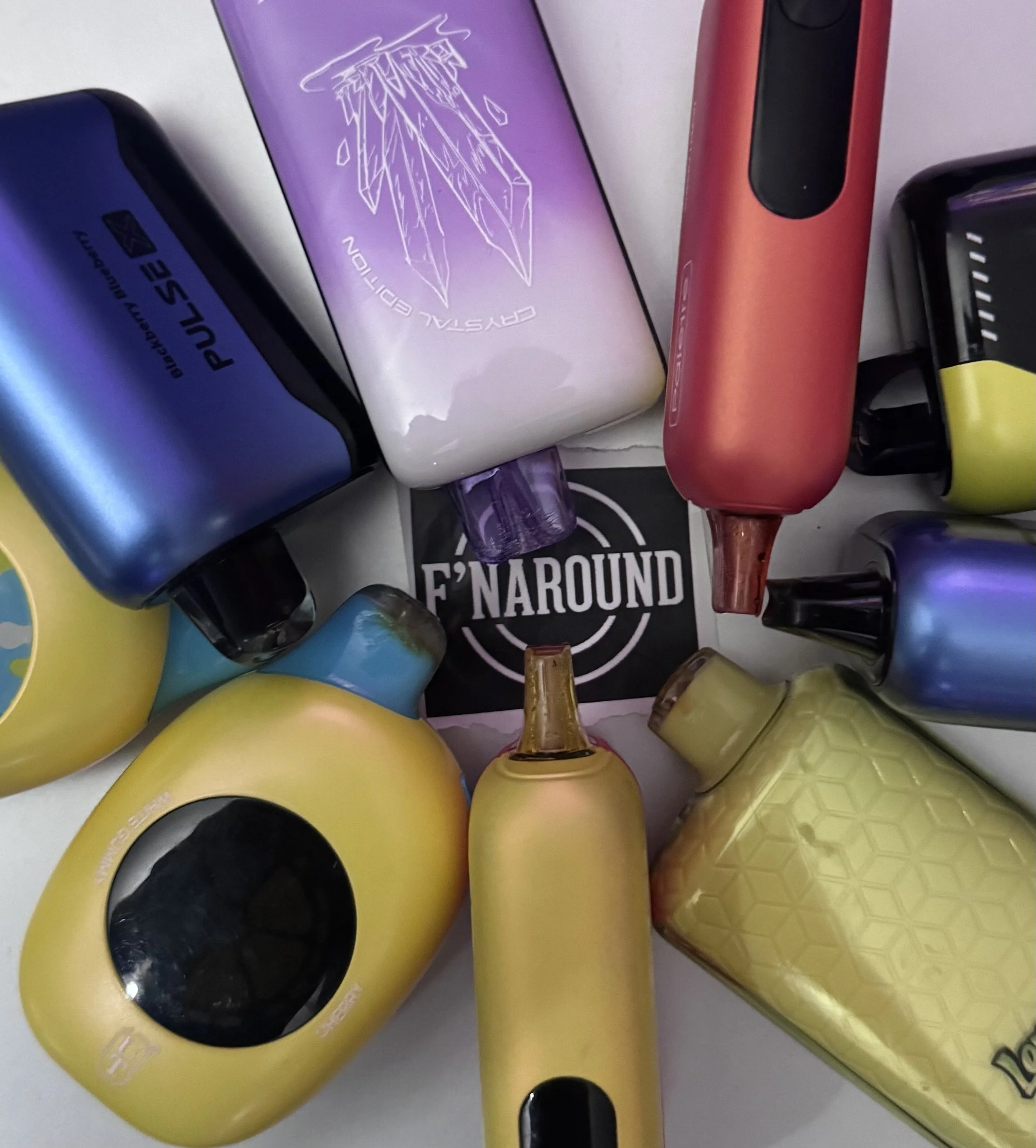
What started as a vape stop on the road to Summer’s End Smokeout turned into a much bigger question: who gets to survive when states start deciding which products can be sold?
What started as a vape stop on the road to Summer’s End Smokeout turned into a much bigger question: who gets to survive when states start deciding which products can be sold?
We Warned About This in Kentucky. Then We Drove Through Wisconsin.
Vape Laws, Big Tobacco, Hemp and the Regulatory Pattern Nobody Seems to Be Watching.
Sometimes the best stories aren’t the ones you’re looking for.
We were headed north for Summer’s End Smokeout, SESO, a four-day music and camping festival in Michigan’s Upper Peninsula when we stopped in Wisconsin.
Honestly the most underrated music festival we’ve ever been to and it was a privilege to be media there with such an amazing group and family.
We weren’t conducting an investigation.
We weren’t chasing a government official.
We weren’t filing records requests.
We wanted vapes.
That seemingly ordinary stop turned into something considerably more interesting.
The stores we visited explained that Wisconsin’s rules had changed and many of the products customers were accustomed to buying could no longer legally be sold. Shelves had changed. Familiar brands were disappearing.
One employee essentially gave us the simplest possible advice:
Wait until you leave Wisconsin.
That got my attention.
Because I had heard this song before.
In fact, I wrote about almost exactly this problem in January 2025 when Kentucky’s new vape restrictions were taking effect.
My argument then wasn’t really about vaping.
It was about market structure.
When government creates a regulatory doorway that only a handful of companies can realistically walk through, it doesn’t necessarily “ban” an industry.
Sometimes it does something much more consequential.
It chooses who gets to remain in it.
And Wisconsin has now provided us with another fascinating case study.
First, Wisconsin Didn’t Technically Ban Vaping
This distinction matters.
Wisconsin created an Electronic Vaping Device Directory.
Beginning September 1, 2025, electronic vaping devices generally could not legally be sold in Wisconsin unless they appeared on that directory.
The consequences aren’t trivial.
Wisconsin’s Department of Revenue says manufacturers and retailers selling an unlisted device can face a $1,000-per-day forfeiture for each device, and products can ultimately be seized, forfeited and destroyed. (Wisconsin Department of Revenue)
Manufacturers also have to certify products annually, obtain the necessary manufacturer permit and pay a $500 certification fee per device.
So calling Wisconsin’s policy an outright “vape ban” isn’t technically correct.
The better description is a market-access restriction.
And that distinction actually makes the story more interesting.
Because the question becomes:
Who can still get through the gate?
Look at the Federal Gatekeepers
This is where things start getting familiar.
The FDA currently says there are only approximately 45 e-cigarette products authorized by the agency for lawful marketing in the United States.
And look at some of the names on that list:
R.J. Reynolds Vapor Company Vuse.
NJOY.
Logic Technology Development.
JUUL Labs.
There is also Glas.
FDA specifically cautions that “authorized” does not mean the products are safe or “FDA approved.” Tobacco products remain harmful and potentially addictive.
But from a market-structure perspective, look at what has happened.
A once enormous universe of vape manufacturers runs into an increasingly restrictive federal and state regulatory funnel.
And waiting near the narrow end of that funnel are some very familiar corporate players. (U.S. Food and Drug Administration)
That’s why what the Wisconsin retailers told us was so interesting.
Their practical experience wasn’t, “Nobody can vape anymore.”
It was closer to:
The products people actually came here to buy are disappearing, while a much smaller universe of compliant products remains.
Wisconsin consumers were reporting the same thing shortly after the restrictions took effect, with discussions specifically mentioning Vuse, JUUL and NJOY among the products still available. Those are anecdotes rather than regulatory findings, but they illustrate how dramatically the retail experience changed.
And Then Wisconsin Extended the System to Hemp
Here’s where our August 2026 road trip becomes especially timely.
The original Wisconsin directory restrictions became enforceable in September 2025.
But Wisconsin subsequently expanded the system.
Electronic vaping devices containing hemp but no nicotine had to be certified with the Department of Revenue for the regulatory year beginning July 2026.
Wisconsin says those products must provide an independent laboratory Certificate of Analysis demonstrating that the device contains hemp and does not contain nicotine.
Beginning in July 2026, qualifying hemp vaping devices not appearing on the directory could no longer legally be offered for sale.
And beginning September 1, 2026, manufacturers and retailers selling non-listed hemp devices face the same potential $1,000-per-device, per-day forfeiture.
Read that again.
This isn’t merely a nicotine story anymore.
Wisconsin has already built regulatory infrastructure capable of governing inhaled hemp products through a state product directory.
That does not mean Wisconsin has secretly handed marijuana vaping to Big Tobacco.
There isn’t evidence to support making that claim.
But it raises a question worth asking now rather than five years from now:
What happens to this infrastructure if Wisconsin eventually creates a broader legal cannabis market?
Does cannabis receive an entirely separate regulatory framework?
Do licensed cannabis companies get a carve-out?
Does the existing vaping directory expand again?
Or does Wisconsin eventually apply similar product-registration logic to cannabis vaporization hardware and cartridges?
Nobody should pretend we know the answer yet.
But the infrastructure is sitting there.
Which Is Exactly Why I Wrote About Kentucky
Back on January 4, 2025, I wrote about Kentucky’s new vape law.
Kentucky’s HB 11 had taken effect January 1.
The law created requirements governing authorized and unauthorized vapor products and dramatically increased the importance of federal regulatory status in determining what could participate in Kentucky’s market. (Legislative Research Commission)
At the time, I wrote:
“It’s not about what’s safe; it’s about who can afford the paperwork.”
And:
“Kentucky hasn’t even turned the lights on for medical cannabis yet, and the chessboard is already being set.”
That wasn’t clairvoyance.
It was pattern recognition.
The regulatory structure was sitting in plain sight.
You didn’t have to know what would happen.
You just had to ask what happens when compliance costs rise dramatically in a fragmented industry.
Who survives?
Usually the companies with lawyers.
Regulatory departments.
Lobbyists.
Capital.
Existing federal approvals.
And enough revenue to spend years navigating administrative processes.
Those characteristics don’t generally describe your neighborhood vape startup.
They describe multinational corporations.
Wisconsin Isn’t Alone Anymore
Then there is Indiana.
On July 1, 2026, Indiana’s Senate Enrolled Act 185 took effect.
Indiana took a different route than Wisconsin.
Rather than using essentially the same directory structure, Indiana targeted vaping products manufactured in countries classified as foreign adversaries most importantly China.
State officials framed the law as a consumer-safety and national-security measure, arguing that foreign-manufactured products could contain dangerous or untested chemicals.
But whatever your opinion of the policy rationale, the market consequence is straightforward:
A huge portion of the existing competitive supply disappeared.
Retailers immediately warned of inventory shortages because so much vaping hardware and so many disposable products were manufactured in China. (EIN Presswire)
Different mechanism.
Similar economic result.
Reduce the number of competitors capable of legally reaching consumers.
Kentucky uses one regulatory structure.
Wisconsin uses another.
Indiana attacks the supply chain from another direction.
The policies aren’t identical.
The market direction is.
Regulation Doesn’t Have to Create a Monopoly to Create Consolidation.
This is where the conversation usually becomes unnecessarily political.
You don’t have to believe regulators are sitting in a smoke-filled room plotting with tobacco executives.
You don’t even need corruption.
Economics can produce the outcome all by itself.
Imagine 1,000 companies competing in a market.
Then impose increasingly expensive testing, registration, manufacturing, certification, legal and administrative requirements.
Maybe 500 companies can comply.
Increase the requirements again.
Now 100 can.
Require federal authorization that takes enormous amounts of scientific documentation, capital and time.
Now perhaps only a fraction remain.
Government never technically selected a winner.
But it designed the obstacle course.
And the companies with the deepest pockets tend to finish it.
That’s regulatory consolidation.
The Strange Part of Our Wisconsin Stop.
The retailers we spoke with weren’t celebrating.
They were trying to explain what they could legally sell.
Some stores showed us alternative products they said did not contain traditional nicotine and described them as synthetic or substitute products.
They actually advised us against buying what was available and suggested waiting until we crossed the state line.
We took their advice.
That part of this story should remain exactly what it is: our firsthand account of what Wisconsin retailers told us.
We aren’t going to declare those substitute compounds dangerous without laboratory evidence.
But the situation creates another regulatory question worth examining.
If regulation removes products consumers understand and have been purchasing for years, but consumer demand remains, what replaces them?
Does demand disappear?
Do consumers switch to cigarettes?
Do they cross state lines?
Do new nicotine analogs or other substitutes appear?
Does an underground market develop?
Those are measurable questions.
And they matter when evaluating whether regulation accomplished what legislators intended.
And Now Look Toward Cannabis.
This is the part cannabis operators should pay attention to.
Wisconsin’s current system explicitly reaches hemp vaping devices.
That doesn’t automatically translate into marijuana regulation.
But tobacco, nicotine, hemp and cannabis increasingly share something important: delivery technology.
Cartridges.
Atomizers.
Batteries.
Disposable devices.
Extracts.
Aerosols.
Testing laboratories.
Manufacturing standards.
Packaging.
Age restrictions.
Retail licensing.
Product registration.
Once government develops an administrative system capable of regulating a delivery mechanism, extending that infrastructure becomes considerably easier than inventing a completely new regulatory regime.
Which brings us back to the question I asked in Kentucky before its medical cannabis market had even fully arrived:
Who is positioning themselves before everyone else realizes there’s a game being played?
Will Cannabis Get a Carve-Out?
Maybe.
And that’s probably the most important unanswered question.
Wisconsin could eventually decide that marijuana vaping products belong exclusively inside a future licensed cannabis system.
It could distinguish cannabis cartridges from nicotine electronic cigarettes entirely.
It could create separate manufacturing and testing requirements.
It could exempt certain cannabis hardware.
It could create a completely different regulatory architecture.
All of those are possible.
What we shouldn’t do is assume the answer before legislation exists.
But what we can do is watch who advocates for each version.
Watch the definitions.
Watch the exemptions.
Watch which products get grandfathered.
Watch who can afford certification.
Watch which companies already possess federal authorizations.
Watch which companies acquire smaller competitors.
Watch which industries ask for carve-outs.
And especially watch legislation that everyone describes as boring administrative cleanup.
That’s usually where the interesting language lives.
Kentucky. Wisconsin. Indiana.
Three neighboring markets.
Three approaches.
One increasingly obvious question.
Kentucky tightened which vapor products could participate in its market.
Wisconsin created a state directory, backed it with potentially enormous penalties and subsequently extended that framework to hemp vaping devices.
Indiana removed products originating from adversarial countries, dramatically reducing access to a supply chain heavily dependent on Chinese manufacturing.
None of those facts individually proves a coordinated Big Tobacco strategy.
They don’t need to.
The more important observation is structural:
America’s vape market is consolidating through regulation.
And when a market consolidates, the businesses best positioned to survive are usually the businesses with the most capital, compliance infrastructure and political experience.
Big Tobacco happens to have all three.
So How Long Until This Trend Moves Again?
That’s what we’re watching now.
Maybe Wisconsin ultimately builds a cannabis system completely insulated from its nicotine-vape framework.
Maybe lawmakers deliberately create space for independent cannabis manufacturers.
Maybe hemp gets treated separately.
Maybe cannabis gets a carve-out.
Maybe the companies dominating federally authorized nicotine vaping decide cannabis isn’t worth pursuing.
All possible.
But there’s another possibility.
The infrastructure being created today becomes the foundation for tomorrow’s market.
And if that happens, people will eventually act surprised.
They’ll ask when the market changed.
They’ll wonder why small manufacturers disappeared.
They’ll ask how a handful of enormous corporations ended up controlling another product category.
And somebody will explain that it happened gradually.
One certification.
One directory.
One exemption.
One compliance requirement.
One state at a time.
That’s why we keep saying the same thing at F’nAround:
Don’t just watch what government bans.
Watch who is still allowed to sell after the ban.
Because sometimes that’s the entire story.
And apparently sometimes you discover the next chapter while driving to a music festival in the Upper Peninsula because you stopped in Wisconsin looking for a vape.