Renaming the Map Is Nothing New: Why Countries Change Names Before, During and After War
Renaming the Map Is Nothing New: Why Countries Change Names Before, During and After War
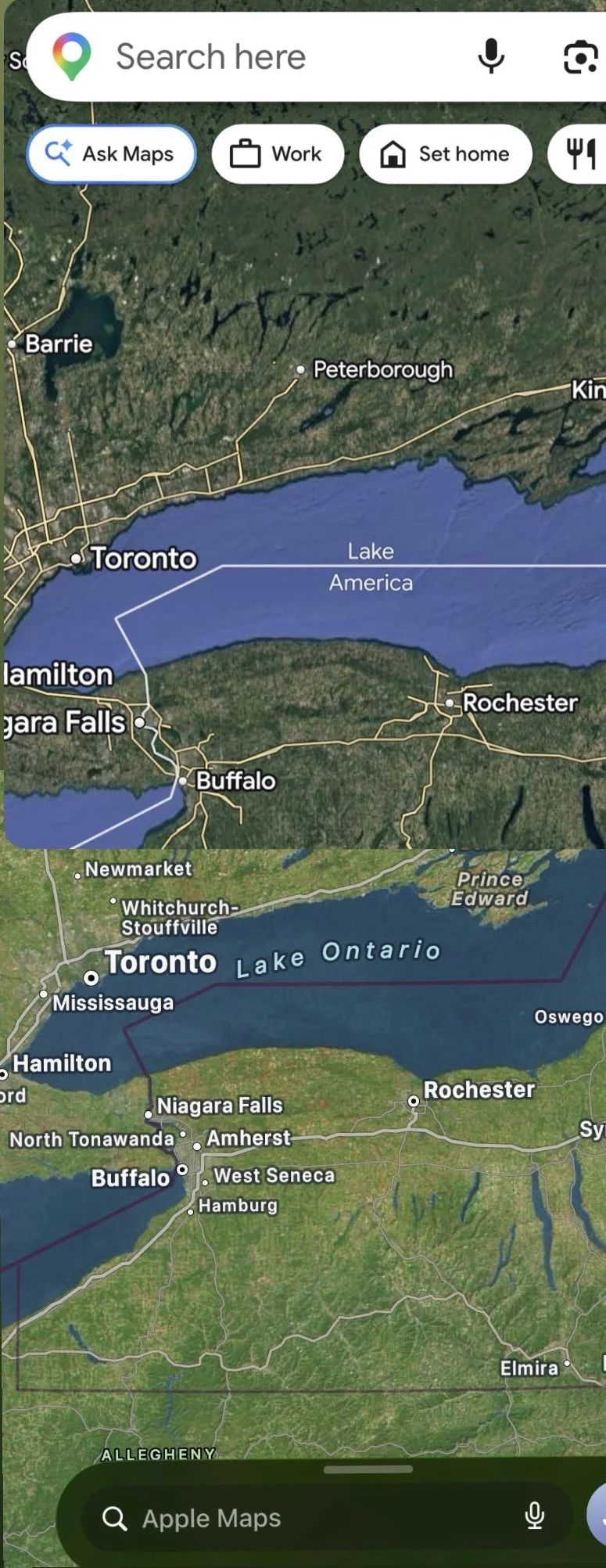
While discussing the news, the F’nAround team did what apparently passes for research around here: we started checking our maps.
One map had updated the name of a lake. Another hadn’t.
That raised a much bigger question than which mapping app updates first: How unusual is it for a government to start changing established names in the first place?
So we started digging through history.
As it turns out, it isn’t unusual at all.
Every few generations, somebody looks at a map and decides the names are wrong. A city gets a new name. A mountain gets its old name back. A street honoring yesterday’s hero suddenly honors today’s. Governments rename military installations. Revolutionaries rename calendars. Empires rename conquered territory. Newly independent countries erase names left behind by colonial governments.
Then everybody argues about what to call the place.
Changing established names is one of the oldest forms of political symbolism available to governments. Sometimes it represents liberation. Sometimes nationalism. Sometimes decolonization. Sometimes authoritarianism. Sometimes governments say they are restoring history. Other times their opponents accuse them of erasing it.
But when we started lining up some of history’s largest and most controversial renaming campaigns, another pattern became difficult to ignore.
War and political upheaval are very often somewhere nearby.
That does not mean changing names causes war. It doesn’t mean a country changing names today is secretly preparing for one. History doesn’t support either conclusion.
What history does show is that governments repeatedly reach for the map when the identity of the country itself is being contested before conflicts, during them, after them, following revolutions, after independence, during territorial disputes and when an entirely new political order replaces an old one.
Because this was never really just about names.
A name quietly answers political questions. Whose history matters? Which language is official? Who controls this territory? Which historical figures deserve recognition? Which government won? Which government lost? And perhaps most importantly: Who are we now?
That makes the map an unusually powerful place to write a new answer.
Turkey offers one of the largest modern examples.
Research into Republican Turkey’s renaming campaigns produces different totals depending on what is counted and which period is examined, but the scale reaches into the tens of thousands. One scholarly analysis identified approximately 28,000 settlement-name changes between 1957 and 1978, while another frequently cited figure identifies more than 12,000 renamed villages and settlements.
The changes affected names with Kurdish, Armenian, Greek, Arabic, Syriac, Georgian and other linguistic origins.
The largest systematic programs came decades after the creation of modern Turkey, so it would be inaccurate to simply attribute tens of thousands of changes personally to Mustafa Kemal Atatürk. But the historical roots of the policy stretched back into the transformation from the Ottoman Empire into the modern Turkish nation-state.
And that transformation came out of extraordinary upheaval.
The Ottoman Empire entered World War I and collapsed. Foreign powers occupied portions of its former territory. The Turkish War of Independence followed. A centuries-old imperial political system disappeared and a new republic emerged.
Eventually, the map increasingly reflected that new Turkish national identity.
Yet official terminology didn’t necessarily erase the old names from people’s memories. Researchers have documented communities continuing to use traditional names even after official ones changed.
A government can change a sign.
Changing what generations of people call their hometown can be considerably harder.
Italy offers another revealing example, and its timing is particularly interesting.
Italy emerged from World War I with South Tyrol, formerly part of Austria-Hungary and home to a large German-speaking population. Under Benito Mussolini’s Fascist government, Italianization became an aggressive state project. German geographic terminology was replaced or subordinated by Italian terminology as the regime attempted to make the territory not merely administratively Italian but unmistakably Italian in identity.
This happened in the space between two world wars.
World War I had changed the border. Fascism attempted to change the identity attached to that territory. Then Europe descended into World War II.
That chronology does not mean renaming South Tyrol predicted World War II, much less caused it. What it demonstrates is something more defensible: when governments become intensely concerned with national identity and territorial belonging, language and geography frequently become political instruments.
The Soviet experience makes the same point from almost the opposite ideological direction.
The Bolsheviks inherited an empire filled with cities, streets, institutions and monuments connected to tsars, aristocrats, churches and the political order they had just destroyed. Those names told the wrong story for a revolutionary Communist state.
So the story changed.
And so did the names.
Tsaritsyn became Stalingrad. Saint Petersburg, which had become Petrograd during World War I, became Leningrad after Lenin’s death. Nizhny Novgorod became Gorky. Tver became Kalinin. Across the Soviet system, streets, towns and institutions were renamed for revolutionaries, Communist leaders and ideological concepts.
Once again, look at what surrounded the transformation.
World War I. Revolution. Civil war. Soviet consolidation. Then eventually another world war.
The names weren’t causing any of those events. They were markers of a society whose political identity was being fundamentally reconstructed during one of the most violent periods in modern history.
And what happened afterward may be even more revealing.
Stalingrad became Volgograd. Gorky became Nizhny Novgorod again. Leningrad eventually became Saint Petersburg.
The political story changed again.
So the map changed again.
Spain provides an even clearer example of names following political victory.
The Spanish Civil War wasn’t merely a military contest over control of government. It was a struggle over what Spain itself was supposed to become. After Francisco Franco’s forces won, Republican names and symbols disappeared from public spaces while Francoist figures and concepts appeared in their place. Catalan, Basque and Galician linguistic identities also faced suppression and restrictions of varying forms under the dictatorship.
War produced a new political order.
The new political order produced new names.
Then Franco died, Spain democratized, and the process began moving in the opposite direction. Democratic governments began removing Francoist names from streets and public spaces.
Same governmental tool.
Completely different political purpose.
China went through an even more dramatic transformation. Before the People’s Republic of China existed, the country endured civil war, Japanese invasion, World War II and then renewed civil war. Communist victory in 1949 created another revolutionary government determined to break with the society that preceded it.
Under Mao Zedong, revolutionary terminology increasingly entered public life, but the Cultural Revolution took the idea much further.
The campaign against the “Four Olds” old ideas, old culture, old customs and old habits made names themselves legitimate revolutionary targets. Streets, schools, businesses and institutions acquired new revolutionary terminology.
The point wasn’t merely to make a map look different.
The objective was to make society understand itself differently.
And just as in the Soviet Union, many of the most ideological names didn’t survive the political era that created them.
Iran gives us another fascinating sequence because the transition between revolution, renaming and war happened extraordinarily quickly.
The Shah fell in 1979. The Islamic Republic replaced the monarchy. Names associated with the Pahlavi state and monarchy began disappearing, replaced by names honoring Islamic figures, revolutionaries and martyrs.
Then Iraq invaded Iran in 1980.
Again, chronology is not causation. Iranian street names didn’t cause Saddam Hussein to invade Iran.
But Iran demonstrates why renaming appears so frequently in historical periods surrounding conflict. The Iranian state was redefining itself at precisely the moment the regional political order was extraordinarily unstable. The new government wanted the physical environment to represent the new Iran rather than the monarchy it had overthrown.
Elsewhere, changing the map became almost a punctuation mark at the end of a war.
Zimbabwe is a particularly clear example.
The Rhodesian Bush War ended as the country transitioned to internationally recognized independence in 1980. Rhodesia became Zimbabwe. Salisbury became Harare. Colonial names throughout the country were replaced with African and independence-era terminology.
Nobody needs to interpret that as preparation for another war.
It represented the symbolic conclusion of the previous political order.
The country had changed.
The map announced it.
Something similar happened in the former Belgian Congo, although Mobutu Sese Seko’s increasingly authoritarian personality cult made the process considerably more complicated.
The Congo had endured Belgian colonialism, independence, the Congo Crisis and years of instability before Mobutu consolidated power. His Authenticité campaign attempted to remove European colonial identity from public life.
Léopoldville became Kinshasa. Stanleyville became Kisangani. Elisabethville became Lubumbashi. Katanga became Shaba. The Congo became Zaire, and even the Congo River became the Zaire River.
Then Mobutu fell.
Some names disappeared with him. Zaire became the Democratic Republic of the Congo and the river once again became internationally known as the Congo.
Others survived.
Kinshasa is still Kinshasa. Lubumbashi is still Lubumbashi. Kisangani is still Kisangani.
That’s an important wrinkle in the history of political renaming. A name introduced by an authoritarian government isn’t automatically rejected when that government disappears. Sometimes a society decides the replacement has an identity independent of the ruler who introduced it.
Saddam Hussein’s Iraq provides the opposite kind of example.
His government existed in an atmosphere of almost continuous militarized nationalism: the Iran-Iraq War from 1980 to 1988, the invasion of Kuwait in 1990, the Gulf War, years of sanctions and confrontation, and eventually the 2003 invasion.
Throughout the Ba’athist period, streets, districts, infrastructure and institutions reflected Saddam, the Ba’ath Party and the government’s preferred interpretation of Iraqi history.
After Saddam’s government collapsed, many of those names disappeared with it.
New political authority meant another round of new names.
Ukraine allows us to watch the process while the underlying conflict is still happening.
The country had already begun removing Communist names before Volodymyr Zelenskyy’s presidency, particularly following Russia’s seizure of Crimea and the beginning of the Donbas conflict in 2014. Russia’s full-scale invasion in February 2022 dramatically accelerated the removal of Russian and Soviet-associated names.
Kyiv renamed 95 streets in one action in August 2022. Research examining the capital between 2014 and early 2023 identified hundreds of changed urban names, while changes across Ukraine reached into the thousands.
This isn’t historians decades later interpreting what a postwar government did.
It’s happening while the war is being fought.
And that makes the political purpose unusually visible.
Ukraine is not merely changing words on signs. It is emphasizing a distinct Ukrainian historical and national identity while fighting a war in which Ukrainian sovereignty and identity are themselves central issues.
But none of this started in the twentieth century.
Go back to the French Revolution and things get even stranger.
The revolutionaries didn’t merely decide that a king’s name shouldn’t be on a street anymore.
They decided time itself needed rebranding.
The monarchy disappeared. A republic emerged. The Gregorian calendar was replaced by the French Republican calendar. Months became Vendémiaire, Brumaire, Frimaire, Nivôse, Pluviôse, Ventôse, Germinal, Floréal, Prairial, Messidor, Thermidor and Fructidor. Seven-day weeks were replaced with ten-day divisions. Traditional religious associations were deliberately stripped from the calendar.
Thousands of French communities also experienced name changes during the revolutionary period as names associated with monarchy, feudalism and Christianity became politically unacceptable.
And all of this was happening while revolutionary France was simultaneously fighting European powers, suppressing internal rebellions and reconstructing the political foundations of the country.
The revolutionaries weren’t merely replacing a government.
They were trying to create a different vocabulary for reality.
Once you see that pattern, political renaming starts looking considerably less unusual.
But there’s a temptation here that needs to be resisted.
Does a government suddenly changing names mean war is coming?
No.
History provides too many counterexamples.
Modern India has experienced numerous prominent renamings without an accompanying revolutionary war. Allahabad became Prayagraj, while other colonial and Mughal-associated names have been replaced amid continuing debates over decolonization, indigenous identity and Hindu nationalism.
Swaziland became Eswatini in 2018 without a war.
Turkmenistan’s Saparmurat Niyazov built such an extreme personality cult that his government renamed everything from institutions to months of the year. No major war was required.
Kazakhstan’s capital became Nur-Sultan in honor of former president Nursultan Nazarbayev and then, only a few years later, became Astana again.
And now the United States provides another interesting peacetime case.
Donald Trump’s administrations have embraced conspicuous geographic, military and institutional renaming as part of a broader American nationalist political message. Mount Denali returned to the federal name Mount McKinley. The Gulf of Mexico became the Gulf of America in U.S. federal terminology. Military installations that had recently received new names were changed again, sometimes restoring their familiar historic names while assigning them different American military namesakes.
Some changes have been enthusiastically embraced. Others have generated domestic political opposition. And when terminology involves geography shared with other countries, changing what the United States government calls something doesn’t automatically compel the rest of the world to use the same terminology.
That’s actually what sent us down this rabbit hole in the first place: looking at different maps and seeing different answers.
But the existence of those changes is not evidence by itself that America is preparing for war.
History doesn’t support making that leap.
What history supports is something broader and arguably much more interesting.
Renaming tends to appear when national identity is under stress, reconstruction or unusually intense political debate.
Sometimes that stress comes from war.
Sometimes it comes from revolution.
Sometimes an empire has collapsed.
Sometimes a colony has become independent.
Sometimes territory has changed hands.
Sometimes one political ideology has defeated another.
And sometimes a country is perfectly peaceful but engaged in a fierce argument about its history and what its national identity should mean.
That explains why so many of the largest historical examples sit near wars without making war itself the universal explanation.
Revolutionary France was fighting international and internal wars while reinventing its political identity. Turkey emerged from imperial collapse and war and spent decades constructing a new national identity. The Soviet Union emerged from revolution and civil war. Fascist Italy pursued aggressive nationalization of territory acquired after one world war before participating in another. Franco reconstructed Spain after winning a civil war. Communist China emerged from invasion and civil war. Iran experienced revolution immediately before the Iran-Iraq War. Zimbabwe renamed itself following a war for political control and independence. Iraq lived through repeated wars. Ukraine is changing names during an active invasion.
Then India, Turkmenistan, Kazakhstan, Eswatini and the contemporary United States remind us that war isn’t required at all.
The common denominator isn’t war.
It’s the argument over who “we” are.
War just happens to be one of the most powerful forces in human history for forcing countries to answer that question.
And that brings us back to maps.
We tend to think maps are objective documents.
There’s the mountain. There’s the lake. There’s the river. There’s the city. Put a name next to it and move on.
History suggests maps are much more political than they appear.
Every name quietly answers a question.
Who owns this place?
Who founded it?
Whose language matters?
Which historical figure deserves to be remembered?
Which empire controlled it?
Which government won?
Which government lost?
Which civilization came first?
And ultimately:
Who gets to decide what everyone calls it?
That’s why governments keep reaching for names when societies experience enormous change.
Sometimes changing a name declares that a war has been won. Sometimes it declares that colonial rule is finished. Sometimes it’s revolutionary propaganda. Sometimes it’s nationalist branding. Sometimes it’s restoring a historical name that somebody else erased. Sometimes it’s deliberately erasing the name that came before.
And sometimes it’s just politicians F’nAround with the map.
But the act itself isn’t historically unusual.
Quite the opposite.
When governments believe the story of their country is changing, history shows that one of the places they repeatedly write that new story is directly onto the map.
The mistake would be seeing a wave of renaming and declaring that war must be next.
That’s not what the evidence tells us.
The historical relationship works in several directions. Wars change names. Revolutions change names. Independence changes names. Collapsing empires change names. Victorious governments change names. Nationalist movements change names. Governments trying to escape colonial history change names. Governments trying to resurrect older history change names.
Sometimes those changes happen before wars.
Sometimes they happen while the shooting is still going on.
Sometimes they happen afterward because the people changing the signs are the ones who won.
And sometimes there isn’t a war at all.
The names change because the story a government or society is telling about itself has changed.
And throughout history, sometimes the fight over that story was exactly what the conflict was about in the first place.