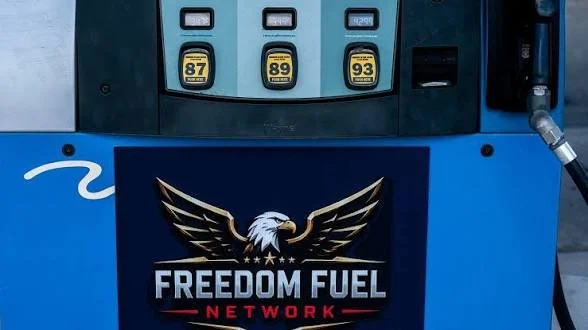
Freedom Fuel Had Really Cheap Gas. A Lawsuit May Have Found One Reason Why.
Freedom Fuel Had Really Cheap Gas. A Lawsuit May Have Found One Reason Why.
There are certain mysteries in American life that eventually explain themselves.
How does Spirit Airlines make the ticket that cheap?
Why does the casino buffet have unlimited crab legs?
How is that guy selling a brand-new iPhone out of his trunk for $200?
And, more recently:
How the hell was Freedom Fuel selling gasoline for $3.47 a gallon while everybody around it was charging considerably more?
We may finally have part of an answer.
And according to a federal lawsuit, it wasn’t simply freedom.
$3.47 for the 47th President
Freedom Fuel Network burst onto the scene around Philadelphia and New Jersey this summer with an extremely simple marketing strategy.
Cheap gas. Patriotism. Donald Trump.
Stations began offering gasoline for $3.47 per gallon, a price chosen as a nod to Trump serving as the 47th president.
Trump noticed.
He praised the retailer on Truth Social in July, calling it “VERY smart” and saying the people behind the effort were lowering prices because they loved America.
The White House subsequently amplified Freedom Fuel as an example of cheaper gasoline.
There was only one awkward question.
How were they doing it?
The Washington Post reported that Freedom Fuel’s introductory price was roughly 40 cents per gallon below the surrounding market, while analysts questioned whether those economics were sustainable.
Turns out somebody else had a question about the economics too.
The people allegedly supplying some of the gasoline.
About That $4 Million Gas Bill…
Mansfield Oil Company of Gainesville filed a federal lawsuit on Aug. 19 against KRSM Inc. and its president, Syed Kazmi.
Mansfield alleges KRSM obtained approximately 1.1 million gallons of gasoline from its supply terminal between May 21 and July 7.
The bill?
$3,998,868.46.
According to Mansfield, it wasn’t paid.
And the lawsuit makes an absolutely brutal allegation about how some of that cheap gasoline could have remained so cheap:
KRSM, Mansfield alleges, was able to sell fuel at unusually low prices and generate publicity because it hadn’t paid Mansfield for the fuel in the first place.
That’s one hell of a loyalty program.
Most gas stations give you 10 cents off after downloading an app.
This one is accused of discovering the ultimate wholesale discount:
Don’t pay the wholesaler.
KRSM Says That’s Not What Happened.
There is an important distinction here.
These are allegations in a civil lawsuit, not established findings that anyone stole gasoline.
KRSM disputes Mansfield’s version of events.
An attorney representing Kazmi and KRSM told The Washington Post that the dispute involves fuel invoices that Mansfield allegedly mispriced. Kazmi has also argued in court that the amounts Mansfield demanded were not necessarily correct and that there were discrepancies in the invoices, including what his side says may have been duplicate charges.
So the basic disagreement is substantial.
Mansfield’s position is essentially:
You took our gasoline and didn’t pay us.
KRSM’s position is essentially:
Your bill is wrong.
That’s what federal judges are for.
A judge has meanwhile ordered KRSM and Kazmi to maintain at least $2.75 million in a bank account while the litigation continues.
Freedom Fuel Isn’t Actually the Defendant
This distinction matters too.
Despite some headlines connecting the lawsuit directly to Freedom Fuel, Freedom Fuel Network itself isn’t named as a defendant in Mansfield’s lawsuit.
The case is against KRSM and Kazmi.
Reporting indicates that some of the gasoline KRSM obtained from Mansfield was supplied to stations participating in the Freedom Fuel Network. The Washington Post reported that Mansfield’s attorney said fuel went to at least 10 Pennsylvania stations listed by Freedom Fuel.
The lawsuit does not establish that Freedom Fuel’s entire discount operation was based on unpaid gasoline, nor does it accuse every participating station of wrongdoing.
The White House also told The Washington Post that the administration had “zero contact or dealings” with Kazmi or KRSM.
What makes the story fascinating isn’t necessarily a direct Trump connection.
It’s the sequence.
Gas prices spike.
A mysterious new network appears.
It dramatically undercuts the market.
Trump publicly celebrates it.
People ask how the math works.
And approximately two months later, somebody files a federal lawsuit saying:
Hey, we’d actually like our $4 million for that gasoline.
That’s incredible timing.
The Beaver Would Have Saved Everyone
The funniest part of this entire story may be that Freedom Fuel apparently chose the wrong mascot.
Because had somebody slapped a cartoon beaver on the sign, this mystery might have been solved before the first tank was filled.
Buc-ee’s has developed something of a reputation for aggressively protecting its famous smiling beaver and related branding.
Earlier this month, Buc-ee’s sued Beaver’s Mini Mart in Beavercreek, Ohio, arguing that the store’s smiling cartoon beaver and red branding could cause consumer confusion. Yes.
A company named Beaver’s Mini Mart.
Located in Beavercreek.
Using a beaver.
Buc-ee’s reportedly said:
We’ll see you in court.
The chain has pursued numerous other businesses over animal-related logos and branding as well.
Which means America’s most effective petroleum-industry regulatory system may not be the Federal Trade Commission.
It may not be the Department of Energy.
It may not even be state weights-and-measures inspectors.
It might just be:
Draw a beaver and wait for Buc-ee’s lawyers to conduct discovery.
Freedom Fuel could apparently sell gas dramatically below market prices and get presidential attention before everyone figured out exactly how the economics worked.
Put one smiling woodland creature on the pump and Buc-ee’s legal department would’ve had corporate records pulled before lunch.
The Economics Were Always the Interesting Part.
Politics will inevitably consume this story because Trump publicly promoted Freedom Fuel.
But strip the politics away and the more interesting F’nAround question is the same one that should be asked whenever something appears economically impossible:
Where is the subsidy coming from?
Businesses don’t magically escape input costs.
If gasoline costs approximately X to acquire and every competitor needs to sell it for X plus some margin, somebody consistently selling it for X minus 40 cents deserves scrutiny not necessarily because they’re doing something wrong, but because something somewhere in the business model has to explain the difference.
Maybe it’s a promotion.
Maybe someone is intentionally eating the loss.
Maybe there’s another revenue source.
Maybe the supply economics are different.
Or maybe your supplier eventually appears in federal court asking where its $3,998,868.46 went.
For Freedom Fuel, that’s now a question a federal lawsuit is going to help answer.
Until then, the allegations remain allegations.
But we have learned one valuable lesson.
If you ever encounter mysteriously cheap gasoline and desperately need someone to investigate it:
Put a beaver on the logo.
Buc-ee’s will take it from there.