The Comparison We Usually Avoid: When the Government Starts Making It for Us
The Comparison We Usually Avoid: When the Government Starts Making It for Us
F’nAround writes about whatever doesn’t sit properly.
Left. Right. Democrat. Republican. Blue. Red. Corporate. Government. It really doesn’t matter.
If something smells wrong, we have a tendency to start digging around until either we understand why it smells wrong or somebody wishes we would stop digging.
Because we live and work primarily in Illinois, a state dominated politically by Democrats, a lot of the corruption, regulatory failure, corporate favoritism and institutional nonsense we encounter naturally involves Democrats.
That has occasionally gotten us pigeonholed as right-wing.
We aren’t.
It is simply difficult to spend years examining government agencies in a heavily Democratic state without writing about a lot of Democrats.
And our position on corruption is remarkably uncomplicated: Corruption is corruption.
A Democrat protecting a corporation instead of the public doesn’t become acceptable because Republicans have done terrible things.
A Republican abusing governmental power doesn’t become acceptable because Democrats have done terrible things.
One political party does not possess all of America’s villains while the other conveniently houses all of its heroes.
Both parties have produced corruption.
Both parties have lied.
Both parties have protected powerful interests.
Members of both parties have committed crimes.
And neither political party deserves immunity from examination because exposing one side might make the other side happy.
Our job isn’t to decide which jersey everybody should wear.
We look for patterns.
And there is one enormous political pattern we’ve generally stayed away from.
Not because we’re afraid of it.
Mostly because it hasn’t been in our backyard.
Until, apparently, the federal government decided to wander into the backyard carrying the comparison itself.
Well, That’s an Unfortunate Tiger!
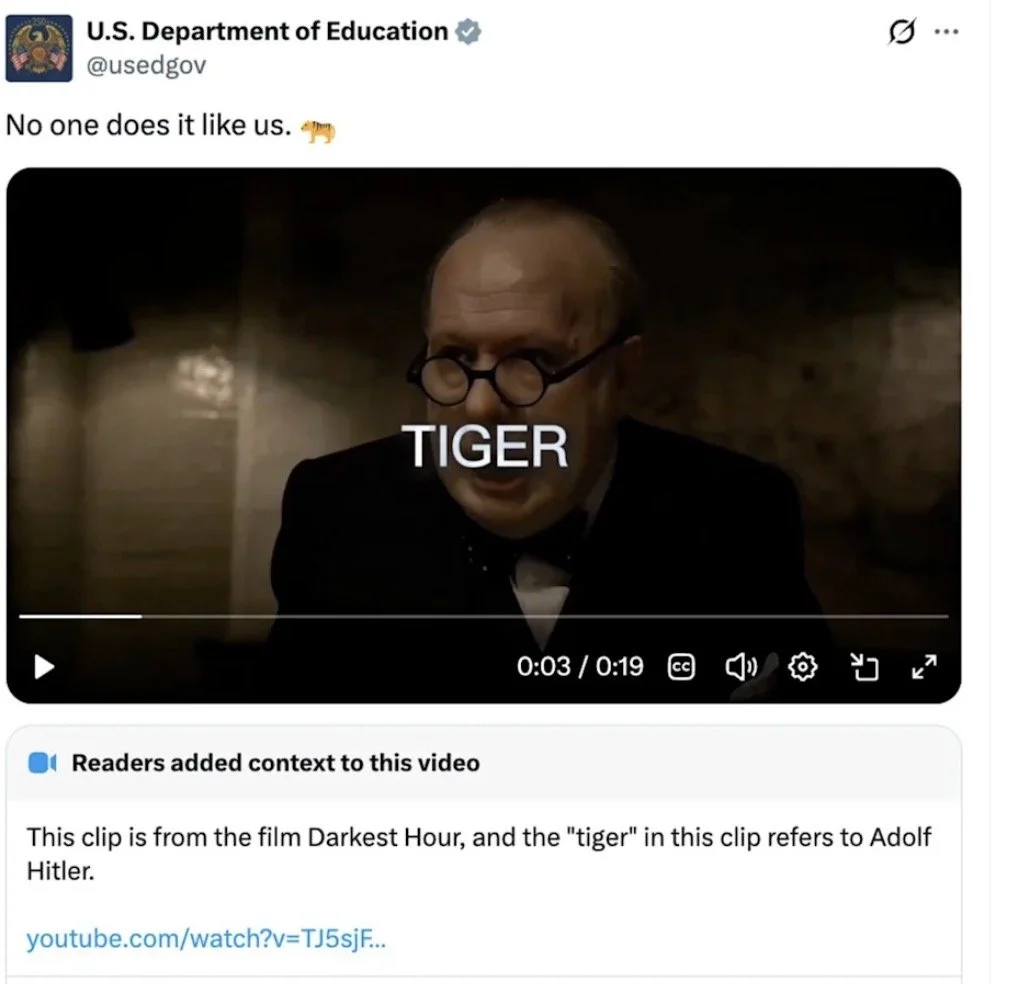
On August 26, 2026, the official United States Department of Education account posted what was apparently intended to be another dramatic President Donald Trump hype video.
It began with Gary Oldman’s Winston Churchill from the 2017 film Darkest Hour pounding a table and declaring:
“You cannot reason with a tiger when your head is in its mouth!”
Then came the dramatic transition.
Trump.
Music.
Trump raising his fist.
Trump pointing.
Trump being Trump.
The Education Department captioned the video:
“No one does it like us. 🐅”
There was one tiny historical problem.
The tiger Churchill was talking about was Adolf Hitler.
The scene depicts Churchill rejecting the idea of negotiating with Nazi Germany.
People noticed.
X added a Community Note explaining the context.
The Department of Education deleted the video.
According to subsequent reporting, the department said a staff member had used the clip without understanding its historical context.
That is objectively hilarious coming from the United States Department of Education.
But it also created a much larger question.
Because critics have spent roughly a decade comparing elements of Trump’s language, political movement and immigration policies with authoritarian and fascist movements of the twentieth century.
Trump supporters generally dismiss those comparisons as hysterical partisan rhetoric.
Sometimes they absolutely are.
Calling every politician you dislike “Hitler” eventually makes the word meaningless.
But what happens when the administration itself keeps accidentally stepping into the comparison?
Instead of screaming TRUMP IS HITLER, which isn’t particularly useful historical analysis anyway, we decided to do what we normally do:
Put everything next to everything else.
And look at the pattern.
(Sources: U.S. Department of Education X post, Aug. 26, 2026, subsequently deleted; Forbes, Siladitya Ray, Aug. 27, 2026; The New Republic, Hafiz Rashid, Aug. 27, 2026; Mediaite, Michael Luciano, Aug. 26, 2026.)
First, an Important Historical Rule.
Comparison does not mean equivalence.
This matters.
The Holocaust was the systematic persecution and murder of six million Jews by Nazi Germany and its collaborators, alongside the persecution and deaths of millions of other victims.
American immigration enforcement even aggressive, controversial or potentially unlawful immigration enforcement is not automatically equivalent to genocide.
A border detention facility isn’t Auschwitz simply because both contain fences.
A deportation order isn’t a Holocaust transport merely because both involve governments removing people.
And Donald Trump is not literally Adolf Hitler because two politicians occasionally use similar words.
That isn’t how historical comparison works.
Historians compare political movements because societies rarely reproduce history frame-for-frame.
They compare rhetoric, institutions, normalization, propaganda, scapegoating, executive power, treatment of minorities, definitions of citizenship and mechanisms through which government authority expands.
The meaningful question therefore isn’t:
“Is Donald Trump Hitler?”
That’s almost childish.
The better question is:
Why do so many pieces of the Trump movement repeatedly cause people including historians, Trump’s own former officials and now apparently Trump’s own government departments to reach for the same historical reference point?
That’s worth examining.
Start With the Language:
Political language matters because governments usually describe people before they decide what government should do to them.
Trump has repeatedly described unauthorized immigration as an “invasion.”
That language didn’t disappear after the campaign.
It became government language.
In April 2025, the White House issued a presidential memorandum titled:
“Military Mission for Sealing the Southern Border of the United States and Repelling Invasions.”
The memorandum described America’s southern border as being “under attack.”
Trump’s 2024 campaign platform similarly promised to:
“Seal the border and stop the migrant invasion.”
And:
“Carry out the largest deportation operation in American history.”
You can agree with those policies.
You can believe illegal immigration represents a serious national problem.
Those are legitimate political positions.
But once a civilian immigration issue is described officially as an invasion, something important happens rhetorically.
Migrants aren’t merely people violating immigration law anymore.
They’re an attacking force.
And governments have substantially broader moral permission to do things to an invading enemy than to people accused of an administrative or immigration violation.
(Sources: White House, “Military Mission for Sealing the Southern Border of the United States and Repelling Invasions,” April 11, 2025; Donald J. Trump 2024 Republican Platform.)
“Poisoning the Blood”
Then there is blood.
In 2023, Trump repeatedly said undocumented immigrants were:
“Poisoning the blood of our country.”
The comparison with Nazi rhetoric was immediate.
Trump later said he hadn’t known Hitler had used similar concepts and said he had never read Mein Kampf. And, honestly, we’re not going to pretend simply reading Hitler proves anything. I read Mein Kampf as a kid specifically to write a book report because I figured my teacher probably wasn’t going to read the thing cover to cover just to refute me. Reading an awful person’s words doesn’t mean endorsing them. Sometimes you read something precisely because you want to understand it, challenge it, or, apparently in my case, because you’re a child looking for a strategic advantage on a book report.
Context matters.
Trump was discussing immigration.
Hitler’s racial ideology concerned hereditary racial purity and ultimately supported a genocidal system.
Those aren’t the same proposition.
But the linguistic overlap is impossible to pretend doesn’t exist.
Nazi racial ideology revolved explicitly around concepts of German blood, contamination, racial purity and the biological definition of citizenship.
The 1935 Nuremberg Laws made ancestry central to whether individuals possessed full German citizenship.
By 1939, Nazi Germany had enacted hundreds of decrees progressively excluding Jews from German public, economic and civic life.
So when an American president starts describing unwanted populations as something entering and poisoning the nation’s blood, historians are going to notice.
That doesn’t prove shared intent.
It does explain the comparison.
(Sources: The Washington Post, Aaron Blake, Nov. 13, 2023; The Washington Post, Dec. 22, 2023; United States Holocaust Memorial Museum, “The Nuremberg Race Laws”; USHMM, “Anti-Jewish Legislation in Prewar Germany.”)
Then Came “Bad Genes”
In October 2024, Trump discussed immigrants who had committed murder and said:
“It’s in their genes.”
He continued by saying America had “a lot of bad genes” entering the country.
His campaign argued that Trump was specifically talking about murderers rather than immigrants generally.
That’s relevant context and should not be omitted.
But it also creates another uncomfortable historical parallel.
Once behavior starts being discussed as hereditary crime existing in someone’s genes rather than merely being something an individual chooses to do the argument moves from law enforcement toward biological determinism.
Twentieth-century eugenics movements, including Nazi racial ideology, relied heavily on the proposition that undesirable characteristics were biologically inherited.
Again:
Similarity is not equivalence.
But pretending there isn’t a recognizable historical pattern would require ignoring quite a bit of history.
(Source: Associated Press, Oct. 7, 2024; United States Holocaust Memorial Museum materials on Nazi racial ideology and eugenics.)
“Vermin”
Then there’s a word that historians really don’t like hearing governments use for human beings.
Vermin.
At a Veterans Day rally in 2023, Trump promised to:
“root out the communists, Marxists, fascists and the radical left thugs that live like vermin within the confines of our country.”
Trump was talking primarily about political opponents.
Nazi propagandists also repeatedly represented targeted populations and political enemies through language comparing them to disease, parasites, pests and vermin.
The important concept here is dehumanization.
If someone is your political opponent, society expects argument.
If someone is a criminal, society expects a legal process.
If someone is vermin, society normally exterminates vermin.
That’s why the vocabulary matters.
(Source: The Washington Post, Aaron Blake, “How Trump’s rhetoric compares with Hitler’s,” Nov. 13, 2023.)
“They’re Not People”
Trump has also used animal terminology when discussing particularly violent migrants and gang members.
In 2024, he said:
“If you call them people … in some cases they’re not people, in my opinion. These are bad these are animals.”
Again, context matters.
Trump defenders correctly point out that these statements have frequently concerned murderers, gang members and MS-13 rather than every immigrant.
That distinction should remain in the record.
But so should the statement.
Because declaring that a category of human beings isn’t actually composed of people is precisely the sort of rhetorical step historians examine when studying dehumanization.
(Source: CNN transcript, March 18, 2024; contemporaneous Trump campaign remarks.)
The Wall Is More Complicated Than the Internet Makes It.
Now let’s address one comparison people regularly butcher.
Trump’s border wall is not the Berlin Wall.
Hitler didn’t build the Berlin Wall.
East Germany began constructing it in 1961.
Hitler had been dead for sixteen years.
And a national border wall designed primarily to prevent unauthorized entry isn’t automatically equivalent to Nazi infrastructure.
But Nazi Germany absolutely did use physical segregation.
The Nazi regime and its allies established more than 1,000 ghettos during the Holocaust, frequently using walls, fences and guarded boundaries to isolate Jewish populations before deportations.
The purpose was fundamentally different.
That’s the distinction.
One keeps people from unlawfully entering a nation.
The other imprisoned targeted populations already under government control as part of a system that eventually facilitated mass murder.
So the visual similarity of walls is real.
The historical purpose is not equivalent.
(Sources: United States Holocaust Memorial Museum, “Ghettos”; U.S. National Archives and Trump White House Archive, Executive Order 13767, Jan. 25, 2017.)
Deportation.
This is where the comparison becomes simultaneously more understandable and more dangerous to oversimplify.
Trump promised the largest deportation operation in American history.
His second administration has pursued that goal aggressively.
A 2026 National Bureau of Economic Research working paper examining ICE arrest data across Trump’s first and second administrations found major increases in immigration arrests while the percentage of detainees with criminal convictions declined substantially, particularly during 2025.
By 2026, ICE arrest operations had expanded dramatically.
That raises legitimate questions about detention capacity, due process, enforcement priorities and what happens when a government establishes numerical pressure to dramatically increase removals.
But we should also say something political commentators sometimes won’t:
Nazi deportation was something categorically different.
Beginning in 1941, Nazi Germany transported Jews into ghettos, concentration camps, killing centers and locations where mass shootings were conducted.
During the Final Solution, deportation became a mechanism of genocide.
Millions were transported.
Many people placed aboard those trains were knowingly being transported to their deaths.
Modern American immigration deportation is a legal mechanism for removing noncitizens from the United States.
You can believe its current implementation is brutal.
You can believe individual removals violate due process.
You can believe the policy is justified.
But calling every deportation a Holocaust deportation destroys the historical distinction.
The comparison becomes valuable somewhere else:
Watch how populations are described.
Watch how legal protections change.
Watch how detention expands.
Watch how executive authority expands.
Watch how exceptions become normal.
That’s where historical comparison can actually teach us something.
(Sources: National Bureau of Economic Research Working Paper 34794, East, Patler & Cox, 2026; United States Holocaust Memorial Museum, “Deportations”; USHMM Holocaust Encyclopedia.)
And Then There Is the Really Weird Part: Government Propaganda.
Political rhetoric from Trump himself is one thing.
Official government communication is another.
Over the past two years, Department of Homeland Security and White House social-media accounts have adopted an increasingly aggressive visual style to promote immigration enforcement.
The posts routinely use dramatic paintings, militaristic imagery, nostalgia, nationalism and slogans about homeland, invasion and belonging.
Critics have repeatedly identified material with connections to white-nationalist or extremist subcultures.
In January 2026, the Southern Poverty Law Center’s Hatewatch reported that DHS and White House accounts shared immigration-enforcement material using “We’ll Have Our Home Again,” a song it traced to a white-nationalist organization.
That doesn’t necessarily establish that every government employee sharing it knew its history.
But that’s beginning to sound familiar.
DHS has also published imagery asking:
“Which way, American man?”
Critics compared the phrase with Which Way Western Man?, a 1978 book by William Gayley Simpson that became influential in white-nationalist circles and was later published by National Vanguard Books, associated with neo-Nazi leader William Luther Pierce.
The administration’s defense of its broader communications strategy has largely been that it is unapologetically promoting American history, nationalism and immigration enforcement.
Fair enough.
But eventually a pattern deserves examination.
(Sources: Southern Poverty Law Center Hatewatch, Jan. 15, 2026; The New Republic reporting on DHS social-media imagery, 2025–2026.)
“Did You Remain Loyal?”
And then, just days before the Education Department’s accidental Hitler video, the Department of Homeland Security posted something else.
A portrait of Donald Trump.
The caption:
“Did you remain loyal?”
That was posted August 24, 2026.
Loyal to America?
Loyal to the Constitution?
Loyal to the government?
The post specifically depicted Donald Trump.
That distinction matters in a republic built around the idea that government officials swear loyalty to the Constitution rather than an individual ruler.
One social-media post doesn’t transform a constitutional republic into a dictatorship.
But combine it with everything else we’ve just discussed and you begin to understand why people keep noticing a pattern.
(Source: Department of Homeland Security official social-media post, Aug. 24, 2026; People, Aug. 26, 2026.)
His Own Chief of Staff Went There.
Perhaps the most significant comparison didn’t come from Democrats.
It came from retired Marine Corps General John Kelly.
Kelly served as Trump’s Secretary of Homeland Security and then White House chief of staff.
According to Kelly, Trump complained about American generals and said he wanted generals more like “Hitler’s generals.”
Trump denied the account.
Kelly subsequently went much further.
In interviews before the 2024 election, Kelly said that based on his understanding of fascism and his experience working directly for Trump, Trump fit within the general definition of a fascist.
That’s not Rachel Maddow.
That’s not an anonymous Twitter account.
That’s Donald Trump’s former chief of staff.
A retired four-star Marine general.
A man who sat inside the administration and interacted directly with him.
People are free to disagree with Kelly.
But his testimony belongs in any serious examination of why this comparison exists.
(Sources: The Atlantic, Jeffrey Goldberg, Oct. 22, 2024; The New York Times interview with John Kelly, Oct. 22–23, 2024; Associated Press coverage, October 2024.)
And Apparently Hitler’s Speeches Were Already Somewhere in the Story.
Then there is perhaps the strangest historical footnote of all.
It predates Trump’s political career by decades.
A 1990 Vanity Fair profile reported that Ivana Trump had told her attorney that Donald Trump kept a book of Hitler’s collected speeches near his bed.
When questioned, Trump initially described the book as Mein Kampf and said it had been given to him by a Jewish friend.
The friend, Marty Davis, later said he wasn’t Jewish and that the book he gave Trump was actually My New Order, a collection of Hitler’s speeches.
Trump responded:
“If I had these speeches, and I am not saying that I do, I would never read them.”
None of that establishes ideological agreement.
People read historical monsters all the time.
Historians read Hitler.
Military strategists read Hitler.
Researchers read Hitler.
We’re currently writing about Hitler.
Owning the book isn’t evidence that someone subscribes to it.
But when the subject is why the Hitler comparison has followed Trump for years, an account from 1990 involving a collection of Hitler’s speeches sitting near his bed is too bizarre to omit.
(Source: Vanity Fair, Marie Brenner, September 1990; revisited by Vanity Fair in 2015; Maggie Haberman, Confidence Man, 2022.)
Even Willy Wonka Somehow Wanders Into This.
And because history apparently wasn’t strange enough already, there’s even a Willy Wonka detour.
Trump has repeatedly leaned into gold imagery.
Gold buildings.
Gold interiors.
Gold branding.
And eventually:
A literal Trump Gold Card for immigration.
Trump originally displayed a prototype aboard Air Force One in April 2025, complete with his photograph, telling reporters:
“For $5 million, this could be yours.”
The eventual Gold Card program established expedited immigration processing tied to a substantial financial contribution to the United States.
The current government program advertises a $1 million individual contribution after vetting, in addition to processing fees.
That inevitably produced comparisons with Willy Wonka’s Golden Ticket.
Except Wonka’s Golden Ticket famously found its way into the hands of Charlie Bucket the desperately poor kid.
America’s golden ticket, under this program, is explicitly designed for people capable of writing a seven-figure check.
That’s a fascinating inversion all by itself.
And there is an even stranger historical footnote surrounding Charlie and the Chocolate Factory.
Roald Dahl’s original 1964 depiction of the Oompa-Loompas described them as African “pygmies” brought from the jungle to live and work inside Wonka’s factory in exchange for cacao beans.
Civil-rights criticism followed.
Dahl eventually rewrote them as inhabitants of the fictional Loompaland.
Dahl also made openly antisemitic statements later in life, including an infamous 1983 remark asserting that even Hitler “didn’t just pick on” Jews without a reason.
Scholars, journalists and cultural critics have consequently spent decades arguing about colonialism, race and authoritarian imagery buried inside a children’s story most of us remember primarily for chocolate rivers and Gene Wilder.
So yes.
Apparently even the Wonka factory has historical baggage.
(Sources: White House presidential remarks aboard Air Force One, April 3, 2025; Executive Order 14351, “The Gold Card,” Sept. 19, 2025; TrumpCard.gov; National Geographic Education, 2017, on Dahl’s original Oompa-Loompas; Jewish Telegraphic Agency, 2020, on Dahl’s antisemitic statements.)
But Here’s Where We Refuse to Cheat
If we’re going to look for patterns, we have an obligation to identify the differences too.
Hitler abolished democratic government.
Trump has operated inside and repeatedly fought against the institutions of an American constitutional system that still includes opposition parties, independent courts, elections, state governments, journalists and civil society.
Nazi racial legislation defined citizenship biologically.
American immigration law, whatever its flaws, does not currently define American citizenship according to Aryan ancestry.
Nazi deportations ultimately became mechanisms of genocide.
American immigration deportations are not extermination transports.
Nazi Germany systematically murdered six million Jews.
Nothing occurring in the United States today is historically equivalent to the Holocaust.
Those aren’t minor caveats.
They’re enormous distinctions.
And failing to acknowledge them doesn’t strengthen criticism of Trump.
It weakens it.
Because once everything becomes Hitler, nothing is Hitler.
But Patterns Don’t Require Identical Endings
Here’s the reason studying history still matters.
History doesn’t warn us by replaying itself perfectly.
If somebody is waiting for jackboots, swastikas, identical laws, identical speeches and identical concentration camps before they’re willing to recognize authoritarian patterns, they’ve misunderstood the purpose of studying history.
The useful questions happen much earlier.
When does disagreement become disloyalty?
When does an immigrant become an invader?
When does a criminal become an animal?
When does a political opponent become vermin?
When does ancestry become blood?
When does behavior become genetics?
When does enforcement become militarized?
When does loyalty to a Constitution begin sounding like loyalty to a man?
When does government propaganda stop communicating policy and start cultivating a mythology around its leader?
Those questions aren’t Democratic questions.
They aren’t Republican questions.
They’re governance questions.
And we’d ask exactly the same ones if the president had a D after his name.
Which Brings Us Back to the Department of Education.
Maybe the employee responsible for the video simply didn’t know the movie.
That’s entirely possible.
Someone saw Churchill yell something cool about a tiger, thought:
Trump = tiger.
Added some music.
Hit upload.
And discovered several minutes later that Winston Churchill wasn’t complimenting the tiger.
If that’s what happened, it’s probably one of the funniest government social-media mistakes imaginable.
But it also unintentionally accomplished something political opponents haven’t been able to do particularly well.
It condensed a decade-long argument into nineteen seconds.
Churchill.
Hitler.
Tiger.
Trump.
“No one does it like us.”
Delete.
The irony is that F’nAround probably wouldn’t have written this article because somebody on the left called Trump Hitler again.
We’ve heard that argument.
You’ve heard that argument.
Trump supporters have definitely heard that argument.
But we’re a little obsessed with patterns.
And when the President’s own Department of Education accidentally joins a historical comparison already being made because of words like blood, genes, vermin, invasion, animals and loyalty, while another federal department is publishing nationalist imagery to advertise mass deportation eventually you have to put the pieces on the same table.
We’re still not going to tell you:
Donald Trump is Adolf Hitler.
History deserves considerably more respect than that.
We’ll tell you something much simpler.
These are the words.
These are the policies.
These are the government posts.
These are the historical records.
These are the comparisons Trump’s critics have made.
These are the comparisons people who actually worked for Trump have made.
These are also the places where those comparisons fail.
And now Trump’s own Department of Education managed to make the comparison completely by accident.
Probably.
Look at the pattern.
Decide for yourself.
That’s kind of the whole point.
References
Associated Press. Coverage of Donald Trump’s October 2024 comments regarding migrants, murder and “genes.”
Brenner, Marie. After the Gold Rush. Vanity Fair, September 1990.
East, Chloe N., Caitlin Patler & Elizabeth Cox. ICE Arrests Across Trump’s First and Second Terms: Variation in Targeting, Method, and Geography. National Bureau of Economic Research Working Paper No. 34794, 2026.
Forbes. Siladitya Ray. Education Department Posts Then Deletes Clip That Compared Trump to Hitler. August 27, 2026.
Goldberg, Jeffrey. Trump: “I Need the Kind of Generals That Hitler Had.” The Atlantic, October 22, 2024.
Haberman, Maggie. Confidence Man: The Making of Donald Trump and the Breaking of America. Penguin Press, 2022.
Mediaite. Michael Luciano. Coverage of the Department of Education’s deleted Darkest Hour video, August 26, 2026.
National Geographic Education. Coverage of the original depiction and later revision of Roald Dahl’s Oompa-Loompas, September 2017.
Southern Poverty Law Center, Hatewatch. DHS, White House Shared White Nationalist Song in ICE Recruitment Posts. January 15, 2026.
The New Republic. Hafiz Rashid. Education Department Seriously Posts Video Comparing Trump to Hitler. August 27, 2026.
The Washington Post. Aaron Blake. How Trump’s Rhetoric Compares With Hitler’s. November 13, 2023.
Trump White House Archives. Executive Order 13767, Border Security and Immigration Enforcement Improvements. January 25, 2017.
The White House. Military Mission for Sealing the Southern Border of the United States and Repelling Invasions. April 11, 2025.
The White House. Presidential remarks aboard Air Force One concerning the proposed Trump Gold Card. April 3, 2025.
The White House. Executive Order 14351, The Gold Card. September 19, 2025.
TrumpCard.gov. Official Trump Gold Card program information.
United States Holocaust Memorial Museum, Holocaust Encyclopedia. Anti-Jewish Legislation in Prewar Germany.
United States Holocaust Memorial Museum, Holocaust Encyclopedia. Deportations.
United States Holocaust Memorial Museum, Holocaust Encyclopedia. Ghettos.
United States Holocaust Memorial Museum, Holocaust Encyclopedia. The Nuremberg Race Laws.