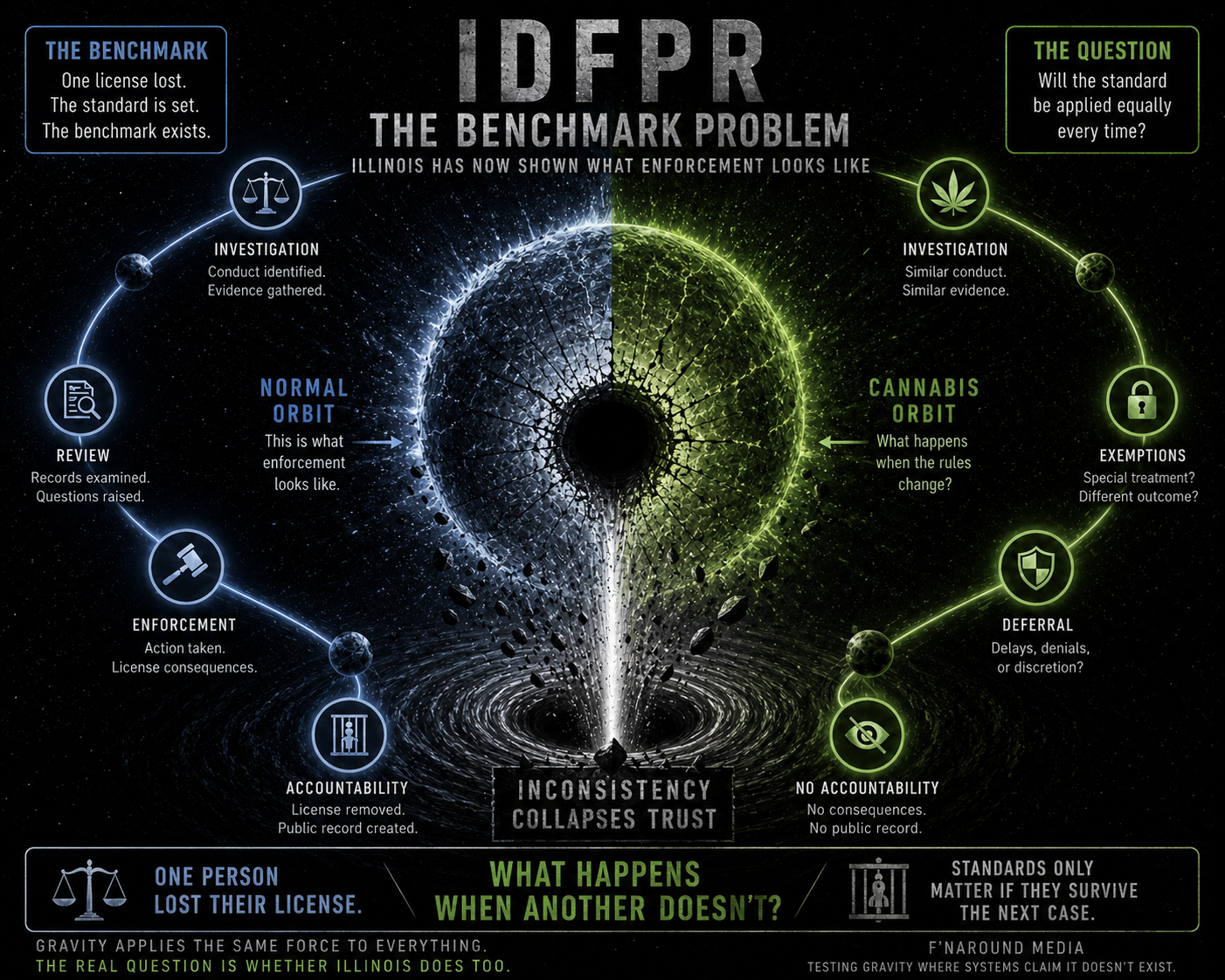
The Benchmark Problem: Illinois Has Now Shown What Enforcement Looks Like
The Benchmark Problem: Illinois Has Now Shown What Enforcement Looks Like
For more than a year, the question has never been whether Illinois cannabis regulators possess enforcement authority.
Of course they do.
The question has always been whether enforcement operates as a fixed standard or a variable.
This week, Illinois gave the public an answer.
According to reporting by the Chicago Sun-Times, a cannabis license holder (David Berger associated with Ivy Hall) connected to a federal conviction involving cocaine proceeds ultimately lost that license relationship after months of scrutiny.
The significance of that outcome is not the individual.
It is the benchmark.
Because benchmarks change systems.
Before this week, regulators could argue hypotheticals.
Now they cannot.
The state has publicly demonstrated that certain conduct can result in licensing consequences.
That fact now exists.
The benchmark has been established.
And benchmarks have consequences.
Especially when the public record already contains years of questions regarding ownership, control, disclosure, reporting obligations, financial relationships, and regulatory consistency within Illinois cannabis.
For months, F’nAround has examined one recurring issue:
Does Illinois apply the same standards regardless of who is involved?
That question has become increasingly relevant because Illinois cannabis is no longer a collection of small operators.
It is an industry increasingly dominated by large organizations controlling multiple licenses, cultivation facilities, processing operations, management structures, affiliated entities, and extensive ownership networks.
In theory, this should make enforcement easier.
The larger the organization, the more documentation exists.
The more documentation exists, the easier compliance should be to verify.
Yet the opposite often appears true.
As organizations grow, transparency frequently becomes harder to obtain.
Ownership becomes layered.
Control becomes segmented.
Management functions become distributed.
Responsibilities become divided among subsidiaries, affiliates, operating companies, management entities, holding companies, and related parties.
The result is a regulatory environment where determining who owns what can become surprisingly difficult.
That matters because Illinois built its cannabis framework around ownership disclosure.
The system assumes regulators know who owns licenses.
The system assumes regulators know who exercises control.
The system assumes regulators know who receives economic benefit.
The system assumes regulators know who must be reported.
Without those assumptions, the framework stops functioning.
Which brings us to the public record.
Over the past year, records obtained through litigation, agency responses, public filings, ownership disclosures, and open-records requests have repeatedly raised questions regarding ownership structures, operational control, beneficial interests, management authority, reporting obligations, and regulatory oversight.
Separately, public reporting has now demonstrated that Illinois regulators are willing to remove a license holder from the regulated framework when criminal conduct reaches a sufficient threshold.
Those two facts now exist simultaneously.
And together they create a benchmark problem.
Because once a benchmark exists, every future case becomes measurable.
The issue is not whether the facts are identical.
They never are.
The issue is whether the standard remains consistent.
If Illinois determines that one ownership interest warrants review, should larger ownership interests receive less review?
If one license holder creates regulatory concern, should an executive exercising authority over multiple facilities receive less scrutiny?
If one individual can trigger licensing consequences, should ownership structures spanning cultivation facilities and numerous dispensaries receive greater scrutiny or less?
Those are not accusations.
They are system design questions.
And systems either answer them consistently or they do not.
The public record has already produced another interesting development.
While these questions were being raised, multiple FOIA requests sought clarification regarding Illinois’ treatment of conduct falling within its stated zero-tolerance framework.
The responses followed a familiar pattern.
No records.
Extensions.
Refinements.
Burdensome determinations.
Additional extensions.
Additional refinements.
Further delays.
Individually, none of these responses prove anything.
Collectively, they produce a procedural footprint.
A timeline.
A measurable response pattern.
And timelines matter because they reveal what institutions do when confronted with uncomfortable questions.
Not what they say.
What they do.
The most important development may not be the licensing action itself.
It may be that Illinois has now removed ambiguity.
The state has shown the public what enforcement looks like.
The state has shown the public that licensing consequences can occur.
The state has shown the public that ownership interests can be subject to scrutiny and licensing consequences.
That means the conversation has changed.
The question is no longer whether Illinois can act.
The question is whether Illinois will apply the same benchmark every time.
That question becomes increasingly important as ownership concentrations grow
Public records have already raised questions regarding organizations controlling multiple dispensaries, cultivation facilities, affiliated operations, management entities, and additional ownership interests spread across related structures.
Whether those records ultimately demonstrate compliance or noncompliance is not the immediate issue.
The issue is whether identical standards are applied when identical questions arise.
Because systems do not fail when they enforce.
Systems fail when enforcement becomes conditional.
When standards become flexible.
When outcomes depend on variables unrelated to the conduct being evaluated.
That is how gravity wells form.
Not through corruption.
Not through conspiracy.
Through repetition.
A decision made once becomes easier to make again.
An exception granted once becomes easier to grant again.
A delay accepted once becomes easier to accept again.
Over time, the system begins bending toward consistency with its own past behavior.
That is gravity.
And gravity does not care who owns the license.
The benchmark now exists.
The public can see it.
Future responses will be measured against it.
Not by allegations.
Not by speculation.
By comparison.
One case establishes a benchmark.
The next case reveals whether the benchmark was real.
The state may have unintentionally created its own benchmark.
One individual connected to conduct Illinois deemed incompatible with cannabis licensing ultimately lost his license relationship.
That’s now part of the public record.
The benchmark exists.
Which creates a problem if future outcomes look different.
Because if one owner loses a license, but another owner doesn’t, the public is eventually forced to ask a simple question:
What’s the difference?
Is it the conduct?
Is it the evidence?
Is it the ownership percentage?
Is it the title on the business card?
Is it the size of the company?
Is it how many dispensaries are involved?
Is it how much revenue is generated?
Or is it something else entirely?
That’s the uncomfortable reality of precedent.
Once regulators act once, every future decision becomes a comparison.
Not because critics demand it.
Because the system demands it.
Standards only matter when they survive contact with the next case.
Otherwise they aren’t standards.
They’re exceptions.
And if the same conduct produces different outcomes depending on who is involved, the public isn’t learning something about the companies.
They’re learning something about the system.
That’s the funny thing about gravity.
It doesn’t care if you’re a single-license operator.
It doesn’t care if you’re a vertically integrated company.
It doesn’t care if you own one dispensary or ten dispensaries, or hell even thirteen dispensaries or fourteen through management.
Gravity applies the same force to everything.
The real question is whether Illinois does too.
Because benchmarks are easy to create.
Living with them is the hard part.
F’nAround Media
Testing gravity where systems claim it doesn’t exist.