The Great Loyalty Gold Rush: How Limited Edition Drops Became a Massive Customer Data Grab
The Great Loyalty Gold Rush: How Limited Edition Drops Became a Massive Customer Data Grab
There was a time when getting a limited-edition item meant actually leaving your house.
People lined up outside Starbucks before sunrise hoping to score a seasonal tumbler. Sneakerheads camped outside stores waiting for exclusive releases. McDonald’s released collectible glasses and toys. Dunkin’ offered limited merchandise. Retailers received small allocations and once they were gone, they were gone.
If you missed it, too bad.
Then something changed.
The limited-edition collectible market didn’t disappear.
It evolved.
And in the process, companies discovered something far more valuable than selling a cup, a tote bag, a beer cooler, or a piece of branded merchandise.
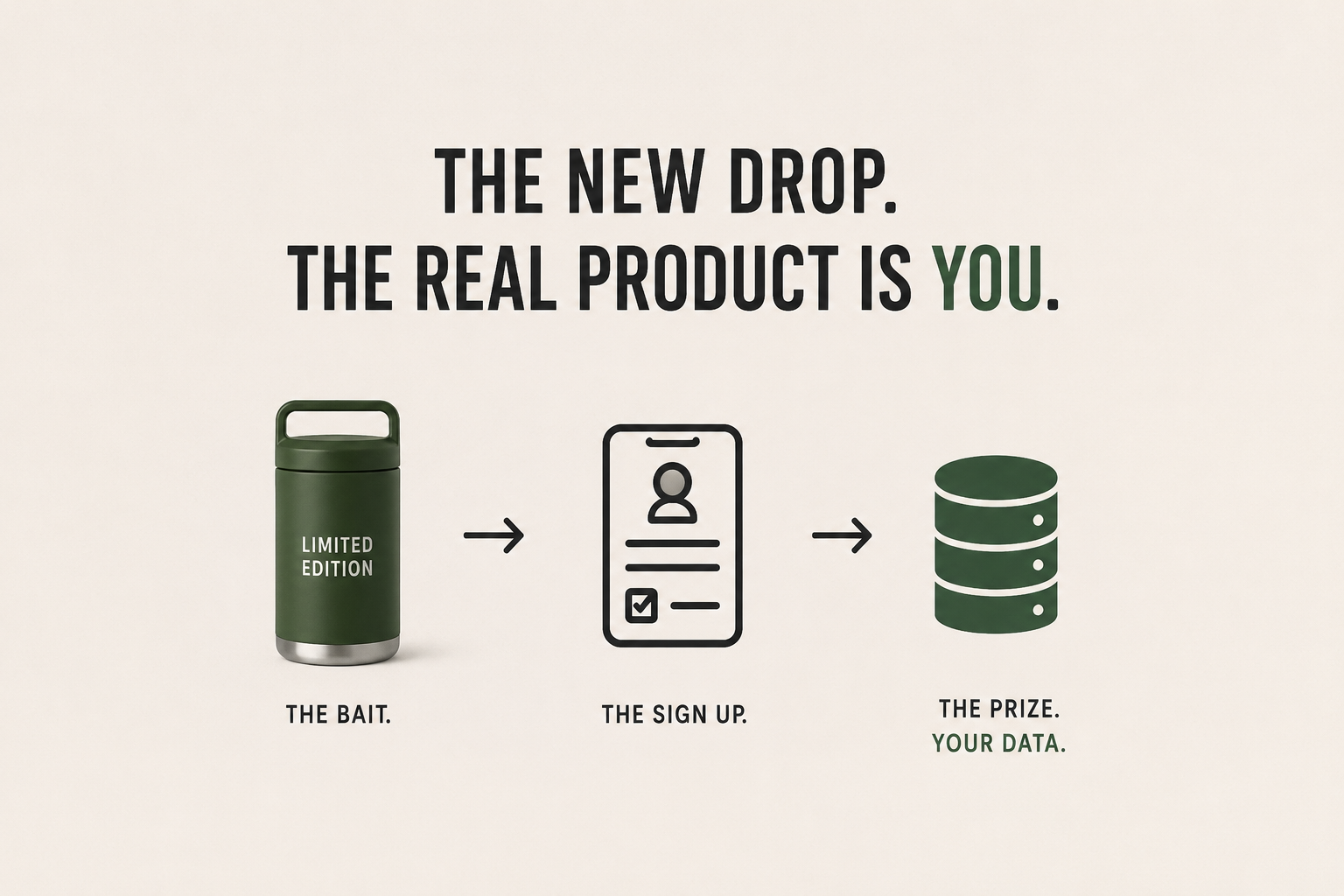
They discovered they could use scarcity to build customer databases.
Welcome to the Loyalty Economy.
The Old Model: Physical Scarcity
For decades, brands created demand by limiting supply.
A company would manufacture a product and distribute it across hundreds or thousands of locations.
Imagine 100 Starbucks stores receiving 25 special tumblers each.
That creates:
2,500 available products
Local excitement
News coverage
Social media photos
Secondary market reselling
The scarcity was real because inventory was physically limited and geographically distributed.
The challenge for companies was that they often had no idea who bought the products.
The customer walked in, bought the item, and walked out.
The company made a sale.
The reseller often made more money than the company.
And the brand gained very little information.
The New Model: Digital Scarcity
Fast forward to today.
Instead of sending products to thousands of stores, companies increasingly create one centralized online drop.
Examples include:
Coors Light’s Tallerboy release
Wingstop’s Club Wingstop merchandise
Taco Bell rewards exclusives
McDonald’s rewards exclusives
Starbucks app member exclusives
Chipotle rewards merchandise
Chick-fil-A app promotions
Various restaurant chains offering loyalty-only collectibles
The formula is remarkably similar.
Step 1:
Announce a highly limited product.
Step 2:
Require customers to join a loyalty program.
Step 3:
Collect customer information.
Step 4:
Release a tiny number of products.
Step 5:
Celebrate the massive demand.
The item itself becomes secondary.
The customer information becomes the prize.
The Product Isn’t The Product
Think about what happens when a company releases 100 limited-edition items online.
Millions of people may see the promotion.
Thousands may register.
Hundreds may compete.
Only a small fraction actually receive the product.
From a traditional retail perspective, that sounds inefficient.
From a marketing perspective, it’s brilliant.
The company now possesses:
Email addresses
Mobile numbers
Geographic data
Shopping habits
Purchase history
App engagement data
Marketing permissions
Customer demographics
Loyalty metrics
The value of that information often exceeds the value of the merchandise itself.
A stainless-steel tumbler might cost a company less than $10 to manufacture.
A loyal customer who spends money for years can be worth hundreds or thousands of dollars.
Viewed through that lens, the collectible isn’t inventory.
It’s customer acquisition.
Why Scarcity Works So Well
The strategy succeeds because it combines several powerful psychological triggers at the same time.
Scarcity
People naturally place greater value on things that are difficult to obtain.
The fewer available items there are, the stronger the demand becomes.
Exclusivity
Humans enjoy belonging to groups.
A loyalty program creates an insider club.
The message becomes:
“Not everyone can have this.”
Social Status
People post limited-edition products online because ownership communicates status.
The item becomes evidence that they gained access.
Fear of Missing Out
FOMO remains one of the most powerful forces in marketing.
Customers often sign up simply because they fear missing an opportunity.
Competition
The drop creates a contest.
Winning becomes part of the experience.
Sometimes obtaining the product becomes more satisfying than actually using it.
Wingstop’s Interesting Admission
One of the more fascinating examples came from Wingstop’s launch of Club Wingstop.
The company described the effort as transforming loyalty into “cultural currency.”
That phrase deserves attention.
Because the strategy is no longer about food.
It’s about culture.
Brands increasingly want to occupy the same emotional space once dominated by:
Sports teams
Music artists
Streetwear brands
Sneaker companies
Entertainment franchises
The goal is to make consumers feel like members rather than customers.
Membership drives engagement.
Engagement drives spending.
Spending drives shareholder value.
Coors Light And The Rise Of Lifestyle Merchandise
Beer companies have traditionally sold beer.
Now many are selling identity.
Coors Light’s Tallerboy release generated attention not because people desperately needed a giant insulated beer canister.
It generated attention because it was unusual, limited, shareable, and difficult to obtain.
The product became social media content.
Social media content generated attention.
Attention generated signups.
Signups generated customer data.
What looked like a novelty product was actually a sophisticated marketing funnel.
Why Companies Prefer This To Discounts
Traditional discounts create problems.
Discounts train customers to wait for lower prices.
Discounts reduce profit margins.
Discounts are difficult to sustain.
Collectibles solve those problems.
Instead of lowering prices, companies create excitement.
Instead of sacrificing margin, they create demand.
Instead of attracting bargain hunters, they attract brand enthusiasts.
A limited-edition merchandise campaign often costs less than a large advertising campaign while generating significant publicity.
The economics are attractive.
The psychology is powerful.
The data collection is invaluable.
The Sneakerification Of Everything
What we’re witnessing is the sneakerification of consumer marketing.
For years, sneaker companies mastered scarcity.
Release a small quantity.
Create massive demand.
Generate social media attention.
Watch resale markets explode.
Now restaurants, coffee chains, fast-food brands, beer companies, and consumer goods manufacturers are applying the same strategy.
The product category no longer matters.
Only the scarcity matters.
People aren’t chasing cups because they need cups.
They’re chasing access.
They’re chasing exclusivity.
They’re chasing the feeling of winning.
The Real Question
The most interesting question isn’t whether these campaigns work.
They clearly do.
The real question is:
What is actually being sold?
At first glance, companies appear to be selling limited-edition merchandise.
At second glance, they’re selling membership.
At third glance, they’re building customer databases.
The collectible is simply the incentive.
The loyalty program is the mechanism.
The customer information is the asset.
That doesn’t make the strategy evil.
In fact, from a business perspective, it’s incredibly smart.
But consumers should understand what they’re participating in.
When a company offers 100 collectible items to millions of potential customers, the merchandise may be the headline.
The data may be the business model.
And that’s why we’re seeing more brands adopt this strategy every year.
The cup, cooler, tote bag, keychain, tumbler, or beer canister might sell out in minutes.
The customer profile they collect could remain valuable for decades.
That’s a return on investment no reseller can match.