The Guinness Effect
Calling the Shot: When Bureaucratic Patterns Become Predictable
On February 28, I published a piece titled “The Portal, The Wall, and “I’ll Have a Guinness Then.””
It was meant to be a lighthearted observation about administrative systems specifically how bureaucratic frameworks built on rigid rules sometimes develop surprising flexibility when the wrong variable enters the equation.
Binary rules, after all, are comforting.
Portal submissions only.
Email invalid.
Follow the procedure.
Stay inside the architecture.
Anyone who files large numbers of public records requests eventually learns the rhythm. You refine, they extend. You narrow, they extend again. Somewhere along the way someone invokes the phrase “unduly burdensome.”
None of this is unusual. It is simply the choreography of administrative transparency.
But patterns are funny things.
Once you start mapping them, you begin to see where the pressure points are.
Which brings us to baseball.
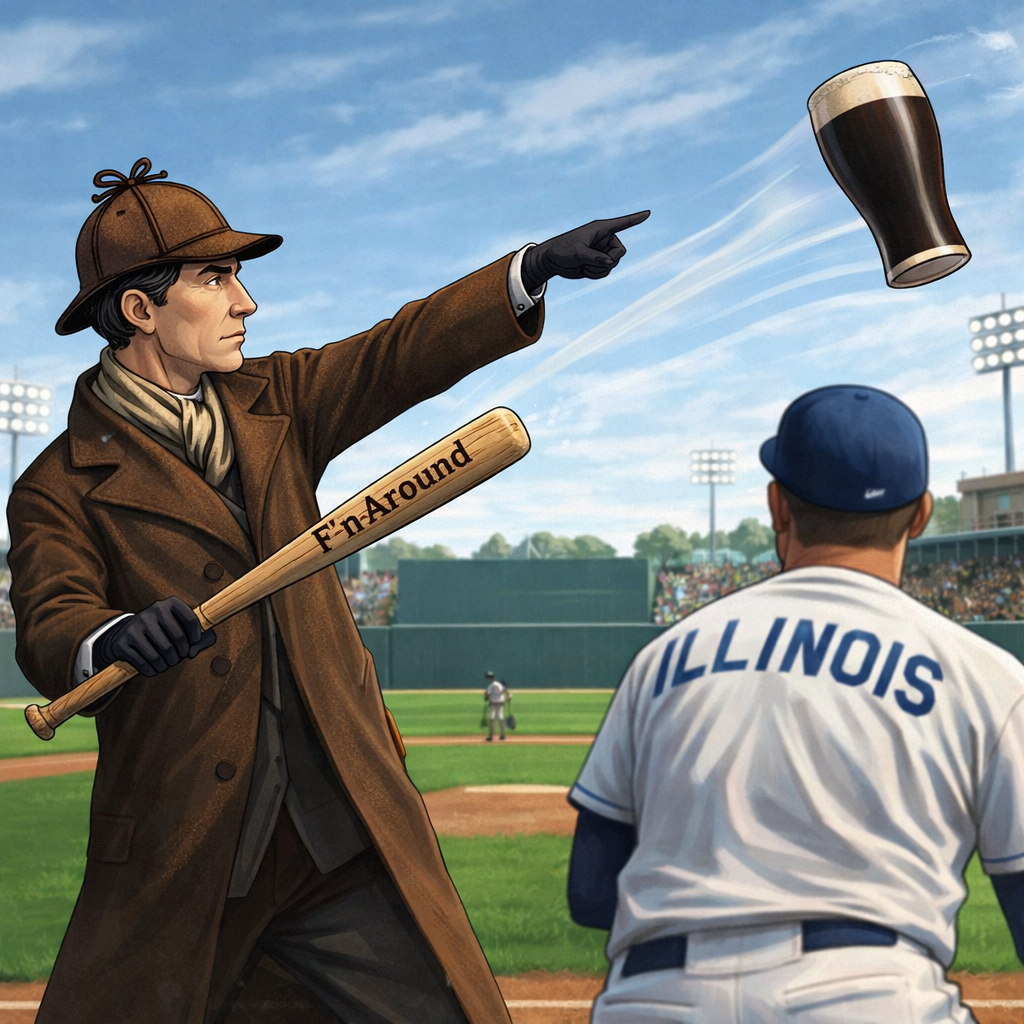
There is a famous story about Babe Ruth in the 1932 World Series. According to legend, he stepped up to the plate, pointed toward center field, and then hit the next pitch exactly where he had pointed.
Whether the gesture happened exactly that way is still debated.
But the legend survives because it represents something deeper than baseball.
It represents pattern recognition.
If you understand the pitcher, the field, and the moment well enough, the next move becomes predictable.
Last week’s article was, in its own small way, a version of that gesture.
It described a system where a binary rule portal submissions only functioned as a procedural wall. Airtight. Watertight. Structurally sound.
Until the request moved into territory where rigidity became inconvenient.
A few days later, the Attorney General’s FOIA office responded.
Two letters arrived.
One closed the original request.
The second opened a new FOIA file and issued an extension on what the office described as a “modified request.”
The modification, for those following along at home, was my response to their own request that I narrow the scope of the original filing.
What had been a refinement inside the existing request was processed as a new request entirely.
And just like that, the clock restarted.
Now, none of this is illegal.
Administrative systems are allowed to reorganize requests. Agencies are allowed to interpret clarifications as modifications. Extensions are explicitly permitted under the statute when records require review for possible exemptions.
In fact, the letter explains exactly that: the files must be examined by personnel with the necessary competence to determine whether portions may be exempt from disclosure.
Perfectly reasonable.
Procedurally defensible.
Structurally interesting.
Because the request in question was not exotic. It involved thirty PAC Request-for-Review files records that contain the original FOIA request submitted by a member of the public and the government’s response to that request.
Public records about public records.
Transparency about transparency.
If those files were routine, the process would likely be routine as well.
But systems reveal themselves in moments of administrative stress.
And that is where Structural Gravity begins to appear.
Gravity, in governance systems, does not announce itself dramatically. It accumulates slowly.
A rule bends here.
A timeline resets there.
A refinement becomes a modification.
Individually, each step is defensible.
Collectively, they form a pattern.
And patterns are measurable.
Anyone who studies regulatory behavior eventually encounters the same phenomenon: certain requests begin to attract procedural mass. They pull extensions, clarifications, reinterpretations, and administrative maneuvering into orbit around them.
Not because anyone explicitly says so.
But because systems, like planets, organize themselves around gravitational centers.
Which leads to the obvious question.
If the records in question were trivial, why would the architecture around them begin shifting?
Why does the refinement loop repeat?
Refine.
Extend.
Burdensome.
Refine.
Extend.
The answer may be entirely benign. Bureaucracies are complex organisms, and complexity often produces friction even when everyone involved is acting in good faith.
But researchers are trained to observe what the system does when it encounters pressure.
And in this case, the pattern was predictable enough that it could be written about before it happened.
That’s the Sherlock Holmes version of the story.
Holmes once remarked that when you eliminate the impossible, whatever remains however improbable must be the truth.
But Holmes also understood something subtler.
Patterns reveal themselves not through dramatic events, but through repetition.
A single coincidence means nothing.
Two coincidences are curious.
Three coincidences begin to look like structure.
In governance research, that structure has weight.
Which brings us back to the Irishman in the joke.
When the genie builds the wall around England airtight and watertight the Irishman doesn’t argue with the rules.
He simply works within them.
“I’ll have a Guinness then.”
Then the gravity well appears.
That remains the strategy.
Use the portal.
Document the timeline.
Observe the architecture.
And when procedural gravity begins to bend the rules around a set of records, researchers take note because gravity does not appear randomly.
It appears where mass has accumulated.
So the process continues.
Thirty files at a time.
One batch at a time.
Until eventually the pattern resolves itself.
And when it does, the interesting question will not be whether the system followed the rules.
The interesting question will be why the rules began bending in the first place.
Until then, the approach remains unchanged.
Use the portal.
Follow the structure.
Watch the gravity.
And when the pattern calls the shot…
sometimes the smartest move is still the simplest one, once again.
“I’ll have a Guinness then.”
In physics, gravity does not reveal itself by announcement.
It reveals itself by behavior.
Objects begin to bend toward something unseen.
Paths curve slightly.
Time stretches just enough to notice if you are paying attention.
Governance systems behave the same way.
When procedures operate normally, they move quietly. Requests enter. Records leave. Timelines advance. Nothing remarkable happens.
But occasionally a request passes through a part of the system where motion slows. Extensions accumulate. Clarifications multiply. Rules that were once rigid develop a curious elasticity.
Nothing illegal.
Nothing dramatic.
Just enough procedural mass that the surrounding architecture begins to bend.
Researchers have a term for that phenomenon.
They call it signal.
Because gravity only appears where something heavy enough exists to generate it.
So when a simple request for public records about public records begins attracting procedural orbit refinements becoming modifications, timelines resetting, batches appearing where single productions might normally suffice the interesting question is not whether the system followed the rules.
The interesting question is what the rules are bending around.
And that is the moment when the wall, the portal, and the Guinness joke stop being jokes at all.
They become instruments.
Tools for measuring where gravity lives inside the system.
Which is precisely why the experiment continues.
Thirty files at a time.
Systems designed to produce records rarely struggle this hard to produce records unless the records themselves are doing something interesting.