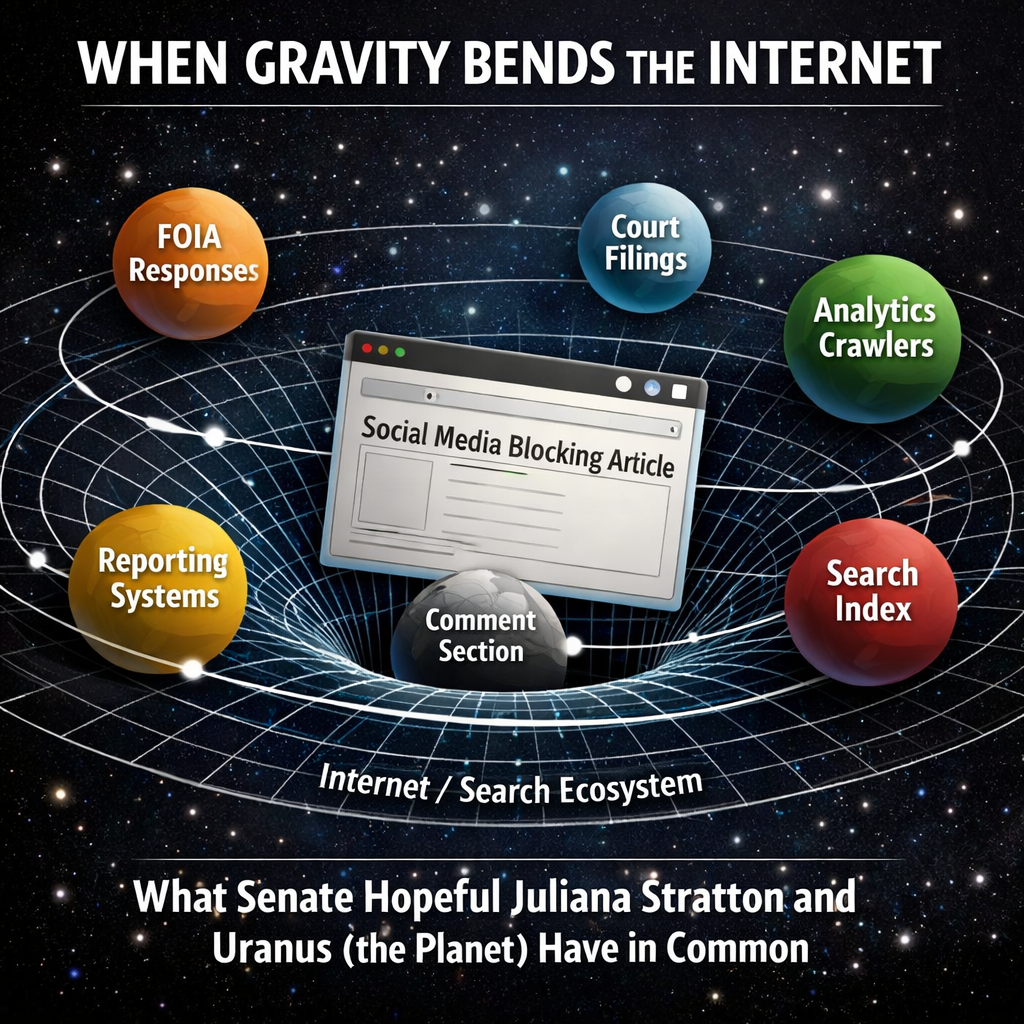
What Senate Hopeful Juliana Stratton and Uranus (the Planet) Have in Common When Gravity Bends the Internet
Astronomers discovered the planet Neptune because something kept pulling Uranus slightly off its expected orbit.
When reality bends in strange ways, scientists look for the mass causing the distortion.
Recently, while studying internet analytics instead of planetary orbits, we noticed something similar involving Senate hopeful Juliana Stratton.
And yes… this article really is about Uranus. The Planet.
One of the funny things about studying systems long enough is that eventually you stop looking for answers and start looking for distortions.
In physics, gravity works in a very simple way. When mass accumulates, space bends around it. Light bends around it. Time bends around it. Astronomers call this gravitational lensing.
What’s interesting is that astronomers don’t always find planets by seeing them.
Sometimes they just watch a star blink.
If the star flickers in a consistent way, it means something heavy is nearby pulling on it.
They don’t see the planet.
They see the distortion.
Over the last few years I’ve noticed institutional systems behave almost the same way.
Except instead of bending light, they bend reality.
Responses slow down.
Procedures suddenly get “complicated.”
Paperwork moves strangely.
Agencies stop answering simple questions.
Or suddenly answer them in a very carefully worded paragraph that somehow avoids the actual question entirely.
If you watch long enough, you realize those distortions usually mean one thing:
Something heavy is sitting there.
Some obligation.
Some decision.
Some accumulation of responsibility that no one really wants to deal with.
So the system bends around it.
In the work we’ve been doing filing FOIAs, reading agency responses, watching court filings, documenting regulatory behavior those distortions show up constantly.
Delays.
Strange wording.
Sudden silence.
Sudden urgency.
It’s actually one of the easiest ways to map where institutional gravity is strongest.
But something else interesting happens when you start publishing your observations online.
Analytics start behaving the same way.
Now most people think website analytics are boring. Just traffic numbers and search results.
But if you watch them long enough, they start acting like astrophysics.
Pages get indexed.
Pages get de-indexed.
Pages get reported.
Pages disappear from search results and then quietly return later like nothing happened.
Clusters of attention appear out of nowhere.
Suddenly a page gets crawled ten times in an hour by systems that normally never touch it.
The internet starts blinking like a star.
And just like astronomy, the blinking tells you where the gravity is.
Some pages make perfect sense.
For example, if you publish a page discussing alleged bribery attempts involving people who were asked to participate in those attempts… you expect attention.
If you publish a page discussing alleged death threats involving elected officials… you expect attention.
If you publish documents showing regulatory agencies ignoring criminal activity… you expect attention.
Those are big things.
Heavy things.
Of course gravity bends around those.
But recently we noticed something a little… different.
A small anomaly.
There’s a particular page that keeps getting reported and unindexed.
Over.
And over.
And over again.
Which is interesting, because the page isn’t about bribery.
It’s not about regulatory misconduct.
It’s not even about the heavier parts of Illinois politics.
It’s about something much smaller.
Social media blocking.
Way back in the ancient historical era of 2025, when our team started asking questions of elected officials on social media, we noticed something interesting.
One official in particular Juliana Stratton, the current Lieutenant Governor of Illinois and Senate hopeful appeared to have blocked several members of our team from commenting on her official government communication pages.
Now, for anyone who has spent time around constitutional law, this is one of those small issues that actually isn’t that small.
Courts have repeatedly held that when government officials use social media to conduct official communication with constituents, those spaces can function as public forums.
Which means blocking constituents for disagreement raises First Amendment questions.
Not the end of the world.
Not exactly the crime of the century.
But definitely the kind of thing that makes constitutional lawyers perk up a little.
So we wrote about it.
Nothing dramatic.
Just documented the observation.
Explained the legal context.
Pointed out the contradiction between publicly advocating for civil rights while quietly blocking constituents who ask uncomfortable questions.
The state didn’t care.
Federal civil rights offices weren’t interested.
Which honestly makes sense.
Compared to everything else happening in the world, someone blocking critics on social media probably isn’t exactly top priority.
Case closed.
Except…
the article keeps getting reported.
Repeatedly.
Every time it gets reported, it disappears from indexing for a bit.
Then it comes back.
Then it gets reported again.
Then it disappears again.
Meanwhile pages discussing much larger and much more serious issues sit quietly online without any trouble at all.
Which raises a funny little research question.
Why that page?
Now to be fair, there are plenty of possible explanations.
Maybe someone just really doesn’t like the article.
Maybe automated moderation systems keep flagging it.
Maybe someone out there just has a personal vendetta against discussions of constitutional public forums.
Who knows.
But when you spend enough time studying systems, you learn something important.
Distortions usually happen for a reason.
Astronomers didn’t find Neptune because someone saw it clearly through a telescope.
They found it because Uranus kept behaving strangely.
Which, historically speaking, is how most important discoveries start.
The orbit was bending.
The math didn’t make sense.
So they looked for the mass causing the distortion.
And eventually they found the planet.
Institutional systems aren’t that different.
Sometimes you discover the problem directly.
But more often you discover it because reality starts bending around it.
Paperwork bends.
Language bends.
Processes bend.
Even the internet bends a little.
So when a page keeps blinking in and out of existence…
You don’t necessarily assume anything.
You just watch.
Because sometimes a blinking star means nothing.
And sometimes it means there’s a planet sitting right next to it.
Either way, gravity has a funny habit of distorting reality.
And if you’re paying attention…
the distortions usually tell you where the mass really is.
Sometimes that mass is a planet.
Sometimes it’s a policy decision.
And sometimes it’s just a comment section.
And considering the senate platform she’s built around civil rights and protecting the voices of the unheard, the whole thing creates a small but measurable contradiction.
A leader standing up for open speech…
while quietly muting constituents who disagree.
But in fairness, that’s the thing about gravity.
It doesn’t care what something says it stands for.
It only cares how much weight it’s actually carrying.