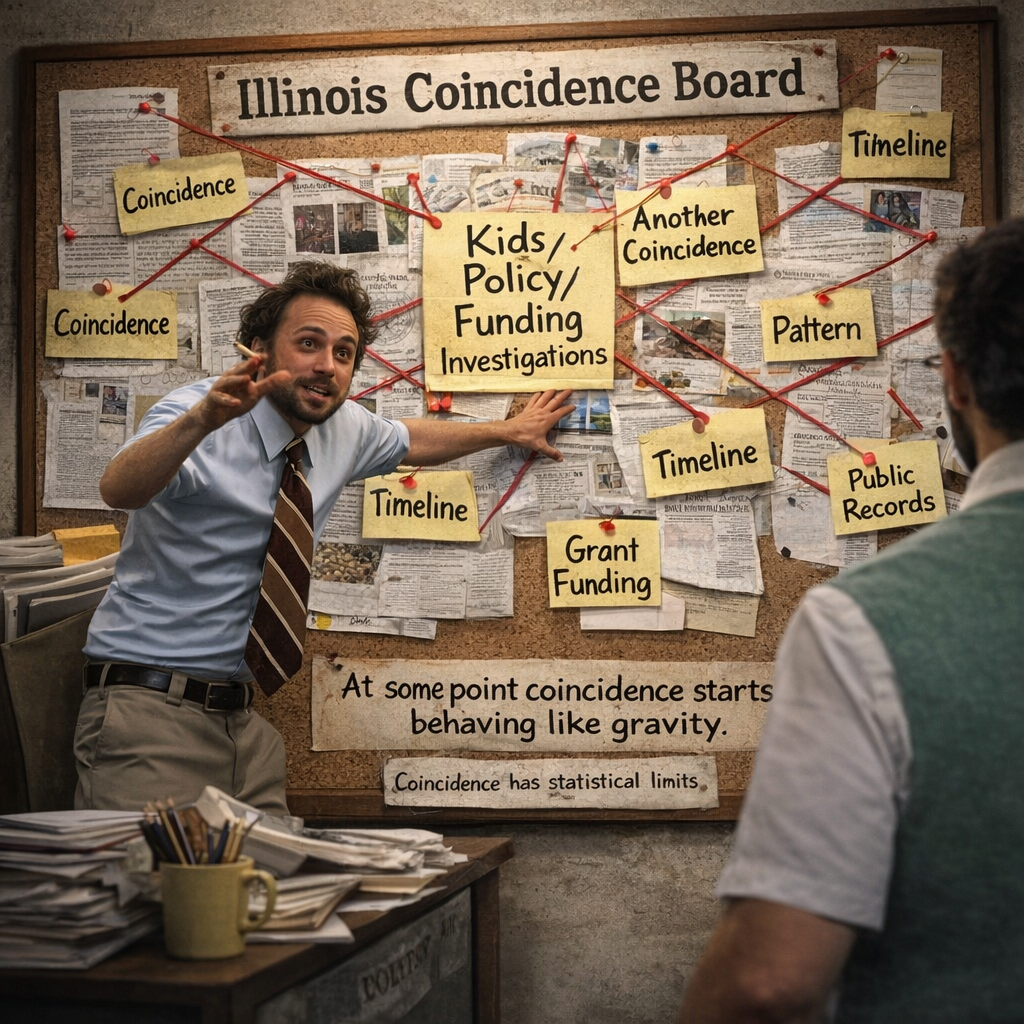
When Coincidences Start Behaving Like Gravity
When Coincidences Start Behaving Like Gravity
Coincidences, Timelines, and the Statistical Limits of “Nothing to See Here”
I did something this week that I haven’t done in over a decade.
I voted in a Democratic primary.
Now before anyone panics, this wasn’t the dramatic ideological awakening of a man suddenly seeing the light. I simply early-voted, called my friend Mike afterward, and said, “Guess what I did that I haven’t done in like ten years?”
His answer, without hesitation:
“Did you write us in?”
While he wasn’t technically wrong, that wasn’t what I meant.
What I meant was that I voted in the primary at all. Which, for those who follow Illinois politics long enough, becomes less about party loyalty and more about anthropology. You’re not just participating in democracy, you’re observing it.
And sometimes, when you observe long enough, you start noticing something interesting.
Patterns.
A few days later, Illinois politics produced one of those moments that reminds you why timelines exist in the first place.
Our current governor suddenly appeared in national news because a former president reportedly mentioned him in connection with travel on a certain aircraft owned by a certain individual whose name has become shorthand for a particularly disturbing chapter of modern history. Shortly thereafter, the former president clarified that statement outside of a deposition context, noting that the earlier testimony was mistaken.
And that, of course, led to the familiar public reaction: coincidence.
Now, coincidence is a wonderful thing. Life is full of them. But one of the reasons investigators, journalists, and researchers use timelines is because coincidence has statistical limits. When events are placed chronologically, the human brain begins to notice something subtle but important: patterns.
A single event can always be explained away.
Two events may raise an eyebrow.
But when enough events begin to cluster in sequence, coincidence starts to look less like randomness and more like structure.
At some point the accumulation of events begins to carry weight. Patterns form, pressure builds, and what once looked like coincidence starts to behave more like gravity.
That is usually the point where timelines become useful.
That’s why timelines matter.
They don’t accuse. They don’t speculate. They simply place events in order and let readers observe what emerges.
And for clarity, every event discussed below comes from publicly reported information and linked sources that readers can review themselves.
Consider, for example, a few public events related to policies and organizations connected to Illinois political life.
In 2023, Monogram Meat Plant paid penalties for violations of federal child labor laws involving teenagers, according to the U.S. Department of Labor.
https://www.dol.gov/newsroom/releases/whd/whd20231010
The company’s primary investor and partner is Pritzker Private Capital.
Shortly thereafter, Illinois saw the passage of legislation strengthening child labor protections, signed by Governor J.B. Pritzker in July 2024.
https://gov-pritzker-newsroom.prezly.com/gov-pritzker-signs-legislation-to-protect-minors-from-labor-exploitation
Cause and effect? Possibly.
Policy response? Also possible.
Coincidence? Certainly an option.
But again, timelines simply note sequence.
Another example involves Aunt Martha’s Health and Wellness, a foster care and social services organization that has received substantial public support and grant funding over the years.
The Chicago Tribune reported in 1998 that the agency faced investigation following the deaths of children in its care.
https://www.chicagotribune.com/1998/10/16/foster-agency-probed-after-2nd-child-dies/
Decades later, the organization again appeared in news coverage related to abuse allegations and the closure of a facility.
https://www.injusticewatch.org/juvenile-courts/2024/aunt-marthas-foster-care-dcfs-abuse-allegations/
https://www.cbsnews.com/amp/chicago/news/aunt-marthas-another-arrest/
https://chicago.suntimes.com/the-watchdogs/2024/09/20/dcfs-aunt-marthas-health-wellness-aalert-security-services-antonio-hopkins-trulon-henry-marc-smith-heidi-mueller-renardo-johnson
The organization has also received philanthropic funding, including a $9 million donation from philanthropist MacKenzie Scott.
https://blockclubchicago.org/2023/10/31/aunt-marthas-health-and-wellness-gets-9-million-from-philanthropist-mackenzie-scott/
Her former husband, readers may recall, has appeared in widely reported documents connected to an interesting social circle.
And during the corruption trial of former Illinois House Speaker Michael Madigan, testimony referenced donations directed to the organization from corporate sources.
https://www.chicagotribune.com/2024/08/29/potential-testimony-in-madigan-case-is-previewed-as-attorneys-start-wrangling-over-what-a-jury-might-hear/
The story becomes even more interesting when one examines the broader institutional support surrounding the organization.
Over the years, Aunt Martha’s Health and Wellness has received substantial backing from both government programs and philanthropic initiatives. In addition to private donations, the organization has been connected to multiple layers of state-supported funding and policy initiatives.
For example, the Pritzker administration awarded $18 million in Healthcare Transformation funds to a Central Illinois partnership involving Aunt Martha’s, part of a statewide initiative aimed at expanding healthcare access and restructuring service delivery models.
https://www.illinois.gov/content/dam/soi/en/web/illinois/iisnewsattachments/23880-pritzker-administration-awards-18-million-in-healthcare-transformation-funds-to-new-central-illinois-partnership.pdf
Municipal and regional policy organizations have also highlighted the group as a partner within broader public service networks. Documentation circulated through the Illinois Municipal League, for example, references Aunt Martha’s within discussions of regional health and service partnerships supported through public programs.
https://iml.org/file.cfm?key=15671
Meanwhile, the organization itself has emphasized its participation in quality certification and service initiatives across Illinois healthcare systems, presenting itself as a key provider within the state’s behavioral health and community service infrastructure.
https://www.auntmarthas.org/tag/quality/
Political reporting has likewise described Aunt Martha’s as a major recipient of state support and a significant player in Illinois’ expanding network of publicly funded social services.
https://amp.bnd.com/news/politics-government/article261583162.html
None of this, of course, is unusual on its face. Public-private partnerships are a common feature of modern governance, especially in healthcare and social services. Governments fund organizations, organizations deliver services, and everyone points to improved outcomes.
The timeline observation, however, is simply this:
An organization that has repeatedly appeared in investigative reporting regarding internal problems has also simultaneously operated within a robust ecosystem of state support, grant funding, and political advocacy.
Coincidence? Possibly.
Institutional inertia? Also possible.
But once again, this is exactly why timelines exist. They do not claim motive, and they do not assign blame. They simply place events in order so that readers can observe the relationship between public funding, policy support, and subsequent outcomes.
And in Illinois, the relationship between those three things often produces some very interesting timelines.
Once again, each event can be explained individually.
But timelines are not about individual explanations.
They are about context.
The same principle applies to the state’s recent regulatory debates over intoxicating hemp products. Throughout 2024 and 2025, the governor’s office advocated for restrictions on certain hemp-derived intoxicants, citing concerns about protecting minors.
At the same time, it was pointed out with photographic evidence that similar behavior appeared within the state’s regulated cannabis market, raising questions about enforcement consistency. Read our previous articles on it and the state’s response of an investigation…
Coincidence? Regulatory complexity? Policy evolution?
All plausible explanations.
But again, timelines record events. They do not interpret them.
Finally, this week’s news cycle added yet another entry to the chronology when reports surfaced regarding alleged testimony involving Governor Pritzker and travel on Jeffrey Epstein’s aircraft, an assertion the governor strongly denied and which the former president later clarified as erroneous testimony.
https://www.pbs.org/newshour/nation/thomas-pritzker-steps-down-from-hyatt-board-saying-he-deeply-regrets-association-with-epstein
https://abc7chicago.com/post/gov-jb-pritzker-denies-traveling-jeffrey-epsteins-plane-bill-clintons-recanted-testimony/18672515/
https://capitolnewsillinois.com/news/pritzker-denies-traveling-on-epsteins-plane/
https://www.wbez.org/politics/2026/03/03/jb-pritzker-bill-clinton-erroneous-testimony-jeffrey-epstein-aircraft
Coincidences again.
Which brings us back to the purpose of timelines.
They are not accusations.
They are not conclusions.
They are simply a chronological record of publicly reported events.
But timelines have an inconvenient side effect: they reveal patterns.
And patterns are where curiosity begins.
As an old investigative saying goes:
Once is coincidence.
Twice is interesting.
Three times is a pattern.
Illinois politics, however, appears committed to testing the upper limits of statistical coincidence.
Which is why we keep building timelines.
Not because they prove anything.
But because eventually the accumulation of events begins to carry weight. And when enough weight gathers in one place, coincidence stops behaving like coincidence.
It starts behaving like gravity.
Which leaves a simple question:
How many coincidences does it take before coincidence stops being the explanation?
Which leaves a simple question:
How many coincidences does it take before coincidence stops being the explanation?
Because eventually the accumulation of events begins to pull on everything around it.
And when that happens, what we are observing is no longer coincidence.
It’s gravity.
Until then, as one former Illinois state representative once put it on a recording:
“The guy’s still the governor. He’s still doing what he doing. Illegal or legal.”
And in Illinois, that may be the most honest line in the entire timeline.