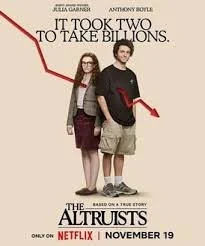
The Altruists: The Love Story That Cost $8 Billion
A Netflix limited series about FTX, and the true story underneath it
I love a Netflix limited series for exactly the reason you would think. It has a beginning, a middle, and an end. Nobody is stretching a story for season nine. Nobody is keeping a mystery box open because the algorithm liked it. And when it is based on a true story, which is my favourite kind, you can do what I do after every episode, which is pause it, look the real thing up, and check who is lying to you, the show or your memory.
The Altruists is that kind of show, and it is also the kind of show that will drive you crazy in the best way, because the true story is so wild that the show actually has to tone some of it down and invent other parts just to make it feel like a story. It dropped on Netflix on Thursday, November 19, 2026, all eight episodes at once, TV-MA, created by Graham Moore, the Oscar winner who wrote The Imitation Game, and Jacqueline Hoyt, and produced by Barack and Michelle Obama's Higher Ground Productions. James Ponsoldt directed the premiere. It is inspired by New York magazine reporting on FTX by Kevin T. Dugan and Jen Wieczner. Inspired by is the important phrase. It is not a documentary. It is not a transcript. It is a drama that took a court file and turned it into a love story, and that choice is the whole argument of the show, for better and for worse.
The short version is this. Sam Bankman-Fried, played by Anthony Boyle, and Caroline Ellison, played by Julia Garner, met as brilliant nerds at Jane Street, fell into a strange on again off again relationship, built a crypto empire on customer money they were not supposed to touch, and watched it collapse in nine days in November 2022. Sam got 25 years. Caroline got two years and testified against him. The company they built is gone. The AI company they invested in with that same money just went public today, November 19, 2026, at a valuation over a trillion dollars, and that is the part of the story that will make your jaw drop, because I did the maths and the number you have heard is wrong, and the real number is still insane.
What the show is, and what it is not
The Altruists runs on two timelines. One starts in 2016, when Sam and Caroline meet at Jane Street, the quantitative trading firm in New York, both vegans, both children of professors, both obsessed with effective altruism, which is the philosophy that you should use maths and evidence to do the most good you can with your money and your life. The other timeline is the Bahamas in 2022, in the final days before FTX collapsed, when an $8 billion hole in customer funds is about to swallow them whole. The show jumps back and forth, sometimes showing the same events from a different angle, which is a clever trick and also a frustrating one, because it keeps interrupting the plot just when you want it to keep going.
That structure is a choice, and the critics noticed it straight away. Time called it Dangerous Liaisons for nerds, and said the show imposes a folie a deux theory, that Sam and Caroline were so in love it destroyed them, on a story where the real relationship was lopsided, with Ellison wanting more from Bankman-Fried than he had the emotional resources to give. Comic Book Club called it a prestige Big Bang Theory, a rom-com for scammers, and said the show front-loads the romantic comedy and back-burners the actual pain they caused by ruining people's livelihoods. There is no time spent on the arrest or the jail time at the end, Ellison's testimony gets its moment, Sam gets arrested, and then the show closes with information cards telling you the sentences.
I get why they did it. If you just film the fraud, you get a spreadsheet with a haircut. If you film the relationship, you get a show people will actually watch. But it does change the story. In real life, Sam was not a virgin haplessly in love, he was a boss who used people, including Caroline, as tools. In the show, he is softer, more awkward, more Michael Cera on an ego trip than Jesse Eisenberg's Machiavellian Zuckerberg, which is how one review put Boyle's performance. In real life, Caroline was not just a Harry Potter fan on Tumblr, she was the CEO of Alameda Research, the trading firm that was secretly taking FTX customer money, and she knew exactly what she was doing when she did it. The show turns her Harry Potter fandom into smutty fanfic writing, which is a funny detail and also a bit of a caricature, and it leans hard on her maths brain approach to sex and love, which is true in spirit and exaggerated in practice.
Here is what the show gets right, and it matters. The timeline of the collapse is right. The $8 billion shortfall is right. The code changes that gave Alameda special privileges are right. The Bahamas penthouse, the polyamorous group house, the Margaritaville hangs, the celebrity endorsements, Gisele Bundchen and Tom Brady, Katy Perry performing, all of that happened, or close enough that it feels true. The effective altruism stuff is right too, and it is the most important part, because it is the cover story. Sam and Caroline told themselves, and told the world, that they were going to get rich so they could give it all away and save the world. Sam later admitted, in his own words after the trial, that a lot of that ethics stuff was just a way of getting people to trust him. The show knows that, and it lets you watch two smart people lie to themselves in real time, which is the most honest thing about it.
The cast, and what else they did
Anthony Boyle plays Sam Bankman-Fried. Boyle is from Northern Ireland, and he came to fame playing Scorpius Malfoy in Harry Potter and the Cursed Child on stage, which is a funny coincidence I will come back to, because Caroline Ellison in real life was a huge Harry Potter fan. On screen, Boyle was in Masters of the Air, Say Nothing, where he played Brendan Hughes, and House of Guinness. He plays Sam as brash, awkward, fast talking, always a little too sure of himself, with a mop of curly hair and a wardrobe that looks like he got dressed in the dark on purpose. It is a good performance, and it is also a sympathetic one, which is a choice. The real Sam was colder than this.
Julia Garner plays Caroline Ellison, and yes, you are right, she is the Anna Delvey girl. She played Anna Sorokin, known as Anna Delvey, in Inventing Anna, the 2022 Netflix limited series created by Shonda Rhimes, based on Jessica Pressler's 2018 New York magazine article How Anna Delvey Tricked New York's Party People. She got an Emmy nomination and a Golden Globe nomination for it. Before that she was Ruth Langmore in Ozark, which won her three Emmys, and she was in Dirty John, The Assistant, Martha Marcy May Marlene, and this year she played the Silver Surfer in The Fantastic Four: First Steps. Garner is now, officially, Netflix's fraud girl. If a young woman has conned a whole city or a whole financial system, Julia Garner is playing her, and she is very good at it, because she plays them as vulnerable and manipulative at the same time, which is exactly how a con works.
The supporting cast is stacked. Eugene Young plays Gary Wang, the FTX co-founder and chief technology officer, who wrote the code that let Alameda take customer money. Karan Soni, who you know from Deadpool as Dopinder the taxi driver, plays Nishad Singh, the head of engineering at FTX. Matt Rife, the stand-up comedian, plays Ryan Salame, the CEO of FTX Digital Markets in the Bahamas, which is a wild bit of casting and it works, because Salame in real life was the loud, partying, politics guy in the group. Alex Lawther, Madison Hu, Hudson Williams, and Naomi Okada fill out the inner circle, the Jane Street friends, the Alameda traders, the people who either saw what was happening and stayed, or saw it and left.
Yes, you are right about Anna Delvey, and here is the whole story
You are right. Julia Garner played Anna Delvey, and that is not a coincidence, it is the whole point of the casting. Netflix knew exactly what it was doing when it put the woman who played Anna Delvey in the role of Caroline Ellison. It is the same job, twice, with different costumes.
Anna Delvey is not her real name. Her real name is Anna Sorokin. She was born in Russia in 1991, moved to Germany as a teenager, then to New York in 2013. She told everyone she was a German heiress with a 60 million euro trust fund waiting to come in. She was not. She had no fortune. She lived in expensive hotels, ate at expensive restaurants, flew on private jets, and paid for it with bad cheques, other people's credit cards, and a $100,000 overdraft she talked City National Bank into giving her while she was trying to borrow $22 million for her Anna Delvey Foundation, an art space she never built. Her friend Rachel DeLoache Williams got stuck with about $62,000 from a trip to Morocco, to La Mamounia in Marrakech, which Anna had promised to pay for. Anna was arrested in October 2017 in California, tried in Manhattan in April 2019, and convicted on eight counts, including grand larceny in the second degree, attempted grand larceny, and theft of services. On May 9, 2019, she was sentenced to four to 12 years in prison, fined $24,000, and ordered to pay about $199,000 in restitution.
She served about two years and was released on parole in February 2021. Six weeks later, Immigration and Customs Enforcement took her into custody for overstaying her visa. She spent 19 months in ICE detention in Goshen, New York, and in October 2022 she was released on a $10,000 bond to house arrest in New York, with a GPS ankle monitor and a ban on social media. In August 2024 the social media ban was lifted, and in September 2024 she went on Dancing with the Stars, season 33, with professional dancer Ezra Sosa, dancing with her ankle monitor on, bedazzled into the costume. She was the first couple eliminated. As of mid-2026 she was still in New York under house arrest, still fighting deportation to Germany. And in November 2026, she posed for photos with Julia Garner at a screening of The Altruists at the Paris Theater in New York, four years after Garner played her on television. The con artist and the woman who played her, at a party for a show about another con artist. You could not write that if you tried.
The similarities between Anna and Caroline, as Garner plays them, are the reason the casting works. Both are young women who built a fake persona and got powerful people to believe it. Anna pretended to be a rich heiress. Caroline pretended, or at least Sam pretended for her, that she was a maths genius who could run a trading firm, when in reality she was in over her head and doing what Sam told her to do. Both used charm and awkwardness as a weapon. Anna used a strange accent, a blank stare, and the promise of money that was always just about to arrive. Caroline used Harry Potter, polyamory, and a Tumblr blog about effective altruism to signal that she was one of the good nerds, not one of the finance bros. Both frauds worked because the victims wanted to believe the story. Rich people wanted to believe a German heiress wanted to be their friend. Crypto investors wanted to believe a vegan altruist in cargo shorts was going to save the world. Garner plays both women as people who know they are lying and also believe their own lie, which is the scariest kind of fraudster, because they are not acting. They are just being themselves, and themselves is a con.
The true story, start to finish
Sam Bankman-Fried was born in 1992 to two Stanford law professors, Barbara Fried and Joseph Bankman. He went to MIT, studied physics, then worked at Jane Street, a quantitative trading firm, from 2014 to 2017. That is where he met Caroline Ellison, who had also studied at Stanford, and Gary Wang, who he had known since a maths summer camp as a child. In 2017, Sam founded Alameda Research, a crypto trading firm, with Tara Mac Aulay, who he later pushed out. Caroline joined Alameda, and by 2021 she was co-CEO, then sole CEO. In 2019, Sam and Gary Wang founded FTX, a crypto exchange, in Hong Kong, then moved it to the Bahamas in 2021. FTX grew fast, very fast. It signed Tom Brady and Gisele Bundchen, it bought the naming rights to the Miami Heat arena, it ran Super Bowl adverts, and in January 2022 it was valued at $32 billion. Sam was on magazine covers, testifying to Congress, giving money to politicians, giving money to effective altruism charities, and telling everyone he was going to give away his whole fortune.
Underneath that, Alameda was losing money on bad trades, and FTX was quietly letting Alameda take customer money to cover the losses. Gary Wang and Nishad Singh wrote code that gave Alameda special privileges in FTX's system, including a $65 billion line of credit that no other customer had, and an exemption from the automatic liquidation that would have closed Alameda's positions when they went bad. Customer deposits were not sitting in a vault. They were being used as Alameda's piggy bank. By November 2022, the hole was about $8 billion.
The collapse took nine days. On November 2, 2022, CoinDesk published Alameda's balance sheet, which showed it was mostly made up of FTT, FTX's own token, which is like a bank saying its assets are mostly IOUs from itself. On November 6, Changpeng Zhao, the head of rival exchange Binance, said Binance was selling its FTT holdings. Customers panicked and tried to withdraw their money. FTX did not have it. On November 8, Binance said it might buy FTX, then walked away on November 9 after looking at the books. On November 11, FTX and Alameda filed for bankruptcy. Sam resigned. On December 12, he was arrested in the Bahamas and extradited to the United States. On December 21, Caroline Ellison and Gary Wang pleaded guilty to fraud and conspiracy charges and agreed to cooperate with prosecutors. In February 2023, Nishad Singh also pleaded guilty.
The trial was in October and November 2023 in New York, before Judge Lewis A. Kaplan. Caroline was the star witness. She testified for three days that Sam directed her to commit the crimes, that they had used FTX customer money, and that she, Sam, Gary, and Nishad all knew. Gary and Nishad testified too. Sam testified in his own defence and said he had made mistakes but had not committed fraud. The jury did not believe him. On November 2, 2023, he was convicted on all seven counts, two counts of wire fraud, two counts of conspiracy to commit wire fraud, one count of conspiracy to commit securities fraud, one count of conspiracy to commit commodities fraud, and one count of conspiracy to commit money laundering. On March 28, 2024, Judge Kaplan sentenced him to 25 years in prison and ordered him to forfeit $11 billion. On June 12, 2026, the Second Circuit Court of Appeals upheld his conviction and his sentence. He is serving his sentence in a low security federal prison in Lompoc, California, and is expected to be eligible for release in 2044. He is 34 years old. He maintains his innocence and is still fighting the conviction, including a Supreme Court appeal.
What happened to everyone else
Caroline Ellison pleaded guilty in December 2022 to two counts of wire fraud, two counts of conspiracy to commit wire fraud, one count of conspiracy to commit securities fraud, and one count of conspiracy to commit money laundering. On September 24, 2024, Judge Kaplan sentenced her to two years in prison and ordered her to forfeit $11 billion in assets, citing her very, very substantial cooperation and genuine remorse. She began serving her sentence on November 7, 2024, at the low security Federal Correctional Institution in Danbury, Connecticut. She served 14 months, was transferred to community confinement in December 2025, and was released from federal custody on January 21, 2026. She is now working at Manifund, a nonprofit funding platform tied to the effective altruism movement, which is either a nice bit of symmetry or a very dark joke, depending on how you look at it. She also got a five year trading ban and a 10 year registration ban from the Commodity Futures Trading Commission in August 2026, running from December 2022.
Gary Wang pleaded guilty to one count of conspiracy to commit wire fraud, one count of wire fraud, one count of conspiracy to commit commodities fraud, and one count of conspiracy to commit securities fraud. He testified at Sam's trial. In November 2024, he was sentenced to time served and three years of supervised release. No prison time. He also got a five year trading ban and an eight year registration ban from the CFTC.
Nishad Singh pleaded guilty in February 2023 to one count of wire fraud, three counts of conspiracy to commit fraud, one count of conspiracy to commit money laundering, and one count of conspiracy to defraud the United States by violating campaign finance laws. He testified at Sam's trial. In October 2024, he was sentenced to time served and three years of supervised release, and was ordered to forfeit $11 billion. No prison time.
Ryan Salame is the odd one out, and the show knows it. Salame was the CEO of FTX Digital Markets, the Bahamian subsidiary. He did not cooperate against Sam, and he did not testify at the trial. He pleaded guilty in September 2023 to conspiracy to make unlawful political contributions and defraud the Federal Election Commission, and conspiracy to operate an unlicensed money transmitting business. In May 2024, Judge Kaplan sentenced him to 90 months, seven and a half years, in prison. He is serving his sentence at FCI Cumberland in Maryland. He got a longer sentence than Caroline, Gary, and Nishad combined, in prison time, because he did not cooperate, and because prosecutors said his campaign finance scheme helped hide the fraud. The show plays him as the fun one, the party guy, and then it lets you sit with the fact that he is the one who is still in prison for seven and a half years while the people who actually wrote the code and ran the books walked free. That is not a mistake. That is the system working exactly as it is designed to work, which is to say, if you help the prosecutors, you go home. If you do not, you do the time.
So the scoreboard is this. Sam Bankman-Fried: 25 years, $11 billion forfeiture, in prison until 2044. Caroline Ellison: two years, served 14 months, $11 billion forfeiture, free since January 2026. Gary Wang: time served, three years supervised release. Nishad Singh: time served, three years supervised release, $11 billion forfeiture. Ryan Salame: seven and a half years, in prison now. Anna Sorokin, for comparison, because Garner played her too: four to 12 years, served about two years in state prison, $24,000 fine, $199,000 restitution, then 19 months in ICE detention, then house arrest since October 2022. Anna stole about $200,000. Sam stole $8 billion. Anna did two years in prison plus 19 months in immigration detention. Sam is doing 25 years. Caroline did 14 months. The maths of justice is not maths. It is cooperation.
The Anthropic money, and the number you heard is wrong
Now the part you asked about, and I need to correct you, because I love you too much to let you walk around with the wrong number in your head. You said the Anthropic investment is worth almost $100 billion today if they had not committed the crimes. It is not $100 billion. It is big, it is insane, but it is not $100 billion, and the real number is actually more interesting, because it happened today, while we were watching this show.
Here is what happened. In late 2021 and April 2022, Sam Bankman-Fried led Anthropic's $580 million Series B round, and FTX and Alameda put $500 million into Anthropic, the AI company that makes Claude, through a company called Clifton Bay Investments. That bought 44,539,240 shares of Series B preferred stock at $11.23 a share, which gave FTX about a 13.56 percent stake in Anthropic at the time. That was a good bet. That was a great bet. That was the best bet Sam ever made, and he made it with customer money, which is the whole problem.
When FTX collapsed, the bankruptcy estate sold that stake in two sales in 2024 for about $1.34 billion, to pay creditors. That was about 2.7 times what FTX had paid, which sounds good until you see what happened next. Anthropic kept growing. It raised money at a $61.5 billion valuation in March 2025, and at $965 billion in May 2026. Its revenue went from $2.5 billion in the first nine months of 2025 to $33.2 billion in the first nine months of 2026, and its annual revenue run rate hit $81 billion by the end of October 2026. Then, on November 18, 2026, Anthropic priced its IPO at $83 a share, above its $70 to $78 range, selling 980 million shares and raising $81.3 billion, the largest IPO on record. At $83, Anthropic was worth about $1.1 trillion on shares outstanding, and about $1.5 trillion fully diluted, counting options and unvested shares. On November 19, 2026, the same day The Altruists dropped on Netflix, Anthropic started trading on Nasdaq under the ticker ANT. It opened at $111.50, hit a high of $115.10, and closed at $97.17, up 17 percent on the day.
Now do the maths on FTX's old stake. Anthropic did a 10 for 1 stock split on September 17, 2026, so each old preferred share converts into 10 common shares. FTX's 44,539,240 shares become 445,392,400 shares. At the $83 IPO price, that block is worth $37.0 billion. At the $97.17 closing price on November 19, it is worth $43.3 billion. At the $111.50 opening price, it would have been $49.7 billion. The New York Times, on November 16, estimated it at $35 billion after dilution. An independent tracker called the SBF Index, which follows all 461 positions FTX and Alameda bought in 2021 and 2022, put the Anthropic stake at $42.8 billion on October 30, 2026, using a pre-IPO trading price of about $96 a share, and put the whole FTX venture portfolio at $61.3 billion, against $5.3 billion put in and $6.2 billion raised by the bankruptcy estate.
So the real number is $37 billion to $43 billion, depending on which price you use, not almost $100 billion. Even if you take the whole portfolio, every startup and coin Sam bought with FTX and Alameda money, it is $61.3 billion, not $100 billion. The $100 billion number is wrong, but do not feel bad about it, because the real number is still one of the greatest what ifs in financial history. If FTX had not collapsed, if Sam had not stolen customer money, if the estate had not been forced to sell in 2024, that $500 million would be $37 billion to $43 billion today, 74 to 87 times what he paid for it, and about 28 to 32 times what the estate sold it for. The creditors got $1.34 billion. The buyers who bought it from the estate, led by Abu Dhabi's ATIC, which paid $500 million for part of it, now hold a stake worth about $16 billion. Sam is in prison in Lompoc, California, and he does not get any of it. That is the joke, and it is not a funny joke. He picked the right AI company, at the right time, for the right amount, and then he threw it away by stealing $8 billion to keep his trading firm alive. He could have been a billionaire, legally, many times over, just by sitting on that one investment and doing nothing. Instead, he is doing 25 years, and the people who bought his stake from the bankruptcy court are billionaires. That is the most expensive lesson in the history of finance, and it is also the most boring lesson, which is: do not steal, and do not sell your winners to pay for your losers.
Show versus story, the differences that matter
The show and the story agree on the big beats. They disagree on the meaning, and on a few facts that matter if you are fact checking, which I know you are, because that is why you like true story limited series in the first place.
First, the romance. The show makes Sam and Caroline's relationship the engine of the fraud, a folie a deux, two soulmates who love each other so much they destroy each other. The real relationship was lopsided. Caroline wanted more from Sam than he gave her. Sam was emotionally distant, he dated other people, he treated Caroline as an employee who was also a girlfriend when it was convenient. The show softens that, because a love story is easier to watch than a boss exploiting his girlfriend. It is also less true.
Second, the timeline. The show jumps between 2016 and 2022, and it shows the same events from different angles, which is a clever way to show how two people can remember the same thing differently. In real life, the timeline was messier and slower. Alameda was founded in 2017, FTX in 2019, the hole in customer funds built up over years, not in a single montage. The show compresses that, which is fine, it is television, but do not take the show's pacing as the real pacing.
Third, the victims. The show barely shows them. There are no long scenes with customers who lost their life savings, no retirees, no small investors in other countries who trusted FTX because Tom Brady told them to. The show is about Sam and Caroline, in a penthouse in the Bahamas, drinking and doing drugs and having relationship problems, while $8 billion of other people's money disappears off screen. That is a real criticism, and it is fair. The show is fun to watch, and it is also a little gross, because it makes you like two people who ruined thousands of lives, and then it does not make you sit with the people they ruined.
Fourth, the ending. The show ends with Sam's arrest and Caroline's testimony, and then information cards. It does not show the trial in full, it does not show the sentencing, it does not show Caroline in prison, it does not show Sam in Lompoc. In real life, the trial was a month long, Caroline cried on the stand for three days, Sam testified and lied, and the jury convicted him in four hours. The show gives you the love story and skips the punishment, which is a strange choice for a show about a fraud, but it is also honest in a way, because the show is not really about the punishment. It is about how two smart people talked themselves into doing something terrible, and then kept talking until it was too late.
Fifth, the details. The show exaggerates Caroline's Harry Potter fanfic writing, it invents some conversations, it merges some characters, and it makes Sam a virgin in love for the first time, which is not how the real Sam talked about himself. It also gets a lot of small things right, the cargo shorts, the Toyota Corolla, the vegan food, the effective altruism meetings, the Bahamas office, the code. If you are fact checking, use the show as a starting point, not a source. The court transcript is the source. The bankruptcy filings are the source. The show is the story you tell at a party after you have read the court transcript.
Why this one works, and why you liked it
You liked it because it has a beginning, a middle, and an end, and because it is based on a true story you can verify. That is the whole appeal of a Netflix limited series, and The Altruists is a good example of it, even with its flaws. It starts with two nerds who want to save the world, it goes through a crypto empire that was built on a lie, and it ends with one of them in prison for 25 years and the other one free after 14 months, working at a nonprofit. That is a complete story. You do not need a season two. You do not need a cliffhanger. You just need to sit with the fact that the smartest people in the room were also the dumbest people in the room, because they thought being smart meant they did not have to follow the rules.
It also works because Julia Garner is in it, and because you have now watched her play two different fraudsters, Anna Delvey and Caroline Ellison, and you can see the pattern. Both women are outsiders who learned how to perform belonging. Anna performed being rich. Caroline performed being a genius. Both performances worked because the audience wanted them to work. Rich New Yorkers wanted Anna to be a heiress, because then they could be friends with a heiress. Crypto investors wanted Caroline and Sam to be altruists, because then they could invest in a company that was going to save the world and also make them rich. Garner is good at playing that, because she does not play them as villains. She plays them as people who are scared, and lonely, and very good at maths, or at accents, and who use that skill to get people to love them. That is why the show is fun to watch, and also why it is a little scary, because you can see yourself in it. You can see how you would have believed them too.
My verdict is this. Watch it, all eight episodes, in one go if you can, because that is how it was made to be watched. Then read the real story, because the real story is better, and worse, than the show. The show is a love story. The real story is a crime story. The love story is more fun. The crime story is more true. And the Anthropic number is the punchline to both of them. Sam Bankman-Fried picked the right company, at the right time, for $500 million, and it is worth $37 billion to $43 billion today, and he is in prison, and he does not get a dollar of it. That is not a tragedy. That is a consequence. And that is why I love a limited series based on a true story. Because at the end, you can check the maths, and the maths does not lie, even when everybody in the show does.
The facts, in one place
The Altruists: Netflix, November 19, 2026, eight episodes, all at once, TV-MA. Created by Graham Moore and Jacqueline Hoyt. Directed by James Ponsoldt, premiere. Produced by Higher Ground Productions and Vox Media Studios. Inspired by New York magazine reporting by Kevin T. Dugan and Jen Wieczner. Anthony Boyle as Sam Bankman-Fried. Julia Garner as Caroline Ellison. Eugene Young as Gary Wang. Karan Soni as Nishad Singh. Matt Rife as Ryan Salame.
FTX: founded 2019, valued at $32 billion in January 2022, filed for bankruptcy November 11, 2022, after an $8 billion shortfall in customer funds was exposed. Alameda Research: founded 2017, took FTX customer money to cover trading losses, given special code privileges including a $65 billion line of credit.
Sam Bankman-Fried: convicted November 2, 2023, on seven counts of fraud and conspiracy. Sentenced March 28, 2024, to 25 years in prison, ordered to forfeit $11 billion. Conviction and sentence upheld June 12, 2026. Serving his sentence in Lompoc, California, eligible for release in 2044.
Caroline Ellison: pleaded guilty December 2022. Sentenced September 24, 2024, to two years in prison, ordered to forfeit $11 billion. Served 14 months at FCI Danbury, released January 21, 2026. Now working at Manifund.
Gary Wang: pleaded guilty December 2022. Sentenced November 2024 to time served and three years supervised release. Nishad Singh: pleaded guilty February 2023. Sentenced October 2024 to time served and three years supervised release, ordered to forfeit $11 billion. Ryan Salame: pleaded guilty September 2023. Sentenced May 2024 to 90 months, seven and a half years, in prison.
Anna Sorokin, known as Anna Delvey: convicted April 2019 on eight counts including grand larceny and theft of services. Sentenced May 9, 2019, to four to 12 years, fined $24,000, ordered to pay about $199,000 in restitution. Released on parole February 2021, ICE detention March 2021 to October 2022, house arrest since October 2022, Dancing with the Stars season 33, September 2024.
Julia Garner as Anna Delvey: Inventing Anna, Netflix, February 11, 2022, nine episodes, created by Shonda Rhimes, based on Jessica Pressler's 2018 New York magazine article. Garner received Emmy and Golden Globe nominations for the role.
Anthropic: FTX and Alameda invested $500 million in April 2022, buying 44,539,240 Series B shares at $11.23 a share, about a 13.56 percent stake. Bankruptcy estate sold the stake in 2024 for about $1.34 billion. After a 10 for 1 stock split on September 17, 2026, the stake equals 445,392,400 shares. At the $83 IPO price on November 18, 2026, that is $37.0 billion. At the $97.17 closing price on November 19, 2026, that is $43.3 billion. Anthropic IPO: priced $83 a share, November 18, 2026, raised $81.3 billion, valued at about $1.1 trillion on shares outstanding and about $1.5 trillion fully diluted. Trading on Nasdaq under ANT began November 19, 2026, opened at $111.50, closed at $97.17.