
The God-Jump
A review of The Vampire Diaries, The Originals, and Legacies, and the moment a fantasy show jumps the shark.
November 14, 2026
I have a trigger menu. You see something in a show and your brain goes, shit, I have seen this pattern before. Then you start running through the mmemory. Fonzie on water skis. The shark. The moment a show passes its peak and starts doing stunts to stay alive.
Jon Hein coined the term jumping the shark for Happy Days in 1977, when Fonzie literally jumped a shark on water skis. It stuck because every long-running show eventually does the same thing in its own way. In fantasy shows, the version is specific. The show brings in a god.
Not a vampire. Not a witch. Not a werewolf. A god. Or a demon. Or an angel. A being from a higher order than anything the show had mentioned before, dropped in because the show reached its natural conclusion and its big bad, the ratings were still good, and the network wanted another season. So the writers needed a newer, bigger bad, and the only way up was to break the ceiling and import a god.
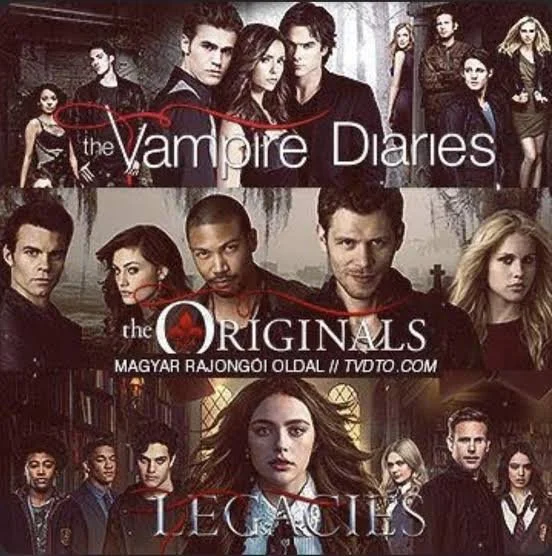
That is the god-jump. It is fantasy's jumping the shark. And the three shows that prove it are The Vampire Diaries, The Originals, and Legacies, because between them they ran 17 seasons and 331 episodes over 13 years, and they jumped the shark in three different ways.
The Vampire Diaries
The Vampire Diaries ran eight seasons and 171 episodes on The CW, from 2009 to 2017. It started as a teen vampire soap based on L.J. Smith's books, created by Kevin Williamson and Julie Plec, and it became a universe. Elena Gilbert, a human girl in Mystic Falls, caught between two vampire brothers, Stefan and Damon Salvatore. That is the premise. It is small. It is a love triangle in a small town with vampires in it. And for the first few seasons, it worked.
The early seasons are the show at its best. Katherine Pierce, the doppelganger, is a great villain because she is personal. The Originals, the first vampires, are a great escalation because they are still vampires, just older and stronger. Silas, in season 4, is a great villain because he is tied to the doppelganger mythology the show had been building. The show knew how to raise the stakes without breaking its own rules. Every new threat was bigger, but it was still the same kind of thing. A vampire. A witch. A werewolf. A hybrid. The ceiling held.
Then the ceiling broke. Season 8 brought in Cade, whose full name is Arcadius, the creator and ruler of Hell. Not a vampire. Not a witch. The Devil, more or less, a psychic who created Hell after being betrayed and executed, and who spent centuries damning souls. He turned Sybil and Seline into sirens. He dragged the denizens of the Other Side into Hell when it collapsed. He wanted Stefan and Damon as his servants. He is a god, or close enough that the difference does not matter.
Cade is the god-jump, and it is the worst kind, because the show had already told its story. Elena was gone. Nina Dobrev had left after season 6. The Other Side, the show's afterlife, had been destroyed. The show had reached its natural conclusion and its big bad, and the network wanted one more season. So the writers brought in the Devil. It is not that Cade is a bad character. It is that he does not belong in this show. Mystic Falls is a small town. The show is about two brothers and a girl. The Devil is too big for it. The show had to bend itself around him, and you can feel it bending.
That said, The Vampire Diaries earned a lot of goodwill. The first four seasons are genuinely good television, fast, funny, romantic, and willing to kill characters. Damon Salvatore is one of the great TV antiheroes, and Ian Somerhalder knew exactly what he was doing. The show's best trick was that it never pretended to be prestige television. It was a soap, and it was a great soap. It just stayed too long, and when it stayed too long, it brought in a god.
The Originals
The Originals ran five seasons and 92 episodes on The CW, from 2013 to 2018. It is a spinoff about the Mikaelson family, the Original vampires, in New Orleans. Klaus, Elijah, Rebekah, and the rest, trying to take back the city and hold their family together. The theme is family. The family motto is always and forever. That is the show. It is about whether a family of monsters can keep a promise to each other.
The Originals is the strongest of the three shows, because the theme holds it together. The villains are tied to the family. Esther, the mother who created vampires and then tried to undo them. Dahlia, the aunt who wants Hope. The Strix, the ancient vampire society. Lucien, the first vampire Klaus ever turned. Every threat is personal. Every threat is about the family. The show is darker and more serious than The Vampire Diaries, and it is better for it.
Then season 4 brought in the Hollow. Inadu, an ancient witch, a spirit so powerful she created the werewolf curse in her dying moments, and who returns to New Orleans to gather a cult and resurrect herself through the sacrifice of a powerful immortal. She is not a vampire. She is not a witch in the normal sense. She is a force, a godlike spirit, and she is the god-jump.
The Hollow is the most forgivable of the three god-jumps, and the reason is that she is tied to the family. She created the werewolf curse, and the werewolf curse is Hayley's story and Hope's story. She is connected to the Mikaelsons' past. The show does the work to make her feel like she belongs, even if she is bigger than anything that came before. It is still a god-jump. The show's ceiling was vampires and witches, and the Hollow is above that. But it is the god-jump done with the most care, because the writers tied her to the theme. Family. Always and forever. Even the god is about the family.
Legacies
Legacies ran four seasons and 68 episodes on The CW, from 2018 to 2022. It is a spinoff about the Salvatore School for the Young and Gifted, a boarding school in Mystic Falls for young vampires, werewolves, and witches. Hope Mikaelson, Klaus's daughter, a tribrid, witch, werewolf, and vampire, is the lead. The show is lighter than the other two. It is fun. It is a monster-of-the-week show, with Malivore, a pit that eats monsters and erases them from memory, as the big bad. The monsters are the point. A dragon. A gargoyle. A unicorn. A leprechaun. The show knows it is silly, and it leans into it.
Then season 4 brought in the gods. Ken, the father of the gods, heavily implied to be Zeus himself, wakes up and wages war on the supernatural world. He is the king of the gods, the father of Ben, who is Prometheus, and Jen, who is Vulcan. He is arrogant and bloodthirsty. He wants to conquer the world again and dethrone Hope as the most powerful being. He is on another level beyond all previous villains in the universe. He is a god.
Ken is the worst god-jump of the three, and it is not close. The reason is the size of the gap. Legacies is the smallest show of the three. It is a school. The premise is a boarding school for supernatural teenagers. The villains are monsters. Malivore is a pit. And then, in the final season, literal gods walk in. The show's ceiling was a school, and the gods are above that by so much that the show cannot hold them. Ken is behind the deaths of five major characters. He triggers the werewolf curse across the school, forcing students to transform and attack their allies. He is too big for the show, and the show knows it, because it has to give him a weakness, siphoning and a God Spear, just to make him beatable. A god who can be killed by a spear is not a god. He is a bigger bad with a god label on him.
Legacies is the purest case because it is the clearest example of the pattern. The show reached its natural conclusion and its big bad, Malivore, and the ratings were still good, and the network wanted another season. So the writers brought in gods. It is not that the gods are a bad idea. It is that they do not belong in this show. A school for supernatural teenagers does not need Zeus. It needs a better monster.
The test
So how do you tell if a god is an import or earned? The test is simple. Was the show's cosmology closed at the premise? If the show started with vampires, werewolves, and witches, and nothing above that, then a god is an import. If the show started with gods, or seeded them, then a god is earned.
Supernatural is the exception that proves the test. It ran 15 seasons, from 2005 to 2020, and it started with demons. The pilot is about a demon, Azazel, the Yellow-Eyed Demon, who killed Sam and Dean's mother. Demons are in the premise. Angels show up in season 4, with Castiel. God shows up in season 11, as Chuck. The Darkness, God's sister, shows up in season 11. The show climbs the hierarchy, demons to angels to God, but climbing the hierarchy was the premise from the start. The show is about two brothers who hunt the supernatural, and the supernatural keeps getting bigger. That is not a god-jump. That is the show.
The jump is when the premise was closed and the god is an import. The Vampire Diaries started with vampires in a small town. The Originals started with a vampire family in New Orleans. Legacies started with a school. None of them started with gods. So when the gods show up, they are imports. They are the shark.
The TV Tropes name for the pattern is Serial Escalation, and the general term is power creep. The god-jump is what Serial Escalation looks like when a fantasy show runs out of ceiling. Every threat has to be bigger than the last one, and when the last one was the Devil, or the creator of the werewolf curse, the only thing left is a god.
The shows that did it right
Not every god is a jump. Some shows did it right, or led up to it, and the difference is whether the god was in the premise, seeded, or tied to the theme.
Buffy the Vampire Slayer did it right with Glory. Glory is a hell god, the villain of season 5, and she works because season 5 is about family and sacrifice. Buffy becomes a mother figure to her sister Dawn, who is the Key, a mystical energy Glory needs to get home. Glory is a god trying to get home, and Buffy is a sister trying to protect her family. The god is tied to the theme. It is not just a bigger bad. It is a bigger bad that means something. Buffy also earned the escalation, because the ladder was gradual. The Master, then Angelus, then the Mayor, then Adam, then Glory, then the Trio and Dark Willow, then the First Evil. Each villain was bigger, but each was tied to the season's theme. The show built the ladder. It did not just jump to the top.
The Magicians did it right because gods were in the premise. The show is about Fillory, a magical world from a series of fantasy books, and Fillory has gods. Ember and Umber, the Ram-headed gods of Fillory, Ember the god of Chaos and Umber the god of Order, created Fillory. Ember shows up in season 1. Reynard the Fox, a god, shows up in season 1. The Old Gods shut off magic in season 4 after Ember and Umber die. The gods are not an import. They are the point. The Magicians is a deconstruction of escapist fantasy, and gods are part of what it is deconstructing. When Hades shows up in season 5, sitting in a garage playing video games because he quit ruling the Underworld after Persephone died, it works, because the show had been building to the Underworld for years, and because the show's joke is that gods are as messed up as everyone else.
Lucifer did it right because the Devil was the premise. The show starts with Lucifer Morningstar, the Devil, leaving Hell to run a nightclub in Los Angeles. God shows up in season 5, played by Dennis Haysbert, and it works, because the show had been building to God for five seasons. The whole show is about Lucifer's relationship with his father. God is not an import. He is the point.
Once Upon a Time did it better than most with Hades. Hades is the villain of season 5B, the Underworld arc, and it works better than Cade or Ken, because the Underworld arc had a clear emotional reason. The heroes go to the Underworld to save Hook, who died, and to resolve unfinished business. Hades is the ruler of the Underworld, so he belongs there. The show went to him. He did not just show up. That is the difference. When the heroes go to the god, it is a journey. When the god comes to the heroes because the show needed a bigger bad, it is a jump.
Game of Thrones led up to it. The Night King and the Lord of Light were seeded from the start. The White Walkers are in the first scene of the first episode. Melisandre, the Red Priestess of R'hllor, the Lord of Light, shows up in season 2. The show spent years building the mythology. When the Night King becomes the big bad, it is not an import. It is the payoff.
Charmed had gods in the cosmology from the start. The Elders, the Whitelighters, the Avatars, the Charmed Ones themselves becoming godlike in the later seasons, it is all part of a hierarchy the show established early. The show's premise is that witches are part of a larger magical order, and that order has beings above them. So when a godlike being shows up, it is not a jump. It is the hierarchy.
True Blood is the messy middle. Lilith, a vampire god, is the villain of season 5, and it is a god-jump. But the show's mythology was always sprawling, and it had been widening the cosmology for years before Lilith arrived, with faeries, werewolves, witches, and shape-shifters piling up. Lilith is a jump, but it is a jump with a runway, which is better than a jump with no runway at all.
The pattern is clear. A god works when the god was in the premise, seeded, or tied to the theme. A god is a jump when the god is none of those things, and shows up because the show needed a bigger bad.
The verdict
So which god-jump was the worst? Legacies. Ken and the gods in season 4. It is the purest case, the biggest gap between the show's premise and the god, and it happened in the final season, when the show was already ending. The school did not need Zeus. It needed a better monster.
TVD's Cade is second. He is the Devil in a small-town soap, and the show had already told its story. The Hollow is third, the most forgivable, because the writers tied her to the family, and family is the show's theme. But she is still a god-jump. The show's ceiling was vampires and witches, and she is above that.
And Glory proves the counterpoint. A god can work. Glory works because she is tied to the theme, family and sacrifice, and because Buffy built the ladder. The god is not just a bigger bad. She is a bigger bad that means something.
That is the test. If the god was in the premise, or seeded, or tied to the theme, it is earned. If the god shows up because the show needed a bigger bad, it is the shark. The god-jump is fantasy's jumping the shark, and once you see it, you cannot unsee it.
Sources
The Vampire Diaries, The Originals, and Legacies runs and episode counts: https://fictionhorizon.com/the-vampire-diaries-the-originals-legacies/
The Vampire Diaries universe Big Bad ladder: https://tvtropes.org/pmwiki/pmwiki.php/BigBad/TheVampireDiariesUniverse
Every God in Legacies: https://screenrant.com/legacies-every-god-ken-luke-mitchell/
Serial Escalation: http://tvtropes.org/pmwiki/pmwiki.php/Main/SerialEscalation?from=SerialEscalation.RealLife
Buffy the Vampire Slayer power creep: https://screenrant.com/buffy-the-vampire-slayer-revival-villains-power-creep-problem-op-ed/
Ember, god of Fillory, The Magicians: https://themagicians.fandom.com/wiki/Ember