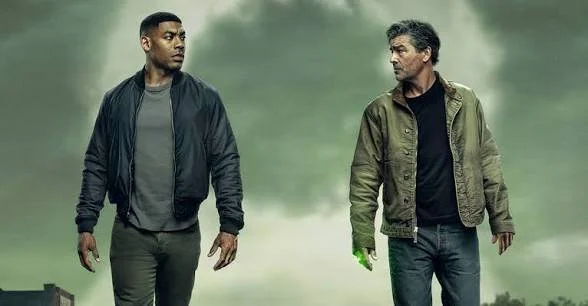
Review of Lanterns: A Darker DC Story and a Rough Landing for Hal Jordan
Review of Lanterns: A Darker DC Story and a Rough Landing for Hal Jordan
Spoilers for the full first season of Lanterns.
I finished Lanterns expecting a Green Lantern story. What I got was closer to a dark, small-town crime mystery with Green Lantern history hanging over it. That choice gives the series its own identity, but it also creates a problem: the show spends so much time rebuilding John Stewart that Hal Jordan can feel like the cost of doing it.
The darker approach reminded me of what Spider-Noir does with a familiar comic-book world: take recognizable heroes and put them in a grittier, more bruised setting. Here, the cosmic scale of the Green Lantern Corps gets pushed aside for a grounded investigation, complicated family histories and the slow transfer of a legacy. It’s a distinctive take. But I came away feeling that the series didn’t just make Hal flawed; it diminished what he represents.
Hal Jordan: mentor, legend and a character the show cuts down to size
In the comics, Hal is more than the veteran who hands a ring to the next person. He’s a test pilot, a fearless and sometimes reckless hero, and one of the most consequential Green Lanterns in DC’s history. John Stewart, introduced later, became a major Lantern in his own right and, in many comic runs, succeeded Hal as Earth’s protector. That history makes a Hal and John story an obvious opportunity to explore mentorship, rivalry and what it means to inherit a role. DC’s own comics guide points readers toward Green Lantern: Rebirth as a key part of Hal’s return and redemption.
The show chooses a much more intimate version of that handoff. Hal is guarded, damaged and difficult. The season’s final turn leaves his legacy resting heavily on John’s shoulders, and the loss is meant to make John’s choice matter. I understand the storytelling reason. Still, I wanted the series to give Hal more room to be the legendary Lantern it keeps telling us he is. For me, the result felt less like a complicated portrait of a hero and more like a dismantling of one.
And yes, I had the thought: Is this a shot at Ryan Reynolds? Reynolds’ Hal Jordan became inseparable from the 2011 film and, later, from the jokes he made about it in Deadpool. The new show’s cynical, diminished Hal can feel like another round of “remember that Green Lantern movie?” But that’s my read of the tone, not something the series has confirmed as its intent. The show’s creative team has described wrestling with how to expand comic canon while changing familiar backstory, and its Hal is built around a different, darker family legacy.
Reynolds’ movie also gave us Mark Strong’s Sinestro, a memorable performance that still hangs over any new version of the character. Ulrich Thomsen brings a different energy to Sinestro here, and he does strong work with it. But I found myself comparing the two. That comparison is hard to avoid when one interpretation made such a lasting impression even if the newer series is pursuing a very different kind of story.
John Stewart gets the transformation; I wanted more balance.
I didn’t mind the show giving John a new angle. The comics have decades of different interpretations, and the series’ version shaped by duty, restraint and personal history can stand on its own. The issue for me was proportion. John gets so much of the season’s character building that the Haland John partnership sometimes feels less like two major Lanterns meeting as equals and more like a long audition for John to replace Hal.
That emphasis pays off in the finale: John takes up the ring and becomes Earth’s Green Lantern. The ending is about his emergence, and DC has confirmed that Aaron Pierre’s John Stewart is part of the universe’s next chapter. I’m interested in seeing where this version goes. I just wish the story had made room for John’s rise without making Hal’s fall feel like the price of admission.
The burned face moment made me pause for a different reason. I immediately thought of Michael Jai White in Spawn and the practical makeup and prosthetics that helped sell his transformation. That comparison is subjective, of course, but the Lanterns effect pulled me out of the scene for a moment. It made me notice the CGI instead of staying with John’s reaction. In a show that leans on grounded performances and close-up character moments, that kind of visual choice has nowhere to hide.
How it fits into James Gunn’s DCU.
Lanterns is part of James Gunn and Peter Safran’s new DC Universe, not a separate Green Lantern continuity. The series connects with the wider story through Guy Gardner, played by Nathan Fillion, who has also appeared in Superman and Peacemaker as well as Lanterns. The show also gives context to how different Lanterns and their rings fit into the same world, while keeping its main mystery focused on Earth. DC introduced Lanterns as a story about Hal and John from the start, and its finale leaves John positioned for a continuing role.
That shared universe connection is one of the things I liked most. Fillion’s Guy Gardner is a jolt of a different DCU tone whenever he arrives: loud, abrasive and unmistakably Guy. He has enough screen time to move the story forward without taking over the show. Watching him recur across projects makes the DCU feel connected through characters, rather than just through references and cameos.
I also appreciate Fillion’s willingness to keep showing up in the story wherever Guy fits. I can’t know what decisions are being made around contracts or paychecks, but as a viewer, the effect feels refreshing: he seems committed to letting the character serve the larger plot, whether that means Superman, Peacemaker or a darker Lantern drama. His presence helps make Guy feel like a working part of this universe.
My verdict.
Lanterns is an ambitious, often compelling reinvention. I liked the darker atmosphere, the fresh perspective on John and the way Guy Gardner ties the series into Gunn’s DCU. Sinestro is strong, too, even if Mark Strong’s earlier performance remains my measuring stick.
But I’m still bothered by what the show does to Hal Jordan. A story about John becoming his own hero didn’t need to leave me feeling that Hal’s legacy had been reduced to a cautionary tale. The series wants us to see John carrying the light forward. I did. I just wish it had let Hal shine a little longer on the way out.