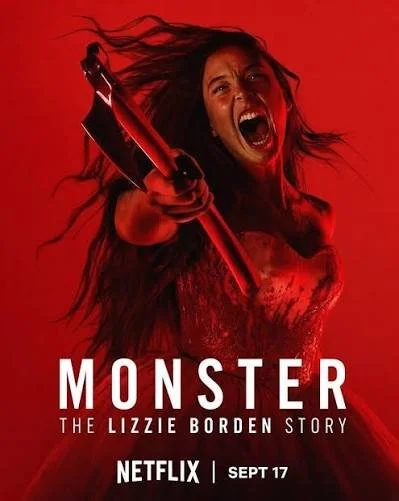
Monster: The Lizzie Borden Story thoughts
Monster: The Lizzie Borden Story thoughts
Takes Ryan Murphy’s Franchise Somewhere Completely Different
Spoilers ahead.
Monster: The Lizzie Borden Story may be the most unusual installment of Ryan Murphy and Ian Brennan’s anthology yet and that is exactly why it works.
Previous seasons largely trapped viewers inside one notorious criminal case. Lizzie Borden’s season initially appears to be doing the same thing: returning to Fall River, Massachusetts, in 1892 to dramatize the killings of Andrew and Abby Borden. Then the story begins jumping between Lizzie’s life and a more modern timeline involving Aileen Wuornos.
That was the twist I never saw coming.
Instead of merely retelling what may have happened inside the Borden house, the series examines what Lizzie eventually became: an American legend capable of influencing how later generations understood women, violence and freedom. Aileen doesn’t simply know the Borden story. She is obsessed with Lizzie, talks to her and begins seeing her as an almost supernatural companion.
That changes the entire meaning of the season. Lizzie is no longer only a woman accused of murder. She has become an idea.
Lizzie Borden and Aileen Wuornos
Sarah Paulson plays Aileen Wuornos, the real-life serial killer convicted of murdering six men in Florida and executed in 2002. In the series, Aileen worships Lizzie and even stays at the former Borden house, where she begins interacting with her idol across time.
It is a fascinating connection but an invented one.
There is no known evidence that Wuornos was obsessed with Borden, spoke about her as an inspiration or visited the Borden house. In fact, the house did not begin operating as a bed-and-breakfast until 1996, when Wuornos was already incarcerated. The entire connection was constructed for the series. Ian Brennan explained that Wuornos allows the show to contrast how American society viewed violent women in different periods.
That fictional device is what separates this season from the others.
Lizzie lived in a period when many people could barely accept that a respectable, churchgoing Victorian woman might be capable of committing such a brutal crime. One hundred years later, there was no similar hesitation about viewing Aileen as dangerous. The show connects the two women through anger, abuse, sexuality and their refusal or inability to remain inside the roles society assigned them.
Sarah Paulson is perfect for that material. As one of Murphy’s most trusted collaborators, she knows how to play a person who is simultaneously frightening, wounded, theatrical and painfully human. Aileen’s conversations with Lizzie are not history. They are the show’s argument about history.
The ending, with Lizzie and Maggie appearing to Aileen after her execution, completes that idea. Whether interpreted as an afterlife, a dying hallucination or pure symbolism, Aileen is finally welcomed by the woman she turned into her patron saint.
The real Lizzie Borden case
The actual murders occurred on August 4, 1892.
Andrew Borden was found dead on a sofa inside his Fall River home. His wife and Lizzie’s stepmother, Abby Borden, was discovered upstairs. Both had been attacked with a hatchet-like weapon.
Lizzie, then 32 years old, quickly became the primary suspect. Prosecutors relied on several pieces of circumstantial evidence:
Lizzie reportedly had a strained relationship with Abby.
The family had been arguing about Andrew’s property and financial decisions.
A pharmacist claimed Lizzie had attempted to purchase prussic acid shortly before the killings.
Lizzie gave inconsistent accounts of where she had been.
She burned a dress several days after the murders.
Investigators recovered a hatchet head from the basement.
But the prosecution had serious problems. There was no direct eyewitness, no definitive murder weapon and no convincing blood evidence connecting Lizzie to the attacks. Some important evidence was excluded from trial, including her inquest testimony and testimony concerning the alleged poison purchase.
Gender and social class also mattered. Many jurors found it difficult to believe that a respectable woman from a prominent family could inflict that degree of violence. After approximately 90 minutes of deliberation, Lizzie was acquitted on June 20, 1893. No one else was ever charged, and the murders remain officially unsolved. The Fall River Historical Society preserves materials connected to the case and emphasizes that, whatever later generations may believe, Borden was acquitted through the legal process.
Even the famous rhyme is wrong. Abby and Andrew were not struck 40 and 41 times. Historical accounts generally place the combined number of wounds at approximately 29.
Lizzie and her sister Emma subsequently purchased a large home called Maplecroft. The sisters eventually became estranged, reportedly after disagreements surrounding Lizzie’s lifestyle and her friendship with actress Nance O’Neil. Lizzie remained in Fall River until her death in 1927, but an acquittal could not erase the public verdict against her.
What the series invented
Murphy and Brennan are not presenting a documentary, and this season takes particularly large liberties with the historical record.
The relationship between Lizzie and the family’s Irish maid, Bridget “Maggie” Sullivan, is heavily fictionalized. There is no reliable evidence establishing the sexual relationship or murder conspiracy portrayed in the series. Likewise, the Aileen Wuornos material, the supernatural conversations and many of the show’s incidents involving Nance O’Neil were created or greatly expanded for dramatic purposes.
Vicky Krieps also plays Elizabeth Báthory, the Hungarian noblewoman accused of torturing and murdering numerous girls and young women centuries before Lizzie’s birth. Báthory’s alleged crimes are themselves surrounded by exaggeration, folklore and political questions. There is no historical connection between Báthory and Borden. She functions as another link in the series’ chain of feared, mythologized and possibly misunderstood violent women.
The series therefore does something intentionally different from a conventional true-crime reconstruction. It mixes:
Established history
Longstanding Borden theories
Queer historical speculation
Gothic horror
Hallucination
Feminist revenge fantasy
Commentary about how criminals become cultural icons
That approach will frustrate anyone expecting a precise reconstruction. But as a piece of Ryan Murphy television, it is arguably more ambitious than simply showing us who swung the axe.
The cast
Ella Beatty carries the season as Lizzie Borden. The daughter of Warren Beatty and Annette Bening, she previously appeared in Murphy’s Feud: Capote vs. The Swans. This is a far larger showcase, requiring her to play Lizzie as repressed daughter, lover, potential murderer, courtroom performer and eventually self-created legend.
The remainder of the principal cast includes:
Actor
Character
Ella Beatty
Lizzie Borden
Vicky Krieps
Bridget “Maggie” Sullivan and Elizabeth Báthory
Sarah Paulson
Aileen Wuornos
Charlie Hunnam
Andrew Borden
Rebecca Hall
Abby Borden
Billie Lourd
Emma Borden
Jessica Barden
Nance O’Neil
Joey Pollari
John Morse
The casting also connects the season to Murphy’s larger repertory company. Paulson and Lourd are strongly associated with American Horror Story. Beatty previously worked on Feud. Krieps and Hunnam appeared in the preceding Monster installment about Ed Gein.
Netflix’s official cast guide describes Lizzie as the franchise’s first female central “monster,” although the show deliberately complicates what that label means.
How it differs from the previous
Monster
seasons
Season
Subject
Principal performers
Primary approach
Dahmer – Monster: The Jeffrey Dahmer Story
Jeffrey Dahmer
Evan Peters, Niecy Nash-Betts, Richard Jenkins, Molly Ringwald
A grim reconstruction emphasizing Dahmer’s victims, his neighbors and institutional failures
Monsters: The Lyle and Erik Menendez Story
Lyle and Erik Menendez
Nicholas Alexander Chavez, Cooper Koch, Javier Bardem, Chloë Sevigny
Competing narratives about abuse, wealth, family violence, media spectacle and whether the brothers were victims, killers or both
Monster: The Ed Gein Story
Ed Gein
Charlie Hunnam, Laurie Metcalf, Suzanna Son, Tom Hollander, Olivia Williams
A study of Gein’s crimes and the way they influenced Hollywood horror, including Psycho
Monster: The Lizzie Borden Story
Lizzie Borden
Ella Beatty, Vicky Krieps, Sarah Paulson, Charlie Hunnam, Rebecca Hall
A Gothic, time-jumping examination of female rage and the transformation of a suspected killer into folklore
The Dahmer season felt claustrophobic and brutally realistic. Evan Peters nearly disappeared into the role, while Niecy Nash-Betts gave the story its moral center as Glenda Cleveland.
The Menendez season was about competing versions of the same family tragedy. Cooper Koch’s performance as Erik particularly his extended, nearly uninterrupted account of alleged abuse became its emotional centerpiece. Nicholas Alexander Chavez played Lyle with a more volatile mixture of arrogance, fear and performance, while Javier Bardem and Chloë Sevigny portrayed José and Kitty Menendez.
The Ed Gein season expanded the franchise’s focus from crime to cultural contamination: how a relatively obscure murderer and grave robber helped inspire Norman Bates, Leatherface and Buffalo Bill. Charlie Hunnam played Gein, with Laurie Metcalf as his mother, Augusta, while Tom Hollander and Olivia Williams appeared as Alfred and Alma Hitchcock.
Lizzie’s season goes further. It is not merely about a crime inspiring entertainment. It depicts a legendary woman inspiring another real murderer. It becomes a story about one “monster” imagining herself in conversation with another.
That is a major departure and, in my opinion, the creative gamble that makes the season memorable.
How Ryan Murphy got here
Ryan Murphy’s career has always been about people performing versions of themselves while hiding something uglier underneath.
His early series Popular examined status, identity and cruelty inside an American high school. Then came Nip/Tuck, the show that truly established the adult Ryan Murphy formula: beautiful surfaces, damaged people, sexual provocation, grotesque violence and questions about whether changing the outside can ever repair what is underneath.
Nip/Tuck matters enormously to understanding Monster. It proved that Murphy could take deliberately excessive material and use it to investigate identity, obsession and the American appetite for reinvention.
Then came Glee, a completely different kind of phenomenon. It combined high-school comedy, musical performance and stories about outsiders into a mainstream network hit. It also demonstrated Murphy’s ability to build recognizable repertory casts and transform actors into cultural figures.
In 2011, Murphy and Brad Falchuk launched American Horror Story. That anthology changed the direction of his career. Each season allowed Murphy to retain familiar actors while constructing an entirely different world. Jessica Lange, Sarah Paulson, Evan Peters, Angela Bassett, Kathy Bates, Lily Rabe, Frances Conroy and Denis O’Hare became part of an unofficial theatrical company.
AHS also perfected several ideas that now define Monster:
American history can be treated as horror.
Real people and invented characters can occupy the same story.
Trauma, sexuality and violence can become visually extravagant.
Actors can return in entirely different roles.
The real monster is frequently the culture surrounding the crime.
Murphy carried that anthology model into American Crime Story. The People v. O.J. Simpson examined race, celebrity, policing and television. The Assassination of Gianni Versace treated a murder spree as a story about sexuality, fame and institutional indifference. Impeachment revisited the Clinton-Lewinsky scandal through the women whose lives were consumed by it.
Other major Murphy projects including Pose, Feud, Scream Queens, Ratched, The Watcher, Hollywood and 9-1-1 continued developing different pieces of the same creative machinery.
By the time Monster arrived, Murphy already had:
The body horror of Nip/Tuck
The recurring performers of American Horror Story
The historical reframing of American Crime Story
The competing female perspectives of Feud
The camp, queerness and theatricality running throughout his career
A willingness to make the audience uncomfortable about whose story it is consuming
Final verdict
Monster: The Lizzie Borden Story is not the most historically faithful season. It may, however, be the season that best understands how history becomes mythology.
Ella Beatty gives the series a compelling central performance, Vicky Krieps makes Maggie far more than a supporting character, and Sarah Paulson turns what initially appears to be a disconnected Aileen Wuornos subplot into the key to the entire season.
The modern timeline does not tell us what happened in the Borden house. It tells us what happened to Lizzie afterward: she stopped belonging exclusively to history. She became a rhyme, a symbol, a tourist attraction, a fantasy and, within the show, an imaginary companion to another infamous woman.
Dahmer was about the monster people failed to stop. The Menendez season questioned who the monsters actually were. Ed Gein showed a monster being transformed into entertainment.
Lizzie Borden shows the monster becoming immortal.