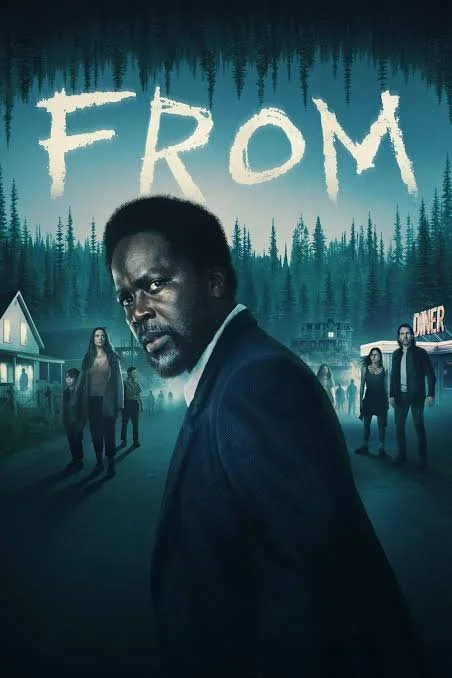
FROM Seasons 1 to 3 Review: The Town You Cannot Leave, and Why It Belongs Next to Dark
F'nAround review. Spoilers for FROM Seasons 1 to 3, and for Dark Seasons 1 to 3, throughout.
The short version, no spoilers first
FROM is a science fiction horror series on MGM+, created by John Griffin, with Jeff Pinkner as showrunner and Jack Bender as director and executive producer. Season 1 premiered on February 20, 2022, when the network was still called Epix. Season 2 followed on April 23, 2023, and Season 3 on September 22, 2024. Each of those seasons has 10 episodes, so the first three seasons are 30 episodes in total.
Seasons 1 to 3 are now also on Netflix in the United States, after arriving on October 19, 2026. Season 4 aired on MGM+ in 2026 and is not part of this review. This article stops at the Season 3 finale, because that is where the story changes from a survival mystery into something much older and much darker.
The premise is simple and cruel. People drive into an ordinary looking American town and discover that every road out leads back in. By day, the town looks almost normal. By night, creatures come out of the forest. They look like people, they smile, and they will kill anyone who is not inside a building protected by a talisman. Nobody knows why the town exists, why the creatures hunt, or why some people see things others cannot. That not knowing is the engine of the show.
Why it works is not just the monsters. It is the rules. The talismans work, but only if a door or window stays shut. Food appears, but it is never quite enough to feel safe. Answers arrive, but they cost someone. FROM trusts its audience to sit in that discomfort, and it rewards patience with answers that actually change what came before.
Spoiler warning
Everything after this point spoils Seasons 1 to 3, including a major death in the Season 3 finale. If you have not watched yet, stop here, watch the first three seasons, and come back.
Season 1: learning how to stay alive
Season 1 arrives with the Matthews family. Jim and Tabitha Matthews, their daughter Julie, and their son Ethan are on a road trip when a detour road takes them into town. Through their eyes, the show teaches its rules. The talismans. The curfew. The faces at the windows. The fact that the town does not negotiate.
Boyd Stevens, played by Harold Perrineau, is the town sheriff and de facto mayor. He is a retired Army veteran who holds a frightened community together with routine, rules, and blunt honesty. His son Ellis lives at Colony House, a separate community led by Donna, where residents try to live more freely and pay for it in other ways.
Other early residents include Kenny Liu, the deputy who becomes the town conscience in many ways, Kristi Miller, the town doctor, Jade Herrera, a wealthy and abrasive newcomer who refuses to believe any of it at first, and Sara Myers, a young woman who hears voices telling her to do terrible things. Victor Kavanaugh is already there, a man who has been in town since he was a boy and remembers more than he can put into words.
Tabitha cannot leave the place alone. She digs under her house and finds tunnels beneath the town. The season also introduces the Boy in White, a child in white clothes who appears to certain residents, and the Faraway Trees, trees that act as portals to other places, but never to a place you chose.
The finale turns the whole show. The Boy in White tells Sara to push Boyd into a Faraway Tree, and she does. Boyd drops down a shaft into darkness. Back in town, a bus full of new arrivals rolls in. Season 1 is about survival. Season 2 is about what survival costs.
Season 2: the town fights back
Season 2 starts with chaos. The bus arrivals do not believe the rules, and many of them die on their first night. That is not just shock value. It resets the town. Food, shelter, trust, and patience all run short at once.
Boyd comes out of the Faraway Tree in a dungeon, where a starving Marine named Martin is chained to a wall. Martin warns him about a music box, cuts Boyd's arm, and passes him his blood. The blood carries parasites that live under Boyd's skin from then on. Boyd comes to believe those parasites could be a weapon against the creatures. Later in the season, he does what nobody in town had managed before. He kills one of the creatures, the one known as Smiley.
Meanwhile, Tabitha is transported to the top of a lighthouse, and the Boy in White pushes her out of a window. She wakes up in a hospital in Camden, Maine, outside the town. For the first time, the show proves that leaving is possible. It does not prove that leaving is permanent. That distinction matters, and Season 3 makes it hurt.
Season 2 also deepens the mythology. The tunnels, the bottles, the symbols, and the visions stop being background decoration and start forming a pattern. The town is not just a trap. It is a place with a history, and that history has victims who were there long before Boyd or the Matthews family arrived.
Season 3: the answers begin, and they are terrible
Season 3 opens with the creatures killing Tian-Chen Liu in front of Boyd, slowly and deliberately. It sets the tone for a season where psychological damage matters as much as physical danger. The town is not just trying to kill its residents. It is trying to break them.
Outside the town, Tabitha tracks down Victor's father, Henry, and learns that Victor's mother, Miranda, knew far more about the town than anyone realised. Her paintings even include the Man in Yellow. Henry comes back into town with Tabitha, which means the past is no longer just a story Victor tells. It is walking around again.
Inside the town, the season delivers its biggest revelation. Fatima's sudden pregnancy turns out to be Smiley being reborn. The creature Boyd killed in Season 2 does not stay dead. Then the show explains what the creatures are. They were people once, adults who sacrificed the town's children in exchange for eternal life. That is what eternal life turned out to mean. They do not age, but they are bound to the night, to the forest, and to the hunger that made the bargain.
The finale cracks the biggest door. The numbers on the bottle tree turn out to be music. Jade plays the tune on a violin, the ghost children come, and Tabitha and Jade realise they have been here before. In an earlier cycle, Tabitha was Miranda, Victor's mother, and Jade was Christopher, two people who tried to save the children and failed. Their very first selves were the parents of one of those children, and the tune on the violin is the lullaby they sang to her.
Julie learns she is what Ethan calls a story walker, someone who can visit chapters of the story that already happened but cannot change them. It was Julie, all along, who threw Boyd the rope in the dungeon. That is a perfect FROM twist. It does not fix anything. It explains something you already saw, and it makes it sadder.
The season ends with the Man in Yellow stepping out of the dark to kill Jim in front of Julie, after telling him his wife should not have dug that hole. Jim is the first loss from the Matthews family, and the first major death that feels like a punishment for understanding too much. Knowledge, in this town, comes at a cost. That line is not a slogan. It is the plot.
The cast of FROM, and where you know them from
Harold Perrineau plays Boyd Stevens. Perrineau is best known as Michael Dawson in Lost, as Link in The Matrix Reloaded and The Matrix Revolutions, and as Mercutio in Baz Luhrmann's Romeo and Juliet. He also played Augustus Hill in HBO's Oz, which makes him the direct link between the two articles in this pair. In FROM, he gives Boyd authority, exhaustion, and a conscience that never fully rests.
Catalina Sandino Moreno plays Tabitha Matthews. She anchors the emotional side of the show, the mother who refuses to accept a rule just because it keeps people alive for one more night. Eion Bailey plays Jim Matthews, the husband and father who tries to solve the town like an engineering problem, and who pays for that rational approach when the town stops playing by rational rules. Bailey is also known from Band of Brothers.
David Alpay plays Jade Herrera, the rich, sarcastic newcomer who becomes one of the most important people in town, precisely because he cannot stop digging into the symbols and the music. Alpay is also known from Castle Rock. Elizabeth Saunders plays Donna Raines, the Colony House leader who protects her people with a mix of warmth and steel. Saunders is also known from Clarice.
Scott McCord plays Victor Kavanaugh, the man who survived a previous generation of the town and carries its history in drawings, memories, and fragments. Ricky He plays Kenny Liu, the deputy who grows from a loyal second in command into a moral centre of the town. He is also known from The Good Doctor. Chloe Van Landschoot plays Kristi Miller, the town doctor who has to make medical decisions with almost no supplies and no outside help.
Pegah Ghafoori plays Fatima Hassan, Ellis's partner, whose Season 3 story becomes central to the creature mythology. Corteon Moore plays Ellis Stevens, Boyd's son, who chose Colony House over his father's rules. Moore is also known from Utopia Falls. Hannah Cheramy plays Julie Matthews, whose story walker ability becomes crucial in Season 3. Simon Webster plays Ethan Matthews, the youngest Matthews child, who often sees the town more clearly than the adults do. Webster is also known from Strays.
Avery Konrad plays Sara Myers, the young woman whose voices make her both dangerous and sympathetic. Konrad is also known from Honor Society. Shaun Majumder plays Father Khatri, the priest whose faith and pragmatism shape Season 1. Elizabeth Moy plays Tian-Chen Liu, Kenny's mother, whose Season 3 death is a turning point for Boyd. A.J. Simmons plays Randall Kirkland, one of the bus arrivals, and is also known from Reacher. Kaelen Ohm plays Marielle Sinclair, Nathan D. Simmons plays Elgin Williams, Angela Moore plays Bakta, Deborah Grover plays Tillie, Robert Joy plays Henry Kavanaugh, and Samantha Brown plays Acosta. Joy is also known from CSI: NY, and Brown from Y: The Last Man.
FROM and Dark: two towns, one trap
Dark is a German science fiction thriller on Netflix, created by Baran bo Odar and Jantje Friese. It ran for three seasons, from 2017 to 2020, with 26 episodes in total. Season 1 came out in 2017, Season 2 in 2019, and Season 3 in 2020. The story follows four families in the fictional town of Winden, Germany, after a child's disappearance exposes a time travel conspiracy spanning several generations.
The Dark cast includes Louis Hofmann as Jonas Kahnwald, Andreas Pietschmann as the adult Jonas, known as the Stranger, Dietrich Hollinderbaumer as Adam, the elder Jonas, Lisa Vicari as Martha Nielsen, Barbara Nusse as Eva, the elder Martha, Oliver Masucci as Ulrich Nielsen, Karoline Eichhorn as Charlotte Doppler, Maja Schone as Hannah Kahnwald, Mark Waschke as Noah, and Julika Jenkins as Claudia Tiedemann.
Here is the connection, and why it is more than a surface comparison. Both shows trap ordinary people in a small town that is not just a setting. Winden and the town in FROM are machines. In Dark, the machine is time. A wormhole in caves near a nuclear power plant allows travel in 33 year intervals, to 1953, 1986, 2019, and beyond. In FROM, the machine is place and cycle. Faraway Trees act as portals, the lighthouse acts as an exit that is also a return, and reincarnation acts as a loop that brings the same souls back to try again and fail again.
The portal idea is the bridge. In Dark, the cave is a door that does not care where you wanted to go. It puts you where the loop needs you. In FROM, the Faraway Tree does the same thing. Boyd enters a tree and ends up in a dungeon. Tabitha is pushed from a lighthouse and wakes up in Maine, only for the town to pull her back. Julie walks into the past and discovers she was already part of it. Both shows use portals not as a fun escape hatch, but as proof that the characters are inside a system that is bigger than them.
The underlying theme is the same, even if the horror looks different. Dark is about determinism and free will. Its central question is whether anyone can change a story that has already happened, or whether every attempt to break the loop is the thing that creates the loop. The bootstrap paradox runs through it. Objects, letters, knowledge, and even people exist only because the loop keeps passing them around. There is no clean origin point.
FROM asks the same question in a different language. Can Tabitha and Jade break a cycle they have already lived through as Miranda and Christopher, or are they just the latest version of a failed rescue? Can Julie change a story she can only visit, or is visiting the story the same as completing it? Can Boyd kill a creature, only for that creature to be reborn through someone he loves? In both shows, trying harder does not automatically mean breaking free. Sometimes trying harder is the trap.
That is why FROM feels like Dark, even though one is a German time travel thriller and the other is an American horror mystery. Both shows respect the audience enough to build a system, follow its rules, and let the characters suffer inside it. Both shows treat family as the real subject. In Dark, four families are bound by secrets, lies, and children who disappear. In FROM, one family arrives together and is slowly pulled apart by a town that knows exactly which thread to cut. Both shows end a season not with a monster jumping out, but with a character realising they were part of the pattern all along.
Why FROM is amazing, in plain terms
FROM is amazing because it does three things at once, and most mystery shows only manage one. First, it is scary in a simple, physical way. Night falls, the creatures smile, and a door left open is a death sentence. Second, it is a genuine mystery. The talismans, the trees, the bottles, the music, and the children all connect, and Season 3 proves the show was keeping score. Third, it is a human drama about people who have to live together after the world stops making sense. Boyd, Tabitha, Victor, and Julie are not puzzle pieces. They are people making bad choices for good reasons, and the show never lets them off the hook for it.
If you liked Dark because you wanted a show that was planned, patient, and willing to be difficult, FROM is the closest recent show to that feeling. It is not Dark with monsters. It is Dark's question, asked in a town where you cannot leave, where the past comes back as a person, and where every answer costs more than the last one did.
Watch Seasons 1 to 3 in order. Do not skip. The show rewards attention, and Season 3 only lands if you remember what Season 1 taught you about doors, trees, and digging.