
Motor City
One of the best trailers I have ever seen. Five lines of dialogue. A great soundtrack. And a lesson: you cannot have a good movie without talking.
November 14, 2026
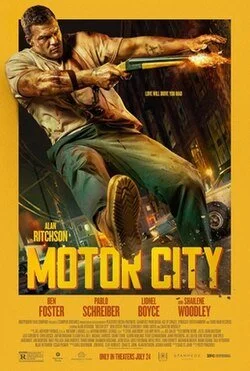
I watched one of the best trailers I have seen in a long time, and I thought, wow, I have to watch this movie. It was Motor City. The trailer had everything. A 1977 Detroit revenge story. Alan Ritchson, huge, silent, furious. A soundtrack that sounded like the whole movie was scored by a jukebox that only plays classics. It looked like a throwback, a 70s exploitation revenge picture with a modern action star. I was sold before the trailer ended.
Then I watched the movie, and I realized it was not a talkie. The whole movie has about five lines of dialogue. Ben Foster, who plays the villain, said it himself. Five lines in 103 minutes. One reviewer counted four. Or six, if you count a Hi and a Hello in a diner scene. The rest of the movie is action and music. No conversations. No speeches. No one explaining anything. Just fists, and songs.
The story
The story is good. That is the first thing to say. John Miller is a Vietnam veteran and an ex-con working a factory floor in 1977 Detroit. He is newly off probation. He is in love with Sophia, played by Shailene Woodley, who used to date Reynolds, a local gangster played by Ben Foster. Reynolds is jealous, so he plants drugs in Miller's Pontiac Firebird, and Miller goes to prison for a crime he did not commit. He gets out, and he wants revenge. That is the whole plot, and it is a good plot. It is a classic. A framed man, a stolen girl, a corrupt city, a reckoning. Chad St. John wrote the script in 2009, it made the Black List that year, and it spent 15 years trying to get made. You can feel the years in it, in a good way. It is a clean, mean revenge story.
The action
The fight scenes and the action are good too. That is the second thing to say. Ritchson is a physical presence, and the movie knows it. The fights are brutal and well staged, and the camera lets you see them. There is a prison escape set to the Moody Blues that is genuinely thrilling. The action does what action is supposed to do. It makes you feel something without anyone saying a word.
The problem
And here is the lesson the movie taught me. No matter how good the story is, no matter how good the plot is, no matter how good the fight scenes and the action are, you truly cannot have a good movie without dialogue. I went in thinking the silence was a gimmick, and a cool one. I came out thinking the silence is the movie's problem. Dialogue is how characters reveal themselves. It is how a relationship breathes. It is how the audience connects to the people on screen. Without it, you are watching a music video with fight scenes. The fights are great, and the songs are great, but the people in between them stay flat. The emotional moments do not land the way they should, because no one ever says what they feel. The movie is a beautiful, violent, musical object, and it is missing the thing that makes a movie a movie. People talking to each other.
The cast
The cast is strong, which makes the silence stranger. Alan Ritchson is John Miller, and he is the whole movie. He is the star of Reacher, the Amazon show where he plays Jack Reacher, and he has become one of the biggest action stars on television. He is huge, he is intense, and he barely speaks for 103 minutes, which is either a perfect use of him or a waste of him, depending on how you look at it. Shailene Woodley is Sophia, and she does a lot with very little. She is the only main female role in the film, and she is the reason the revenge matters. You know her from Divergent, from The Fault in Our Stars, from Big Little Lies. Ben Foster is Reynolds, the gangster, and he steals the show. He is slimy and charming and cruel, and he is the best thing in the movie. You know him from Hell or High Water, from Lone Survivor, from 3:10 to Yuma. Pablo Schreiber is Savick, the corrupt cop who helps Reynolds. You know him as Master Chief in Halo, as Pornstache in Orange Is the New Black, as Mad Sweeney in American Gods. Ben McKenzie is Kent, the skeptical detective watching from the sidewalk. You know him from The O.C. and Gotham. The cast also includes Lionel Boyce, from The Bear. The cast is stacked. That is part of what makes the flop so strange. It is not a bad cast. It is a good cast in a movie that does not let them talk.
The flop
And it is a flop. A big one. The movie cost a reported 30 million dollars to make. It opened on July 24, 2026, in about 1,600 theaters, and it made 1,693,905 dollars in its opening weekend. That is about 1,059 dollars per theater. Ninth place. The second weekend it fell 84 percent, to 271,544 dollars, and the theater count was cut from 1,600 to 600. After two weekends it had made about 2.5 million dollars in the United States, and about 2.7 million worldwide. Against a 30 million dollar budget. It made about a tenth of what it cost. RLJE Films had bought the U.S. rights for 3 to 4 million dollars, and even that looks like too much.
The reception was not the problem. Critics gave it 63 percent on Rotten Tomatoes, from 97 reviews, and a 63 on Metacritic, which is mixed to positive. Audiences were in the same range, mid-60s. Variety called it a true immersive cinematic experience. ScreenRant called it aggravatingly slow. The reviews were split, but they were not terrible. Rotten Tomatoes summed it up like this: the deliberate lack of dialogue occasionally backfires in a story that winds up running on fumes, but a rollicking soundtrack and visual panache soup up the engine enough to deliver a memorable ride. That is about right. The problem was simpler. Nobody wanted to go to a theater to watch a silent action movie. A nearly wordless revenge picture is a hard sell, no matter whose face is on the poster. And Ritchson is a TV star. Reacher is huge. But TV stardom does not automatically sell movie tickets, and Motor City proved it.
The soundtrack
Here is the part the movie gets right, and it gets it very right. The soundtrack is great. Jack White, the Detroit native, the former White Stripes frontman, is the film's music director. He curated the needle drops, and he contributed his own song, Archbishop Harold Holmes, from his 2024 album No Name. Steve Jablonsky did the original score. And because there is almost no dialogue, the songs are not decoration. They are the script. The movie has 16 songs, and the best ones do the work dialogue would normally do.
David Bowie's Cat People (Putting Out Fire) opens the film, over a car-hood action scene, and it sets the tone, dread and rapture at the same time. Fleetwood Mac's The Chain plays while the cops open the trunk of Miller's car and pull out kilos of drugs, and the song's slow build to that exploding climax turns a drug bust into opera. Donna Summer's I Feel Love scores Miller's jealous fantasies. The Moody Blues' Nights in White Satin carries the prison escape. Bill Withers' Lovely Day is in there too. These are great songs, and they are used well, which is why the soundtrack is the best thing about the movie. Some critics said the songs are overfamiliar, that they have been used in other, better films, and that is fair. Cat People belongs to Cat People and to Inglourious Basterds, and The Chain is everywhere. But overfamiliar or not, the songs work here, because they are doing the job of the dialogue. They tell you what the characters feel, because the characters never say it.
The one miss is that the songs drop out in the final act, and Jablonsky's electronic score takes over, which feels like a violation of the movie's own rule. The film spent 90 minutes teaching you that the songs are the dialogue, and then it stops talking.
The coda
The flop has a coda, though. The movie died in theaters, and then it found its audience at home. It went to digital in August, and it climbed to number nine on Apple TV and cracked Amazon's top 10. It started streaming on AMC+ on November 6, and by November 12 it was the number one movie in the world on AMC+. A silent action movie is a hard sell in a theater, where you are paying to sit in the dark with strangers. At home, on your couch, it is a different proposition. You can turn it up, enjoy the music and the fights, and not worry about the silence. The audience was there. It just did not want to go to the theater for it.
The verdict
So is it worth watching? Yes, but know what you are getting. The trailer is better than the movie, and that is the honest truth. The trailer promised a great revenge picture, and the movie delivers a great soundtrack and great fights wrapped around a story that never quite becomes a movie, because no one talks. Watch it at home. Turn it up. Enjoy Bowie and Fleetwood Mac and Donna Summer and the Moody Blues. Enjoy Ritchson beating people up. Enjoy Ben Foster being slimy. But do not expect the movie the trailer sold you. The movie taught me something I did not expect to learn from a revenge picture. You can have a good story, a good plot, and great fights, and still not have a good movie. You need dialogue. People have to talk to each other. That is what makes a movie a movie, and Motor City is the proof, because it has everything except the talking, and everything is not enough.
Sources
Motor City (film), Wikipedia: https://en.wikipedia.org/wiki/Motor_City_(film)
Motor City box office, ComingSoon: https://www.comingsoon.net/movies/news/2170913-alan-ritchson-silent-movie-motor-city-box-office-crash-burn
Motor City reviews, Metacritic: https://www.metacritic.com/movie/motor-city
Motor City soundtrack and digital, TechTimes: https://www.techtimes.com/articles/325818/20260827/motor-city-goes-digital-ritchsons-wordless-thriller-brain-science-explains.htm
Motor City review, Slant Magazine: https://www.slantmagazine.com/film/motor-city-review-shailene-woodley-ben-foster/
Motor City review, soundtrack and dialogue count, altfg: https://www.altfg.com/motor-city-2025-movie-review/
Motor City No. 1 on AMC+, Men's Journal: https://www.mensjournal.com/news/alan-ritchson-action-thriller-motor-city-is-officially-the-no-1-movie-in-the-world-on-amc-plus