
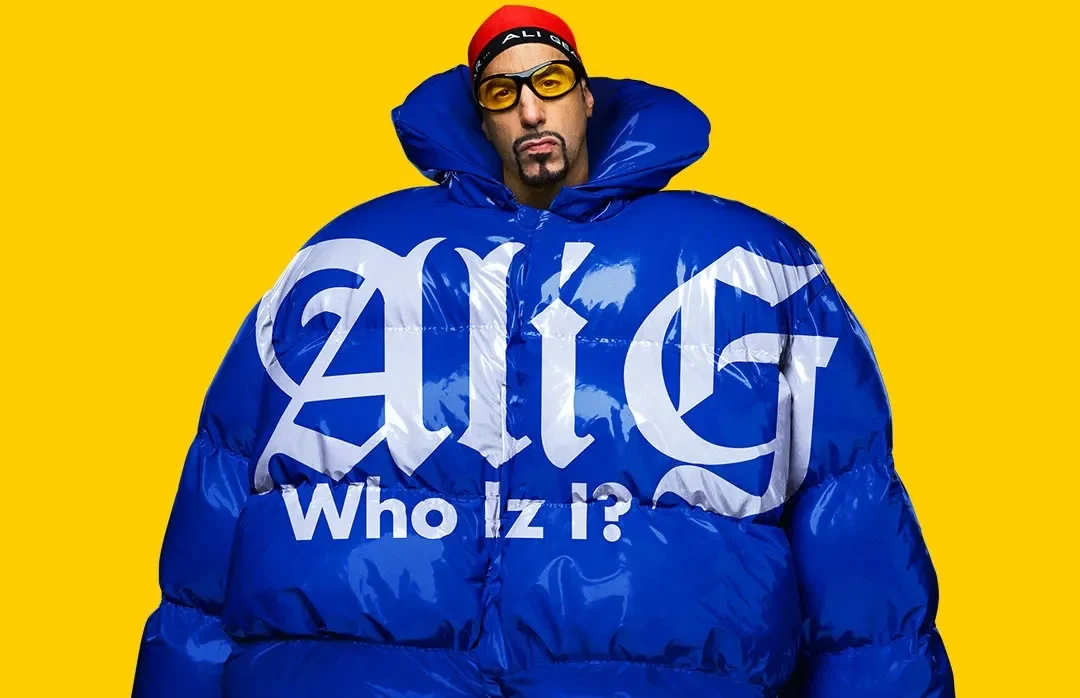
Ali G: Who Iz I?
The movie is lackluster. The stunt is the story. And Sacha Baron Cohen is chasing a high he already had.
November 15, 2026
Ali G is back. Twenty-two years after the end of Da Ali G Show, and twenty-four years after Ali G Indahouse, Sacha Baron Cohen brought his first character back for a new movie, Ali G: Who Iz I? It opened in 125 theaters on October 23, 2026, played for two days, and was on Prime Video five days later. It made about 2.3 million dollars worldwide. Critics gave it 39 percent on Rotten Tomatoes. It is a flop. And the funniest part about it is not the movie. It is the fact that they convinced a Republican Party chairman to kidnap a pregnant woman and almost kill what he thought was a baby. That is the wow moment. That is the movie. The rest of it is just the setup.
The movie
Here is what the movie is. Ali G is older now, and his girlfriend Julie, played by Morgana Robinson, is eight months pregnant. He finds a fax from HBO inviting him back, but it is from 2004 and it has expired. So he goes to America to reclaim his fame, test TikTok and OnlyFans, and search for his father. Out of options, he agrees to host a racist television show for Dirk Visser, a South African former arms dealer and producer. The show features cameos from real people: Kari Lake, Newt Gingrich, and George Santos. And Cohen brings back two of his own characters from Who Is America? as the twist. Dr. Nira Cain-N'Degeocello, a professor of Afro diasporic ethnomusicology, is the antagonist, determined to bring Ali G down for cultural appropriation and to debunk his claim to be black and the son of A$AP Rocky. Col. Erran Morad, the Israeli anti-terrorism expert, is back too. The last 30 minutes of the movie turn into an action film. Cohen spent 3 million dollars of his own money filming the final sequence, an eight-hour continuous shot over multiple locations. It is his directorial debut, and you can tell.
The humor is lackluster. That is the honest word for it. The first half follows the formula he has used for twenty years: gather an unsuspecting audience, antagonize them or try to shock them, and record their reactions. But the formula is tired now. The jokes do not land the way they used to, because the character is from another era and the world moved on. One reviewer gave it 3 out of 10 and said it aims for Borat but does not come anywhere close. Another called it painfully unfunny at some points and disturbing at others. The Guardian gave it 2 out of 5. The reviews were mostly negative, and the release tells you what Amazon thought of it. The theatrical window was cut to a few days in a handful of theaters, and then it was dumped on Prime. It hit number one on Prime Video's movie chart in ten countries, including the United States, which says the audience was there, just not in theaters. But a streaming hit does not fix a movie that does not work.
The experiment
Now the part that matters. The funniest thing in this movie is not a joke. It is an experiment. Col. Erran Morad recruits a group of right-wing zealots for a fake anti-terrorism training, to form a citizens warrior force to protect the American border. One of the recruits is Michael Aboud, the chair of the El Paso County Republican Party. Another is Joshua Loudermilk, a 54-year-old aspiring actor and former preacher from North Carolina. Morad trains them in self-defense, including wearing protective plastic buttocks over their clothes. The buttocks are a gun. That is the level of the training.
Then Morad sends them on a mission. The mission is to stop the birth on American soil of the baby of a fictional South American drug kingpin. Aboud and Loudermilk abduct the kingpin's heavily pregnant girlfriend in a fake ambulance. They drive her to an unstaffed medical facility, where she gives birth to a lifelike prosthetic baby. They abandon her. Morad puts the baby in a zipped bag, and they drive it toward the Mexican border to deliver it by drone. And then Aboud takes the decision to drop the baby from the drone, from a great height, into Mexico, rather than let it touch American soil. He is told to kill it. He does it. The baby is a prop. The scenario is fictional. The text on the screen says Aboud and Loudermilk were not aware it was a hoax.
Aboud says he was told the project would be a documentary about border crossings. He says he did not know it was satirical until The Guardian contacted him. He called Cohen a liar and a pervert, and he said he plans to sue him. When asked if he knew the kidnapping and the dropping of the baby were staged, he said no, it was heavily edited. When pressed further, he said there was never a baby, so to think or imply there was is very bad journalism. He has threatened to sue, but as far as the record shows, he has not filed anything yet.
And then there is the twist inside the twist. Joshua Loudermilk says he was in on the joke the whole time. He says he recognized Cohen early in the shoot, and he kept pretending to be a hard-right MAGA sympathizer prepared to defend the border at all costs, because he wanted to trick Cohen back. He says he spotted the recruitment post on Craigslist in September 2025, from a group called the American Citizen Initiative. The film's representatives say Loudermilk was not in on it. The film itself stresses, repeatedly, that neither man was in on it. So either Loudermilk is telling the truth and he outplayed the great prankster, or he is lying after the fact because he liked the attention. Either way, it is a perfect ending to the story, because the movie is about people tricking each other, and now nobody can agree on who tricked whom.
That is the wow moment. Not a joke. An experiment. They convinced a politician to kidnap a pregnant woman and almost kill what he thought was a baby, because he believed it would keep the baby from becoming an American citizen. The humor is lackluster, but that moment is not funny. It is chilling, and it is the whole point of what Cohen does. He does not write jokes. He builds a situation and lets people show you who they are.
The career
To understand why this movie feels like a comedown, you have to go back to the start. Ali G was Cohen's first character, a white British suburban kid pretending to be a gangster rapper, created on The 11 O'Clock Show in the late 1990s and then on Da Ali G Show, which ran on HBO from 2000 to 2004. The show was famous for prank interviews that made people like Buzz Aldrin and Boutros Boutros-Ghali very uncomfortable. Ali G Indahouse, the first movie, came out in 2002. It was a scripted comedy, no mockumentary, no real people. Ali G saves his leisure center, gets elected as an MP, and becomes a pawn in a conspiracy. Michael Gambon played the Prime Minister. Charles Dance played the Deputy Prime Minister. Martin Freeman was Ricky C. It cost 5 million pounds and made 17.2 million pounds worldwide. It opened at number one in the UK. The reviews were mixed, but it was a hit, and it proved the character could carry a movie.
Then came Borat, and that was the global debut. Borat: Cultural Learnings of America for Make Benefit Glorious Nation of Kazakhstan came out in 2006, and it made Cohen a star all over the world. It cost 18 million dollars and made 262 million dollars worldwide. It got 91 percent on Rotten Tomatoes. It won him a Golden Globe and got him an Oscar nomination for the screenplay. Borat was a Kazakh journalist who came to America to learn about the culture, and the joke was that America taught him exactly what he expected to learn. The frat boys. The rodeo, where he sang the Kazakhstan anthem to the tune of the American one. The dinner party. Pamela Anderson, who he tried to kidnap at a book signing. It was lightning in a bottle, because nobody knew who he was, and nobody knew what was coming.
Then came Bruno, and that was crossing the line. Bruno, from 2009, is an Austrian fashion reporter, and the movie pushed the provocation further than Borat did. Paula Abdul. Ron Paul. The swingers party. The adoption, where he tries to adopt a Black baby from Africa. The cage fight, where he kisses another man in front of a crowd of straight men who came to see a fight. It made 139 million dollars worldwide, which is a lot, but it was not Borat. It was darker, and meaner, and the joke was thinner, because the target was not American ignorance anymore. It was homophobia, and the movie made people uncomfortable in a different way, and not always in a good way.
Then came Borat 2, and that was the first time he tried to reproduce the original and missed the mark. Borat Subsequent Moviefilm came out in 2020, fourteen years after the first one, shot in secret during COVID and released on Amazon Prime. It has Maria Bakalova as Tutar, Borat's daughter, and she is the best thing in it. Her cluelessness is the closest the movie gets to the original. But the movie is too structured, too plot-driven, and too political. The Mike Pence prank, which was advertised as the biggest thing in the movie, is over in seconds. The Rudy Giuliani scene, in the hotel room with Bakalova pretending to be a journalist, is the most famous moment, and it is genuinely shocking. But the rest of it feels like a checklist of topical issues. Stormy Daniels, Jeffrey Epstein, check, check. The reviews were mostly positive, but the consensus was clear. It does not live up to the original. It is a fun movie, but it is not the lightning. It is the echo.
And in between, there was Who Is America?, the Showtime series from 2018, seven episodes, where he came back to the gotcha format with new characters. Erran Morad, the Israeli anti-terrorism expert. Dr. Nira Cain-N'Degeocello. Billy Wayne Ruddick Jr. He got Dick Cheney to sign a waterboard kit. He got Sarah Palin to walk out. He got Roy Moore to wave a fake pedophile detector over himself. That was the return to form, and it worked, because the targets were powerful people and the tricks were sharp. But it was television, and it was seven episodes, and then he went away again.
So here is the twist. Ali G started as a show and a scripted movie. Borat and Bruno were the mockumentaries, the ones with real people. Now, in Who Iz I?, Ali G has taken a twist into Borat and Bruno territory. The Ali G movie is now a mockumentary too, with cameos and live people he tricked. He brought his Who Is America? characters, Nira and Morad, into Ali G's movie. He got Kari Lake, Newt Gingrich, and George Santos to show up. He got Michael Aboud to kidnap a fake baby. The character that started as a studio comedy is now doing the Borat thing. The problem is that the Borat thing does not work as well when you are doing it with Ali G, because Ali G is not Borat. Ali G is a white guy pretending to be a rapper. Borat is a foreigner who does not understand America. The trick is different, and the Ali G trick is older, and the world has seen it before.
The gotchas
Part of what makes Cohen an artist is the catalogue. He has been tricking people for almost thirty years, and the best ones are the ones where the person shows you something real. Borat got the frat boys to say what they really thought about women and minorities, on camera, while drunk. He got a rodeo crowd in Virginia to cheer for a song about throwing Jews down a well. He got Pamela Anderson to run from him at a book signing. Bruno got Paula Abdul to sit through an interview where he showed her pictures of naked men. He got Ron Paul to walk out of an interview in a hotel room. He got a crowd at a cage fight in Arkansas to riot when he kissed another man. Who Is America? got Dick Cheney to autograph a waterboard kit. It got Sarah Palin to sit through an interview as a fake disabled veteran and then call it a scam. It got Roy Moore to hold a device that supposedly detected sex offenders, and the device beeped, and Moore did not walk out. Borat 2 got Rudy Giuliani into a hotel room with a young woman pretending to be a journalist, and the camera caught him with his hand in his pants, and Giuliani spent the next week explaining that he was tucking in his shirt. That is the art. He does not tell you what these people are. He gives them a situation, and they tell you themselves.
The lawsuits
And the lawsuits are part of the art too, because they are the proof the trick worked. Cohen has been sued eight times that we know of, and he has lost almost nothing. The two University of South Carolina frat boys from Borat sued, saying they were misled and signed releases while intoxicated. The case was dismissed. A Macedonian singer named Esma Redzepova sued over the use of her song Chaje Shukarije in Borat, and she won, but she was only awarded about 37,000 dollars, the only plaintiff who ever got paid. A Palestinian grocer named Ayman Abu Aita sued over Bruno, saying the film falsely identified him as a terrorist. That case was settled in 2012. A charity worker sued over a Bruno scene at a seniors bingo game, saying she was left disabled. That case was dismissed. Roy Moore sued for 95 million dollars over Who Is America?, saying the pedophile detector segment was defamatory. A federal judge dismissed it in 2021, because Moore had signed a consent agreement, and an appeals court upheld the dismissal in 2022. That is the record. Eight lawsuits, one small payout, and the rest dismissed or settled. The reason he wins is simple. He gets people to sign releases, and the work is satire, and satire is protected. The lawsuits do not stop him. They confirm him. The fact that people keep suing is the fact that the trick keeps working.
Now Aboud says he plans to sue. He has not filed anything yet, as far as the record shows. If he does, he will run into the same wall everyone else did. He signed something. The film says he was not in on it, and the film is satire. But the threat itself is the point. The lawsuit threat is the final beat of the joke. Cohen tricks a man into doing something terrible on camera, and the man's response is to threaten to sue the comedian, not to apologize for what he did. That is the art, and it is also the indictment.
The diminishing returns
Here is the problem, and it is the reason this movie feels sad even when it works. Cohen is grasping for the same high he had from his best, and he is not finding it. Borat was lightning in a bottle because nobody knew who he was. He could walk into a room as a Kazakh journalist and people would believe him, because they had never seen him before. Now everybody knows him. He has to wear heavier disguises. He has to work harder to get the same reaction. And the targets are more careful now, because they have seen the movies. The element of surprise is gone, and surprise was the whole engine.
So he keeps going back to the old characters, and the old characters keep giving him less. Borat 2 tried to reproduce the first Borat and missed the mark, because Borat was too famous to be Borat anymore. He had to disguise himself, and the disguises made the pranks harder, and the movie became more about the plot than the pranks. Who Iz I? tries the same thing with Ali G, and it misses further, because Ali G is even older and even more out of time. Ali G is a character from the late 1990s, a white suburban kid pretending to be a gangster rapper. The world he was satirizing does not exist anymore. The slang is dated. The joke is dated. And the movie knows it, which is why it brings in Nira and Morad and the real politicians, to give Ali G something to do. But the new characters cannot save the old one. They just remind you that Cohen has better characters, and he is not using them.
He is a brilliant actor and a brilliant artist. His comedy and his concepts are funny. The idea of tricking powerful people into revealing themselves is a great idea, and it is still a great idea. But he is reproducing at a diminishing rate. Each return gives him less than the last one. Borat gave him the world. Bruno gave him half the world. Borat 2 gave him a streaming hit and a Giuliani clip. Who Iz I? gave him a lawsuit threat and a number one on Prime Video. The returns are shrinking, and the reason is that he is bringing back characters from decades ago instead of inventing someone new.
The verdict
He needs a character for the current era. That is the honest answer. Not Ali G again. Not Borat again. Someone new, built for the world we actually live in, with TikTok and OnlyFans and the culture wars and the politicians who learned to spot him. The old characters worked because they were built for their moment. Ali G was built for the late 1990s, when a white kid from the suburbs could pretend to be a rapper and the establishment would take him seriously. Borat was built for 2006, when America was confident enough to laugh at itself and ignorant enough to prove his point. Those moments are gone. A new character would have to be built for 2026, and Cohen is the only person who could build it, because he is the only person who does what he does.
Or he could just keep acting, because he showed in Sweeney Todd that he is great at it. He played Adolfo Pirelli, the rival barber, in Tim Burton's Sweeney Todd, and he was funny and menacing and he could sing. He played Abbie Hoffman in The Trial of the Chicago 7, and he was nominated for an Oscar for it. He played Eli Cohen, the Israeli spy, in The Spy on Netflix, and he was serious and compelling. He does not need the characters to be a great actor. He is a great actor without them. The characters were the vehicle. The acting is the talent.
So the verdict is this. Who Iz I? is not a good movie. The humor is lackluster, and the Ali G character is out of time. But the Aboud experiment is the real thing, and it is the reason the movie matters, because it proves the method still works when the target is right. Cohen can still get a politician to show you who he is. He just cannot do it with Ali G anymore. He needs someone new, or he needs to put the characters down and act. Either way, stop bringing back the old ones. The high is gone. Go find a new one.
Sources
Ali G: Who Iz I? review, Consequence: https://consequence.net/2026/10/ali-g-who-iz-i-review-sacha-baron-cohen/
Ali G: Who Iz I? (2026), Wikipedia: https://en.wikipedia.org/wiki/Ali_G:_Who_Iz_I%3F
Ali G: Who Iz I? review, imjeffreyrex: https://imjeffreyrex.com/2026/10/30/ali-g-who-iz-i-2026-review/
Ali G: Who Iz I? and the Aboud incident, Calcopia Press: https://calcopia.com/ali-g-who-iz-i-2026/
El Paso GOP chair in the Ali G film, El Paso Matters: https://lasvegasnews.co/newswire/story/el-paso-matters/in-sacha-baron-cohen-satire-el-paso-gop-chair-kidnaps-pregnant-woman-abducts-and-drops-newborn-from-drone-to-save-the-white-race/
Aboud threatens to sue, ComingSoon: https://www.comingsoon.net/movies/news/2212377-sacha-baron-cohen-ali-g-movie-republican-leader-sue
Loudermilk says he was in on the joke, The Guardian via richardhartley.com: http://www.richardhartley.com/2026/10/hes-not-going-to-punk-me-ill-trick-him-ali-g-who-iz-i-stooge-says-he-was-in-on-joke-but-didnt-tell-sacha-baron-cohen/
Ali G returns, NPR: https://www.weku.org/2026-10-23/sacha-baron-cohens-ali-g-returns-to-the-big-screen-in-ali-g-who-iz-i
Sacha Baron Cohen, lawsuits and controversies, Wikipedia: https://en.wikipedia.org/wiki/Sacha_Baron_Cohen
Ali G Indahouse (2002), Wikipedia: https://en.wikipedia.org/wiki/Ali_G_Indahouse
Borat Subsequent Moviefilm review, 34th Street Magazine: http://www.34st.com/article/2020/11/borat-subsequent-moviefilm-sequel-sacha-baron-cohen-maria-bakalova-cultural-learning-america-politics-election-coronavirus
Ali G: Who Iz I? box office and streaming, SlashFilm: https://www.slashfilm.com/2302965/sacha-baron-cohen-comedy-ali-g-who-is-u-streaming-prime-video/