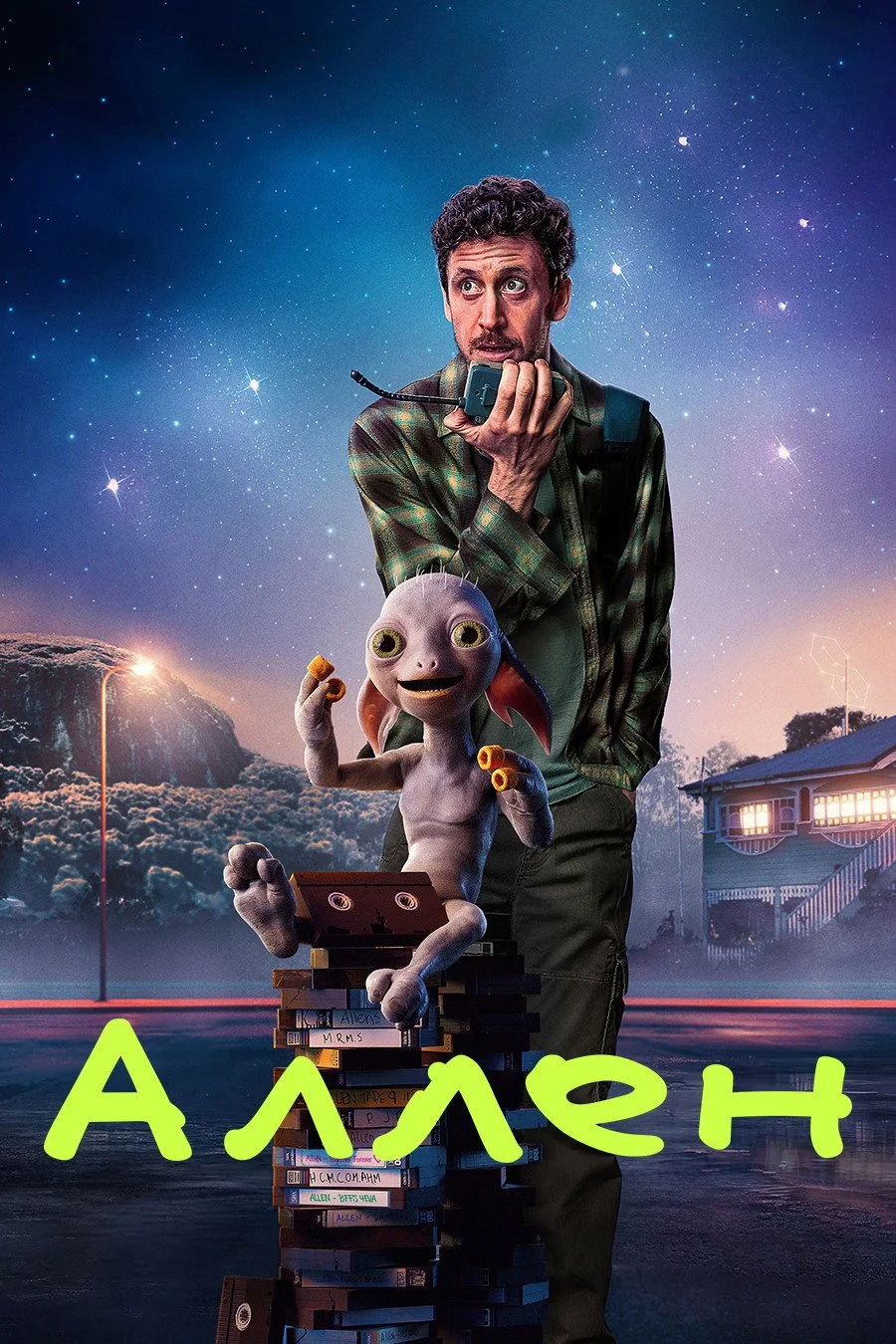
Allen 2026 Review: E.T. Came Back, And It Was A Nightmare
F'nAround movies review. Spoilers for Allen, 2026, because the whole point of this movie is the twist, and you cannot talk about why it works, or why it is so upsetting, without spoiling it. Allen is a 2026 Australian science fiction family film, released globally on Netflix November 12, 2026, directed by Daley Pearson and Jeffrey Walker, written by Pearson and Sophie Miller, produced by Ludo Studio, the Emmy and BAFTA winning Brisbane studio behind Bluey, and it is Ludo's first locally produced live action feature film. It runs 105 minutes, it is rated TV-14, and it is, on the surface, a warm, nostalgic, kid friendly alien movie. Underneath, it is something else entirely, and that something else is the reason to watch it, and the reason it will stick with you long after the credits roll.
Here is my verdict up front. Allen takes the concept of E.T. and every kid friendly dream movie about making a best friend with an alien, and it turns it into a nightmare about why this should never happen. It is not a sequel to E.T. It is a warning about E.T. It asks, what if Elliott never got over E.T., what if he spent twenty years waiting by the phone, what if E.T. came back and did not understand what he had done to that kid, and what if the friendship was never a friendship at all, but a cultural misunderstanding so extreme that it becomes a psychological problem, a codependency issue, and a body horror nightmare. That is a brilliant idea, and a disturbing one, and Allen commits to it in a way most family films would never dare to, even if it does not always stick the landing.
The film is not perfect. The script explains its feelings twice, the villain is airlifted in from central casting, and the third act leans on a conventional adventure that fights against the film's own best ideas. But the idea at the center of it, that nostalgia is a disease, that a magical childhood friend can ruin your adult life, and that an alien who loves you might also be using you as a host, is so strong, so weird, and so honest about grief, that it deserves to be taken seriously, even when the movie around it is messy. This is not a kids movie, even though it looks like one. It is a movie for adults who grew up on E.T., and who are now old enough to ask, what did that movie do to us.
The Idea: What If E.T. Came Back For Elliott As An Adult
The idea came from Daley Pearson, who created Allen, co-founded Ludo Studio, co-wrote an early draft of Talk to Me, and co-wrote Thou Shalt Not Steal with Sophie Miller, his co-writer here. Pearson developed the original concept before he co-founded Ludo, and he has said the story was influenced by family adventure and science fiction films centred on children encountering extraordinary companions, particularly E.T. the Extra-Terrestrial, Steven Spielberg's 1982 classic. The question he built the film around was simple, and devastating: what might happen to a child from such a story after growing into adulthood.
Pearson has said, in interviews, that some people online have joked that he pitched the film as what if E.T. came back and met Elliott as an adult, and he said that was not far from it, but the idea drew on a broader collection of films about children befriending extraordinary creatures, such as Free Willy and Beethoven. All these films, he said, had this magical friend who taught you, or brought you out of your shell, made you like things about yourself, gave you confidence, and then left, or disappeared. Pearson was interested in what happened after the happy ending. What happened to the kid who was left behind, with a memory, and a scar, and a promise, and no one to talk to about it, because no one would believe him.
There is a more personal idea underneath that, and Pearson has been open about it, and it makes the film harder to dismiss as a gimmick. Pearson lost his older brother Liam to cancer at 26, when Pearson was 13, and he told The Guardian that the themes of loss and nostalgia were taken from that death, and that his attachment to films, music and objects from his childhood became associated with memories of his brother and family. He said Liam was his best friend, the best thing ever to him, and that the film is about the perfume of Liam, rather than a literal account of him. He has spent much of his life, he said in the press notes, trying to get back to the person he was before that happened. Allen is, in that sense, a metaphor, a little alien who is obviously a metaphor for a personal loss, but also for anyone else's loss, whether through divorce, a move, or something smaller. A guy loses a little alien, which is obviously a metaphor for my personal one, but anyone else's too, he said.
Pearson also had a more mischievous version of the idea, and it is the version that makes Allen a horror movie in disguise. He has said the original idea came from wondering what would happen if someone spent their whole life missing E.T., only to finally reunite with him and discover he had grown into a Xenomorph. That is the Alien reference, not the alien in general, but the Xenomorph, from Ridley Scott's Alien, the perfect organism, the parasite, the chestburster, the creature that uses a human body as a host. Allen is, in the end, a film about that, about a cute alien who is also a parasite, about a friendship that is also a reproductive ritual, and about a kid who thought he was making a best friend, and was actually making a pact he did not understand. That is the nightmare, and it is the reason this movie is not E.T., even though it starts out looking exactly like E.T.
The project was initially developed as a Netflix television series, an eight episode series, and progressed close to production before being paused, because of its scale and the technical requirements of portraying Allen. Pearson called it a very polite pause, which meant the screenplay had to be rebuilt from scratch, rather than cut down from footage already in hand. The film that resulted is 105 minutes, shot in Queensland, including Brisbane and the Gold Coast, in Pearson's own hometown of Coolum Beach on the Sunshine Coast, and it is, in every frame, an Australian film, not an American film trying to be Australian. The snacks are Cheezels, not Reese's Pieces. The toys are Tazos and Teenage Mutant Ninja Turtles. The board game is Nightmare. The video is on VHS. That specificity matters, because it makes the E.T. riff feel lived in, not borrowed, and it makes the nightmare feel closer to home, because it is happening in a real place, with real kids, and real snacks, not in a Spielberg suburb in California.
Plot Breakdown: A Month Of Magic, Twenty Years Of Waiting, And A Parasite In The Stomach
The plot, in full, because you need the whole thing to understand the codependency, and the cultural difference, and the horror, goes like this. In coastal Queensland during the 1990s, ten year old Petey Burns encounters a small extraterrestrial after seeing an object fall from the sky. He names the creature Allen, because Allen cannot pronounce the word alien, and he calls himself Allen instead. Allen is 69 centimetres tall, a handmade puppet built by the Brisbane creature house Formation Effects, as a family of roughly eight purpose specific puppets, worked bunraku style by Sarah McLeod, Gemma Keliher and Anna Straker, with as many as ten operators on him at once. A fully animatronic version was built first and scrapped after a large test with Netflix did not work. Pearson then made the harder, better call, to stop hiding the character in shadow and shoot him in daylight, in living rooms, the way he put it, he had to be the T-Rex in broad daylight eating the Gallimimus.
Petey, played as a boy by Edward A. O'Sullivan, forms a close friendship with Allen, eventually introducing him to his brother Jaden, played as a boy by Tom Broadmore, and their friend Carly, played as a girl by Caitlin Niemotko. The children show Allen their toys, introduce him to the video board game Nightmare, record his exploits on videotape, discover his healing and levitation powers, and treat secrecy as part of friendship. That is the E.T. part, and it is done well, with a lot of warmth, and a lot of 1990s Australian detail, and a lot of love for the era. Petey's promise of permanent friendship, marked by a circular scar on his palm, carries the absolute seriousness of a child who has found someone worth keeping forever. Petey proposes a spit pact with Allen, a handshake, a spit handshake, and Allen is hesitant, but he does it anyway, and that handshake leaves a ring shaped mark on both Petey and Allen's palms. That mark, which looks like a harmless symbol of friendship, is the whole movie, in one image, and it is not harmless at all.
Allen later disappears without warning. He is pulled back into his mothership and whisked away, and Petey is left behind, heartbroken, with a scar, and a memory, and a promise that forever meant forever, and forever, for a ten year old, means forever. That is the end of the first act, and it is the end of Petey's childhood, in a way, because he never moves on from it. He never gets over it. He never grows up, not really. He spends the next twenty years trying to contact Allen in outer space, transmitting musical signals into deep space, building contact equipment in his house, and clinging to childhood nostalgia, while everyone around him moves on with their lives.
Twenty years later, adult Petey, played by T.J. Power, still occupies the family home, now shared with his brother Jaden, played by Josh Helman, and Jaden's pregnant wife Carly, played by Charlotte Nicdao. Petey is stuck in a state of arrested development, working an unfulfilling job, spending evenings transmitting signals, and increasingly disconnected from the people around him, while Jaden and Carly have moved on, have a life, have a baby on the way, and have learned to live with a memory, not inside a memory. Petey's attempts to contact Allen have left him disconnected, and his obsession is upended when his alien tracking gear sets the house on fire, and things hit rock bottom. That is when Allen finally returns, crash landing along the coast, and Petey is overjoyed, because his biggest dream has come true, and his old friend is back, and nothing has changed, except everything has changed, because Allen thinks he has only been gone a little while, thanks to the theory of relativity, and Petey has grown up, grown old, and grown miserable.
The reunion is complicated by the reason for Allen's return, and that reason is the twist that turns this from a family comedy into a body horror nightmare. After reuniting Allen with Jaden and Carly, Petey begins bleeding from his nose, and then he faints in their front yard. Jaden and Carly notice something moving inside his stomach. Carly, who is a vet, uses her portable ultrasound machine to check what is going on inside Petey's abdomen, and she notices that it is full of giant, snake like parasites. Allen confirms their worst fears via an Etch A Sketch, as he depicts Petey being pregnant with parasites that were destined to come out of his stomach and invade the bodies of other human beings, and keep replicating that process until every single human being was enslaved. Allen was somewhat of a scout, and he had helped his species invade multiple planets using this process, but Earth was supposedly the first one that he had returned to after the impregnation process, because he had formed a bond with his wife, Petey.
That is the cultural difference, at an extreme level, and it is the heart of the movie. Allen never intended malice, as his species genuinely views host colonization as their sacred method of spreading life across galaxies. He thought he had gotten consent from Petey to expand his domain to Earth, and the bond that was formed between them that day, the spit pact, the handshake, the ring on the palm, was what fueled the parasites. Without that bond, they were unable to thrive. Allen thought the spit pact was a marriage, a reproductive ritual, a sacred pact, and Petey thought it was a friendship bracelet, a pinky promise, a forever friends pact, and neither of them was lying, and both of them were wrong, because they were speaking different languages, literally and culturally, and a ten year old cannot consent to being a host for an alien species, even if he thinks he is just making a best friend. That is why this movie is a nightmare about why this should never happen. You cannot make a best friend with an alien, because you do not know what friendship means to an alien, and you do not know what a handshake means to an alien, and you do not know what forever means to an alien, and by the time you find out, it is too late, because you are already pregnant with parasites.
Allen offers Petey only two choices. Petey leaves Earth with him, in his spaceship, forever, keeping the parasites away from everyone else, or he dies, when the parasites emerge, and enslave humanity. Petey tells Allen he accepts his offer. He will leave Earth with him forever, keeping the parasites away from everyone else. He says he is ready, and the ship begins pulling him up. That is the sacrifice, and it is the moment Petey finally grows up, because he is willing to leave, to die, to give up his life, to save the people he loves, and that is what a grown up does, even if he has spent twenty years refusing to grow up.
Allen understands why Petey must stay, and saves him, and that is Allen's turning point. Watching Petey's adult community, Jaden, Carly, Sarah, and the others, risk their freedom to keep Petey alive, Allen finally understands that these people love Petey and need him alive. He touches the mark on Petey's hand from their spit pact, and absorbs the parasites back into himself, and erases the circular scar from their palms, successfully neutralizing the parasites and sparing Petey from imminent death. Petey then tells Allen that sometimes loving someone means letting them go. Allen understands, and the gang says goodbye as he leaves, and Petey finally chooses to embrace earthly maturity and bids his celestial companion a bittersweet farewell. The film tells the audience it is coming, three times in a row, opening with sometimes even best friends have to say goodbye, so that by the time the actual scene arrives, the work of feeling it has already been done for the viewer twice over, which is one of the script's weaknesses, but the goodbye itself still lands, because it is the first time Petey has ever said goodbye, and meant it, and let go.
The narrative concludes with an uplifting one year time jump, showing Petey happily in a relationship with Sarah, played by Emily Barclay, and babysitting Jaden and Carly's newborn daughter, Allie. The calm shatters during the final frames when Allie's nursery monitor crackles to life, capturing an unmistakable interstellar transmission echoing from Allen's coordinates, and a special piano tune Petey and Allen shared plays through the baby monitor. That is a sign that Allen is still out there, watching over Petey and his family, and it is an open ended cliffhanger that implies that while Petey has matured, his cosmic companion may soon stage an unexpected return to Earth. It is also, if you want to be cynical about it, a sequel hook, and a reminder that codependency does not end with one goodbye, and that Allen is still listening, even when Petey has finally learned to live without him.
The Cast: Who They Are, What They Are Known For, And Who They Play
The cast is Australian, and it is strong, and it is built on television talent, not Hollywood stars, which is part of why the film feels grounded, and part of why it feels like a Ludo film, not a Netflix algorithm film. Here is the list, with what each actor is known for, so you can place them, and so you can see why they were cast.
T.J. Power as Petey, adult Petey, and Edward A. O'Sullivan as young Petey. Power is most known for Offspring, the Australian television comedy drama series, where he played Adam, and for The Sapphires, and for Eat Pray Love. He balances comedic timing with heartbreaking sincerity, and he has to carry the whole film, as a man who is both a child and an adult, at the same time, and who is both funny and sad, often in the same scene. Young Petey, O'Sullivan, is the heart of the first act, and he plays the ten year old with absolute seriousness, which is why the spit pact feels so real, and so dangerous, because a child who takes a promise that seriously will keep it forever, even when it ruins his life.
Charlotte Nicdao as Carly, adult Carly, and Caitlin Niemotko as young Carly. Nicdao is widely known to international audiences for her starring performance as game developer Poppy Li in the critically acclaimed comedy series Mythic Quest, and for Thou Shalt Not Steal, the Ludo produced Netflix series. Carly is Petey's long suffering friend, now Jaden's pregnant wife, and the adult in the room, who has moved on, and who has to deal with Petey's obsession, and with Allen's return, and with the parasites, and she does it with a vet's practicality, and a friend's patience, and a wife's frustration, all at once.
Josh Helman as Jaden, adult Jaden, and Tom Broadmore as young Jaden. Helman gained international prominence playing Slit in Mad Max: Fury Road, before returning to the Mad Max universe in Furiosa: A Mad Max Saga, and playing William Stryker in X-Men: Days of Future Past and X-Men: Apocalypse. Jaden is Petey's brother, the practical one, the one who is trying to encourage Petey toward adulthood, and who is now a husband and a father to be, and who has to watch his brother choose an alien over his own family, and then choose his family over an alien, and that arc, from frustration to love, is one of the film's most honest threads.
Emily Barclay as Sarah. Barclay earned critical acclaim early in her career for her performances in independent films such as In My Father's Den and Suburban Mayhem, for which she won Best Lead Actress at the Australian Film Institute Awards, and Australian television audiences know her for recurring parts in Please Like Me, Glitch, and Sisters, and for an acclaimed supporting performance in Babyteeth. Sarah is Petey's longtime friend, who has seemingly moved beyond the experiences that continued to define Petey, and who becomes, in the one year time jump, Petey's partner, which is the film's way of saying, you can grow up, and you can love someone on Earth, and you do not need an alien to feel complete.
Benedict Hardie as Rory. Hardie is recognized for his memorable appearances in major genre films directed by Leigh Whannell, including Upgrade and The Invisible Man, and his filmography also includes roles in Hacksaw Ridge and The Light Between Oceans, and on television in The Commons and Secret City. Rory is Sarah's fiance and colleague, a police officer, and the film's antagonist, in the sense that the other characters are having an adventure, and Rory is trying to maintain order, and control, and he is threatened by Allen himself, and by his inability to control the increasingly ridiculous situation around him. Hardie has said those two things are the same, and he is right, because Rory is not a villain, he is a man who wants the world to make sense, and Allen does not make sense, and that is why he is dangerous, to Rory, and to the film's third act, which needs a villain, and gives us a police chief airlifted in from central casting, instead of a real one.
Chaydon Jay as Roy, known for Elvis, and Kaipo Heke as Nahuel, known for The Bluff, and Danny Kim, and Christopher Sommers as Deputy Officer Gary Foots, round out the supporting cast, giving the film a classic small town feel, and a Queensland coastal town that feels like a real place, not a set. Allen himself, the puppet, is the real star, and he is played by a team of puppeteers, Sarah McLeod, Gemma Keliher and Anna Straker, with as many as ten operators on him at once, and he is, as Pearson said, closer to a goldfish with great powers than to anything that needs to haunt a child afterward, which is both a compliment, and a criticism, because a goldfish does not have a personality, and Allen, for all his craft, is an archetypal cute alien pal, an amalgamation of characteristics rather than an individual with distinctive quirks, and that limits how much we can care about him, even when we are supposed to care about him the most.
The Nightmare: Cultural Difference, Psychological Problems, And Codependency
Now, the part you asked for, and the part that makes Allen more than just an E.T. riff, and more than just a cute alien movie. Allen takes the concept of E.T. and every kid friendly dream movie about making a best friend with an alien, and it turns it into a nightmare about why this should never happen, and it does it through three ideas, cultural difference, psychological problems, and codependency, and it does it at an extreme level, on purpose, because the extreme level is the point.
Cultural difference, at an extreme level, is the spit pact. In human culture, a spit handshake, a pinky promise, a forever friends pact, is a symbolic act, a way for a child to say, I like you, I trust you, I will not forget you. In Allen's culture, that same act is a reproductive ritual, a marriage, a sacred method of spreading life across galaxies, and a way for his species to colonize a planet, by using a host as an incubator. Allen does not see why this is a problem. He even compares it to an alien invasion, referencing Predator, a movie the two watched as kids, and he says, uh oh, when he realizes Petey is sick, as if it is a minor inconvenience, not a death sentence. That is the cultural difference, and it is extreme, because it is not a difference in language, or in food, or in customs. It is a difference in biology, in reproduction, in what love means, and in what friendship means, and it is a difference that a ten year old cannot possibly understand, and that an adult cannot possibly explain, because there is no human word for what Allen did to Petey, except parasite, and host, and incubator, and wife, and those words do not belong in a kids movie, and that is why they are so powerful in this movie, because they do belong here, because the movie is asking, what if the alien did not understand human friendship, and what if human friendship, to an alien, means something else entirely, and something terrifying.
Psychological problems, at an extreme level, is Petey. Petey is not just nostalgic. He is not just a guy who misses his childhood friend. He is a man in a state of arrested development, who has spent twenty years trying to contact an alien, who has built contact equipment in his house, who has set his house on fire with that equipment, who has lost his job, or never had a real job, who lives with his brother and his brother's pregnant wife, who is disconnected from the people around him, and who is, in the words of TheWrap, a normal person driven mad by a magical fantasy that was irresponsibly sprung on a little kid, who eventually loses his ability to imagine a life outside of the box. That is not a character quirk. That is a psychological problem, and it is a problem that E.T. never addressed, because E.T. ended with Elliott saying goodbye, and going back to his life, and growing up, and being fine. Allen asks, what if Elliott was not fine, what if he never grew up, what if he spent his whole life waiting for E.T. to come back, and what if that waiting ruined his life, and his relationships, and his ability to love anyone on Earth. That is a dark question, and it is a fair question, and it is a question that every kid who grew up on E.T., and Free Willy, and Beethoven, and The Chronicles of Narnia, and The Care Bears, should ask, because those movies told us that a magical friend would make us better, and then leave, and we would be fine, and Allen says, no, you would not be fine, you would be broken, and you would spend twenty years trying to get back to the person you were before that friend left, and you would fail, because that person is gone, and the only way forward is to let go, and that is hard, and that is painful, and that is the whole movie.
Codependency issues, at an extreme level, is the relationship itself. Petey needs Allen to feel complete, and Allen needs Petey to feel complete, and neither of them can live without the other, and that is not friendship, that is codependency, and it is codependency that is literally killing Petey, because the parasites inside him are fueled by their bond, by the ring on their palms, by the connection that keeps them linked across the universe, even when they are on different ends of it. Without that connection, the parasites are unable to thrive, and with that connection, they will kill Petey, and then they will kill everyone else, by replicating, and invading, and enslaving humanity. That is codependency as body horror, and it is the most honest metaphor in the film, because codependency, in real life, feels like that, like something inside you is growing, and eating you, and you cannot get rid of it without getting rid of the person you love, and you cannot keep the person you love without keeping the thing that is killing you, and the only way out is to sever the bond, to erase the scar, to let go, and to choose your own life, over the life you shared with someone else. Petey does that, at the end, when he tells Allen that sometimes loving someone means letting them go, and Allen does that, when he erases the scar, and absorbs the parasites, and leaves, and Petey does that, when he chooses Sarah, and Allie, and his family, over Allen, and over the stars. That is growth, and it is the opposite of codependency, and it is why the ending, even though it is sentimental, and even though it is telegraphed three times, still works, because it is the first time Petey has ever chosen himself, and his life on Earth, over a fantasy from his childhood.
That is the nightmare, and it is a nightmare that E.T. never had the courage to tell, because E.T. was a kids movie, and kids movies are supposed to end with a happy goodbye, and a bike flying across the moon, and a promise that we will be right here, and Allen is a movie for adults who grew up on E.T., and who are now old enough to know that a happy goodbye is not always happy, and that a promise of forever can become a prison, and that a best friend from another planet might not be a best friend at all, but a scout for an invasion, and a husband who does not know he is a husband, and a parasite who does not know he is a parasite. That is dark, and it is far, and it is exactly what this movie is about, and it is why it is worth watching, even when it is messy, and even when it is too sentimental, and even when it is too obvious about its own themes.