Sears Survived Bankruptcy. Can It Survive Its AI? A F’nAround Look at What Happens When Automation Stops Helping Customers
Sears Survived Bankruptcy. Can It Survive Its AI?
A F’nAround Look at What Happens When Automation Stops Helping Customers
I have apparently been F’nAround with Sears for longer than F’nAround existed.
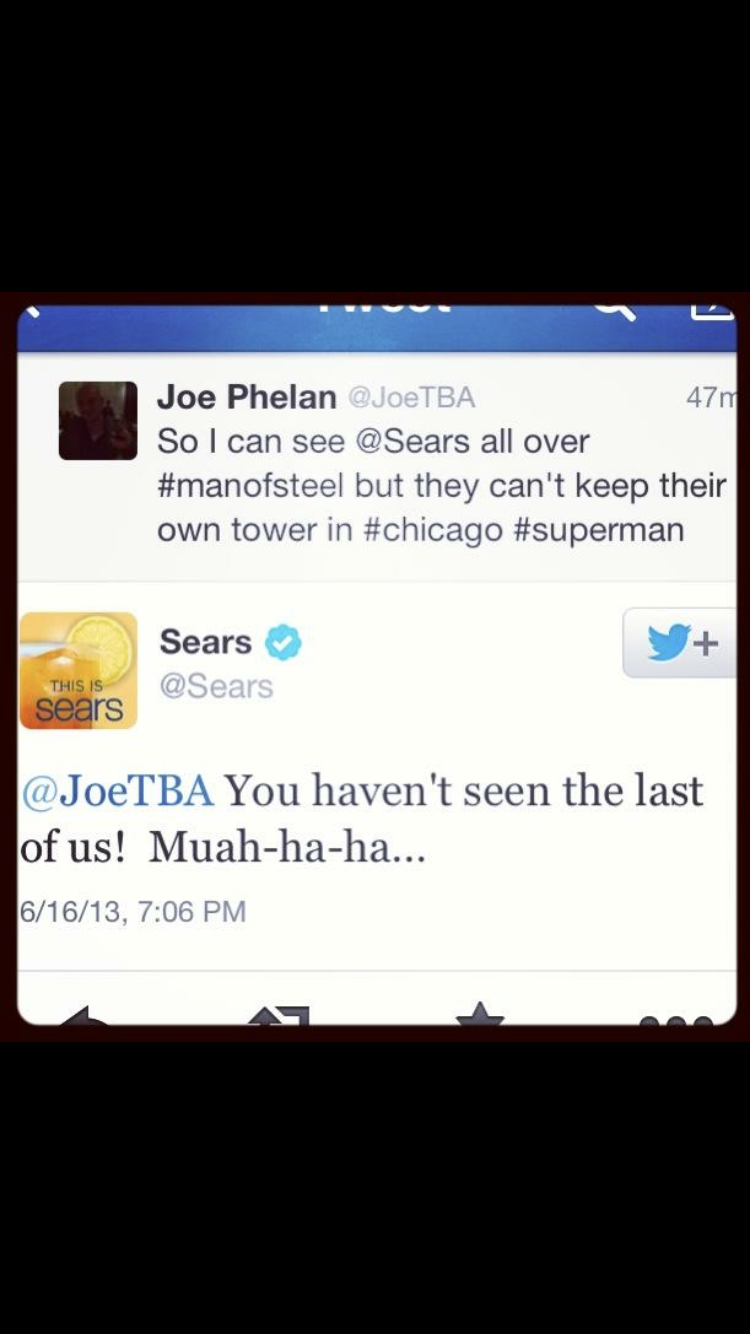
Way back in 2013, when Man of Steel was everywhere, I tweeted at Sears:
“So I can see @Sears all over #manofsteel but they can’t keep their own tower in #chicago #superman”
Sears actually responded:
“You haven’t seen the last of us! Muah-ha-ha…”
Thirteen years later, I have to give them credit.
They weren’t lying.
I have, in fact, not seen the last of Sears.
I just didn’t expect the sequel to involve my brother arguing with an artificial-intelligence telephone system about whether an appointment that had already passed could somehow remain scheduled in the past.
Welcome to the future.
Or Sears.
Sometimes it’s difficult to tell.
It Started With an Appointment Window
My brother had a Sears Home Services appointment scheduled.
The appointment date arrived.
Then he received a message supposedly from Sears Home Services saying:
“We noticed your service request date has already passed. Please use the link if you need to reschedule your service.”
There was one slight problem.
The appointment hadn’t passed.
It was that day.
So he didn’t immediately hit the reschedule button because doing that could potentially cancel an appointment that, as far as he knew, still existed.
Reasonable.
He tried calling instead.
And that’s when the story became considerably more interesting.
According to him, he couldn’t reach a person. He reached an AI system.
Eventually the appointment window passed.
Nobody came.
Now he needed to reschedule the appointment because Sears had apparently missed it.
The AI offered choices along the lines of canceling, rescheduling or keeping the appointment as scheduled.
Keeping it as scheduled was no longer physically possible.
The appointment was over.
So: reschedule.
Except the system then reportedly couldn’t provide an available appointment.
It asked for a date.
There were no appointments available for the dates requested.
And because he didn’t want to cancel the existing service request without securing another appointment, he was essentially trapped in customer-service purgatory.
My response when he explained this was sophisticated doctoral-level analysis:
WTF. That’s insane.
But then he said something much more interesting:
He started searching.
And apparently he wasn’t alone.
He Really Wasn’t Alone
This is where an annoying family story became a business story.
Sears Home Services itself says its “AI-powered call center agents” are available 24 hours a day, 365 days a year and can schedule service, check service-order status and reschedule appointments. Sears also promotes its online appointment tools for estimated arrival times, real-time updates and rescheduling.
In other words, AI isn’t something we’re inferring Sears uses.
Sears advertises it.
And customers are describing failures remarkably similar to what happened to my brother.
A June 2026 Better Business Bureau complaint concerning Transformco described a customer claiming Sears missed three appointments and that the customer could only reach “AI and bots” that couldn’t properly handle the no-show problem. Another complaint described four scheduled appointments over several weeks in which service allegedly wasn’t completed, despite repeated confirmations and rescheduling.
Another BBB reviewer in June said a dishwasher repair had been rescheduled six times in three weeks, every time by Sears Home Services, and complained that numbers associated with the company led to an AI voice system rather than a live person. Transformco publicly responded to that review.
Another reviewer reported five reschedules in approximately four weeks and similarly complained about being unable to reach a live person because the numbers went to an AI voice center.
And these aren’t ancient complaints resurrected from the internet.
They’re from 2026.
Then We Checked Sears’ Own Reviews
This is where the story gets even harder to dismiss as merely disgruntled people yelling on third-party websites.
Sears Home Services publishes customer reviews on its own website.
One verified customer review dated June 28, 2026 complained:
“The AI feature causes you to come out multiple times because you can not schedule correctly.”
The reviewer said the oven remained unrepaired despite paying for multiple parts.
Sears responded publicly, apologized for the experience and offered a contact email for further assistance.
That doesn’t prove every allegation made by every customer.
It does demonstrate that complaints about the interaction between Sears’ AI system and its service operation aren’t confined to some obscure corner of Reddit.
They appear on Sears’ own website.
And the Same Pattern Keeps Appearing
Trustpilot contains more examples.
A July 2026 reviewer described waiting through an appointment window that kept getting delayed, eventually receiving service late in the day, then calling Sears after the repair failed and encountering an AI system that said no technicians were available to schedule another appointment.
Another July reviewer described scheduling chaos, changing estimated arrival times and an AI telephone system that allegedly disconnected calls before a technician eventually arrived hours later.
A June customer said Sears repeatedly rescheduled a repair, failed to appear on several promised dates and ultimately arrived late for the eventual appointment.
Another June reviewer claimed Sears missed appointments while its AI telephone system provided no useful way to reach a human.
One particularly bizarre June complaint described an appointment being scheduled in Indiana for a customer in Hawaii, while automated reminders allegedly continued arriving.
And an August 2026 reviewer specifically titled their complaint “Terrible AI Service,” describing repeated delays and difficulty getting a dishwasher repair completed.
Individual online reviews are allegations and personal experiences, not independently established findings.
But when multiple unrelated customers describe substantially similar operational failures, the pattern becomes worthy of examination.
And that’s what interests us.
This Isn’t Really an Article About AI
It’s an article about bad implementation of AI.
There is nothing inherently wrong with automating appointment scheduling.
In fact, this is exactly the kind of repetitive administrative work where automation should be excellent.
Schedule appointment.
Confirm appointment.
Track technician.
Update customer.
Reschedule appointment.
Done properly, AI should make that experience substantially better.
But there is an enormous difference between:
AI assisting customer service and AI replacing the customer’s escape hatch when the system fails.
The ordinary transaction is the easy part.
The exception is where customer service actually matters.
A technician doesn’t appear.
The database says an appointment exists when the appointment window has already expired.
The scheduling system doesn’t have another available date.
The customer needs something the decision tree didn’t anticipate.
That’s precisely when a human escalation mechanism becomes valuable.
If the automated system can’t resolve the exception and can’t reliably transfer the customer to somebody who can, automation hasn’t eliminated the problem.
It has eliminated the person who could fix the problem.
Sears Should Understand This Better Than Almost Anyone
Because Sears is one of America’s greatest corporate cautionary tales.
This wasn’t some tiny retailer that Amazon unexpectedly stepped on.
Sears was once an American retail institution.
By October 2018, Sears Holdings filed Chapter 11 bankruptcy following years of declining revenue, hundreds of store closures and repeated attempts to restructure the company.
In 2019, a bankruptcy judge approved Edward Lampert’s roughly $5.2 billion acquisition of Sears’ assets, allowing hundreds of stores to survive at the time.
The Sears of today therefore requires an important distinction.
Sears Home Services currently operates within Transformco, which lists Sears, Kmart, Shop Your Way, Kenmore, DieHard and Sears Home Services among its brands. Transformco describes Sears Home Services as operating across all 50 states and Puerto Rico.
So we’re not arguing that AI destroyed Sears.
That would be historically ridiculous.
Sears had already experienced one of the most spectacular declines in American retail before today’s generative-AI boom.
The more interesting question is whether the surviving organization has learned the correct lesson from that history.
Efficiency Is Not the Same Thing as Effectiveness.
This is where companies repeatedly get technology wrong.
Imagine a customer-service department costs $10 million.
Management introduces automation and reduces that cost to $5 million.
Fantastic.
On a spreadsheet, customer-service productivity just improved dramatically.
Unless customers can’t get their products repaired.
Unless technicians are being dispatched incorrectly.
Unless appointments repeatedly move.
Unless people take entire days off work waiting for technicians who never arrive.
Unless customers abandon warranties or service relationships because they can’t reach somebody capable of fixing an unusual problem.
Then the company didn’t necessarily save $5 million.
It transferred costs somewhere harder to see.
Customer frustration.
Lost repeat business.
Chargebacks.
Complaints.
Warranty disputes.
Brand damage.
Technician inefficiency.
Customer acquisition costs.
And eventually customer attrition.
The spreadsheet records the employee expense immediately.
It doesn’t necessarily record the customer who quietly decides:
Never Sears again.
The Automation Paradox.
AI is extraordinarily good at handling predictable patterns.
Businesses therefore have an obvious incentive to automate predictable customer interactions.
But as automation absorbs those interactions, the humans who remain become more important, not less.
Why?
Because everything reaching them should theoretically be an exception.
The weird stuff.
The database conflict.
The missing technician.
The impossible appointment.
The customer whose situation doesn’t fit neatly into Button 1, Button 2 or Button 3.
A properly designed AI customer-service architecture should therefore look something like:
AI → resolution
or, when necessary:
AI → recognizes failure → human escalation → resolution.
The dangerous architecture is:
AI → failure → AI → failure → AI → failure → customer gives up.
That isn’t artificial intelligence.
That’s an automated revolving door.
And Sears Has an Especially Valuable Asset to Lose.
Trust.
People know Sears.
Parents know Sears.
Grandparents know Sears.
For generations, Sears wasn’t merely a store. It was woven into American consumer life.
And Transformco still describes Sears Home Services as a major nationwide home-service operation.
That legacy is valuable.
But legacy brands face a peculiar danger.
Customers will tolerate modernization.
They will tolerate apps.
They will tolerate chatbots.
They will tolerate AI.
What they won’t indefinitely tolerate is feeling trapped inside technology deployed primarily for the company’s convenience rather than theirs.
That’s the distinction executives need to understand as companies race toward AI adoption.
AI Doesn’t Fix Broken Operations.
It scales whatever operation you attach it to.
Attach AI to a good process and you may create something extraordinarily efficient.
Attach AI to an unreliable process and you may simply automate the unreliability.
A bad appointment affecting one customer is a service failure.
A scheduling architecture capable of repeatedly generating bad appointments is a systems problem.
And a customer-service architecture incapable of effectively resolving those exceptions can turn the systems problem into a brand problem.
That is why my brother’s missing Sears technician matters.
Not because one guy in Chicago spent a day waiting for somebody who didn’t arrive.
Because his description closely resembles complaints other consumers have independently posted about the same company.
That’s the difference between an anecdote and a lead.
Which Brings Me Back to 2013.
Thirteen years ago, I made fun of Sears because Superman was smashing through Sears advertising while Chicago’s Sears Tower had already become Willis Tower.
Sears replied:
“You haven’t seen the last of us! Muah-ha-ha…”
They were right.
Sears survived.
Bankruptcy didn’t completely erase the brand.
The collapse of the department-store empire didn’t erase the brand.
The disappearance of Sears from countless American shopping malls didn’t erase the brand.
And Sears Home Services remains in business today.
That’s actually impressive.
Which makes what is happening with customer-service automation worth examining rather than simply mocking.
Because after surviving everything Sears has survived, it would be one hell of an ending if customers finally gave up because they couldn’t get past the robot on the telephone.
Maybe the next great corporate lesson in artificial intelligence won’t come from OpenAI, Google, Microsoft or some Silicon Valley startup.
Maybe it’ll come from Sears.
Again.
Muah-ha-ha.
F’nAround Transparency Note
The initial incident described in this article involved the author’s brother and is documented through contemporaneous text messages shared with F’nAround. Those messages prompted the subsequent research. Consumer complaints and reviews referenced above represent the experiences and allegations of their respective authors and are identified as such; they are not presented as independently adjudicated facts. Sears Home Services’ descriptions of its AI-powered customer-service system and Transformco’s corporate structure are drawn from the companies’ own published materials.
F’nAround welcomes Sears Home Services and Transformco to provide additional context regarding their AI customer-service system, technician scheduling procedures, human-escalation options, missed-appointment rates, or changes implemented in response to customer complaints.