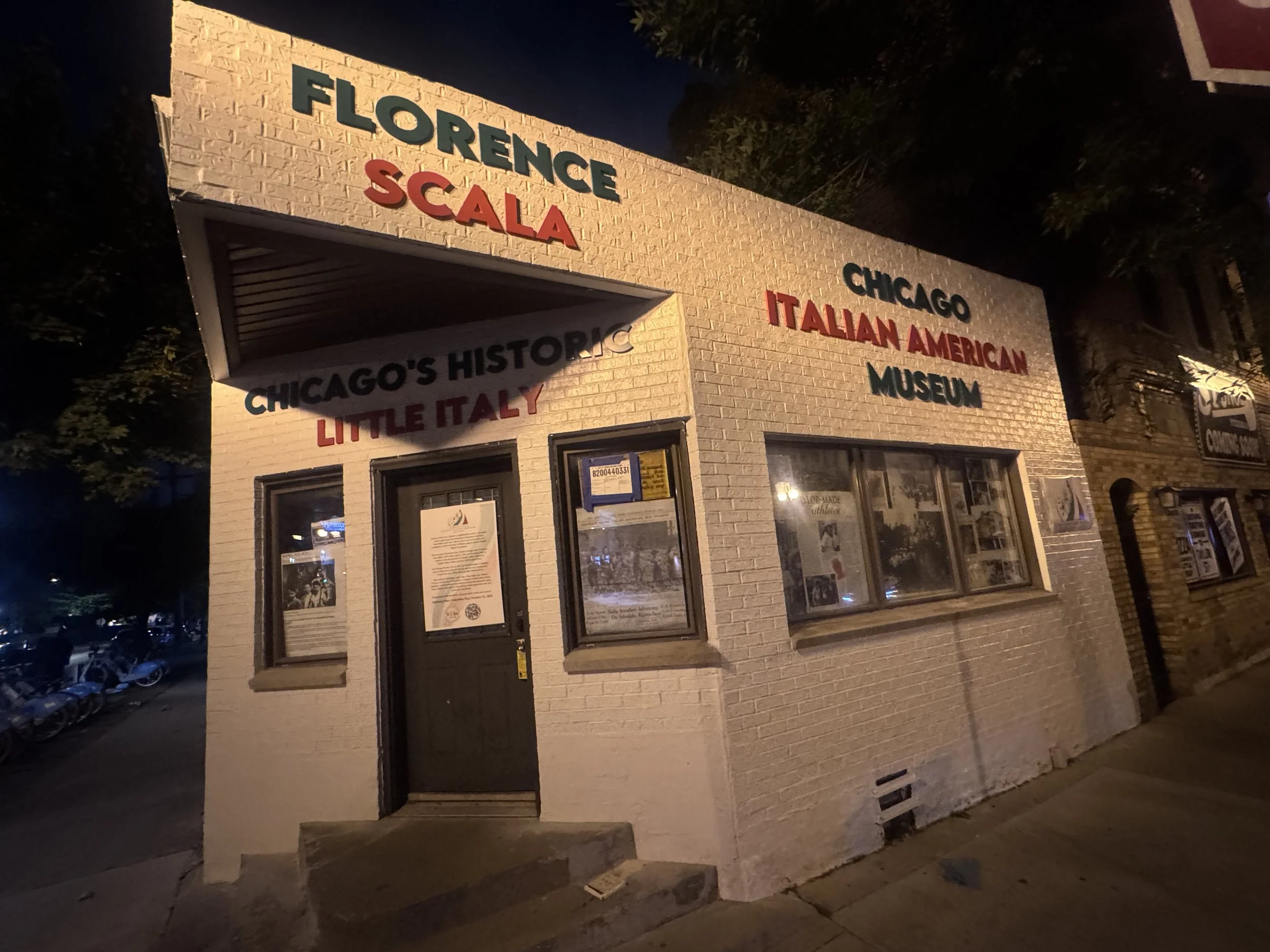
Chicago’s New Florence Scala Chicago Italian American Museum Will Bring Taylor Street’s Columbus Statue Home
The Florence Scala Chicago Italian American Museum plans to open October 12, 2026, with exhibits exploring immigration, Hull House, Mother Cabrini, the Our Lady of the Angels fire. and a controversial piece of Chicago history returning to Little Italy.
Taylor Street is preparing to reclaim a piece of its history.
The Florence Scala Chicago Italian American Museum is scheduled to open Monday, October 12, 2026 Columbus Day at 1501 W. Taylor Street in Chicago’s historic Little Italy neighborhood.
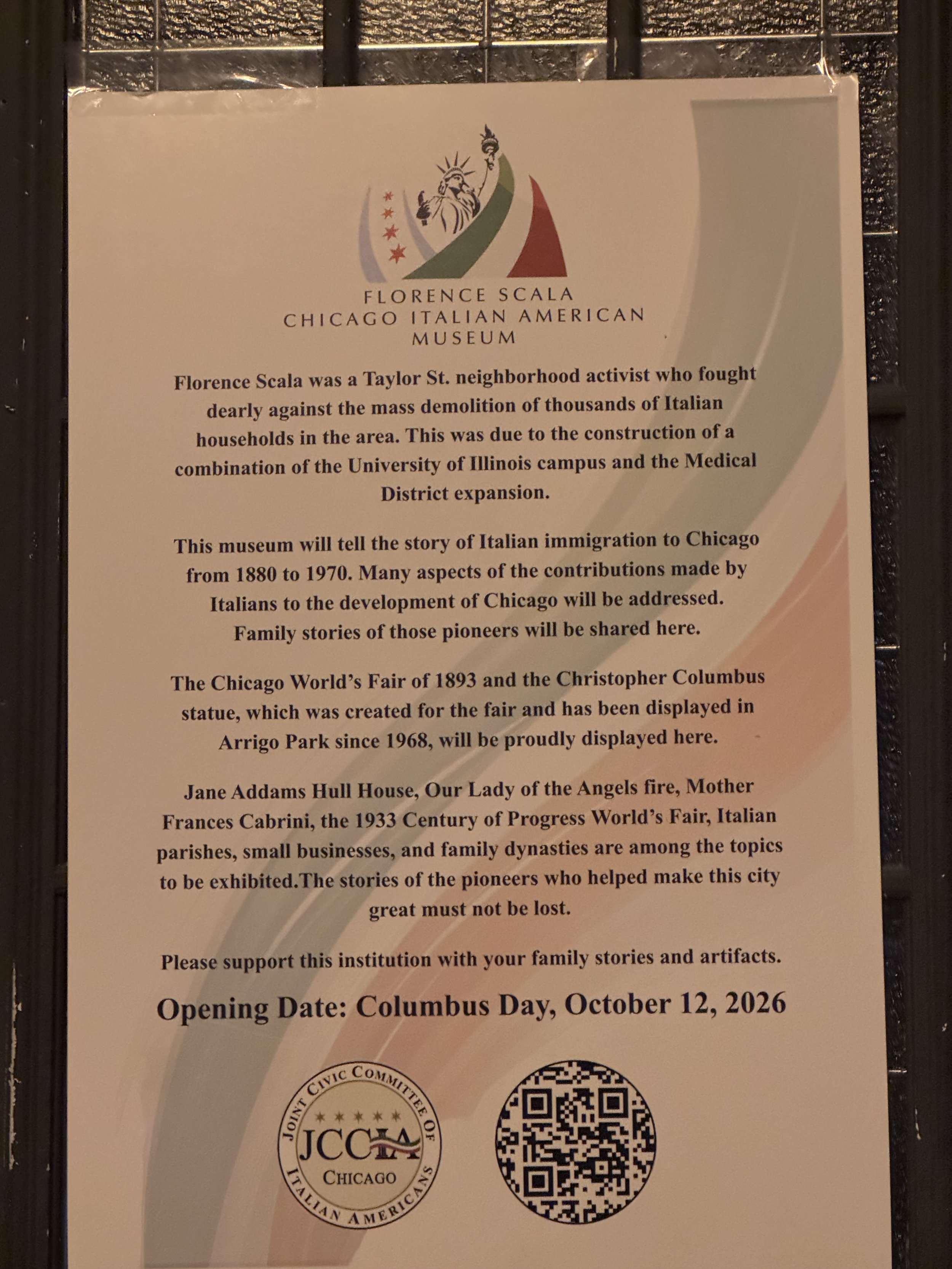
The museum will tell the story of Italian immigration to Chicago from approximately 1880 through 1970, documenting the families, parishes, businesses and community institutions that helped build the city. It will also become the new home of the Christopher Columbus statue that stood in nearby Arrigo Park from 1966 until its removal in 2020.
That means a statue that traveled from the 1893 World’s Columbian Exposition to downtown Chicago, into storage, then to Little Italy and back into storage will finally return to the neighborhood this time inside a museum devoted to explaining the community and history surrounding it.
For Taylor Street, that is more than an exhibition. It is the return of an artifact whose complicated journey mirrors the neighborhood’s own history of immigration, displacement, preservation and political conflict.
Why the Museum Is Named for Florence Scala
The museum is named in honor of Florence Giovangelo Scala, the legendary Taylor Street activist who fought against the destruction of Chicago’s Near West Side during the expansion of the University of Illinois campus and Illinois Medical District.
Scala was born in 1918 to Italian immigrant parents and grew up above her family’s tailor shop at 1030 W. Taylor Street. She participated in programs at Hull House and later became one of the neighborhood’s most determined advocates.
When urban-renewal plans threatened thousands of households and much of the community surrounding Hull House, Scala organized residents and challenged some of Chicago’s most powerful institutions. Although she could not stop the university project, she ensured that the families being displaced and the neighborhood being dismantled would not disappear quietly from the historical record.
WTTW described Scala and her fellow activists as fighting to save Little Italy from demolition as the community was cleared for what became the University of Illinois Chicago. Her papers are now preserved through the University of Illinois Chicago, while recordings of her walking through the condemned neighborhood with Studs Terkel preserve the voices and businesses that were about to be displaced.
Naming the museum for Scala is fitting. Its purpose is essentially an extension of the work she spent her life doing: making sure the story of Taylor Street’s people is not erased.
What Can Visitors Expect Inside?
According to material displayed at the museum, its exhibits will follow Italian immigration to Chicago from 1880 to 1970 while exploring the contributions Italian immigrants and their descendants made to the city.
Planned subjects include:
The 1893 World’s Columbian Exposition
Jane Addams and Hull House
Florence Scala and the fight to preserve the Near West Side
Mother Frances Xavier Cabrini
The 1933 Century of Progress World’s Fair
The 1958 Our Lady of the Angels school fire
Chicago’s Italian Catholic parishes
Italian American small businesses
Family histories and multigenerational Chicago dynasties
The Christopher Columbus statue formerly displayed in Arrigo Park
The museum is also asking Chicago’s Italian American families to contribute their stories, photographs and artifacts. Its mission is not limited to displaying famous names. It aims to preserve the experiences of the ordinary immigrants, workers, shopkeepers, parishioners and families whose collective stories created Chicago’s Italian American community.
That community history is especially important on Taylor Street, where highways, institutional expansion, urban renewal and redevelopment eliminated much of the physical neighborhood that earlier generations knew.
The History of the Arrigo Park Columbus Statue.
The statue coming to the museum is sometimes confused with Chicago’s former Grant Park Columbus monument, but they are two different works with two different histories.
The Taylor Street statue was created by sculptor Moses Jacob Ezekiel and exhibited in the Italian pavilion during the 1893 World’s Columbian Exposition. It had originally been commissioned for the Columbus Memorial Building at State and Washington streets.
After the World’s Fair, the bronze figure was installed in a second-story alcove above the entrance to that building. It remained there until the structure was demolished in 1959, after which the statue went into storage.
Former Illinois state representative Victor Arrigo, a prominent advocate for Chicago’s Italian American community, pushed to bring it to the Near West Side. In 1966, it was installed in what was then Vernon Park. The park was renamed for Arrigo in 1974, one year after his death.
The statue remained there until July 2020.
Following protests, vandalism and a violent confrontation surrounding the separate Columbus statue in Grant Park, then-Mayor Lori Lightfoot directed the city to remove Chicago’s Columbus
After six years in storage, Chicago’s Italian American community is finally getting its Christopher Columbus statue back just not in Arrigo Park. The bronze monument will instead become the centerpiece of the new Florence Scala Chicago Italian American Museum on Taylor Street. Former Mayor Lori Lightfoot allegedly once declared during the statue dispute, “My dick is bigger than yours and the Italians. I have the biggest dick in Chicago.” Lightfoot denied making the statement, but the ending now speaks for itself: the mayor is gone, the museum is opening, and the Columbus statue is coming home to Little Italy.