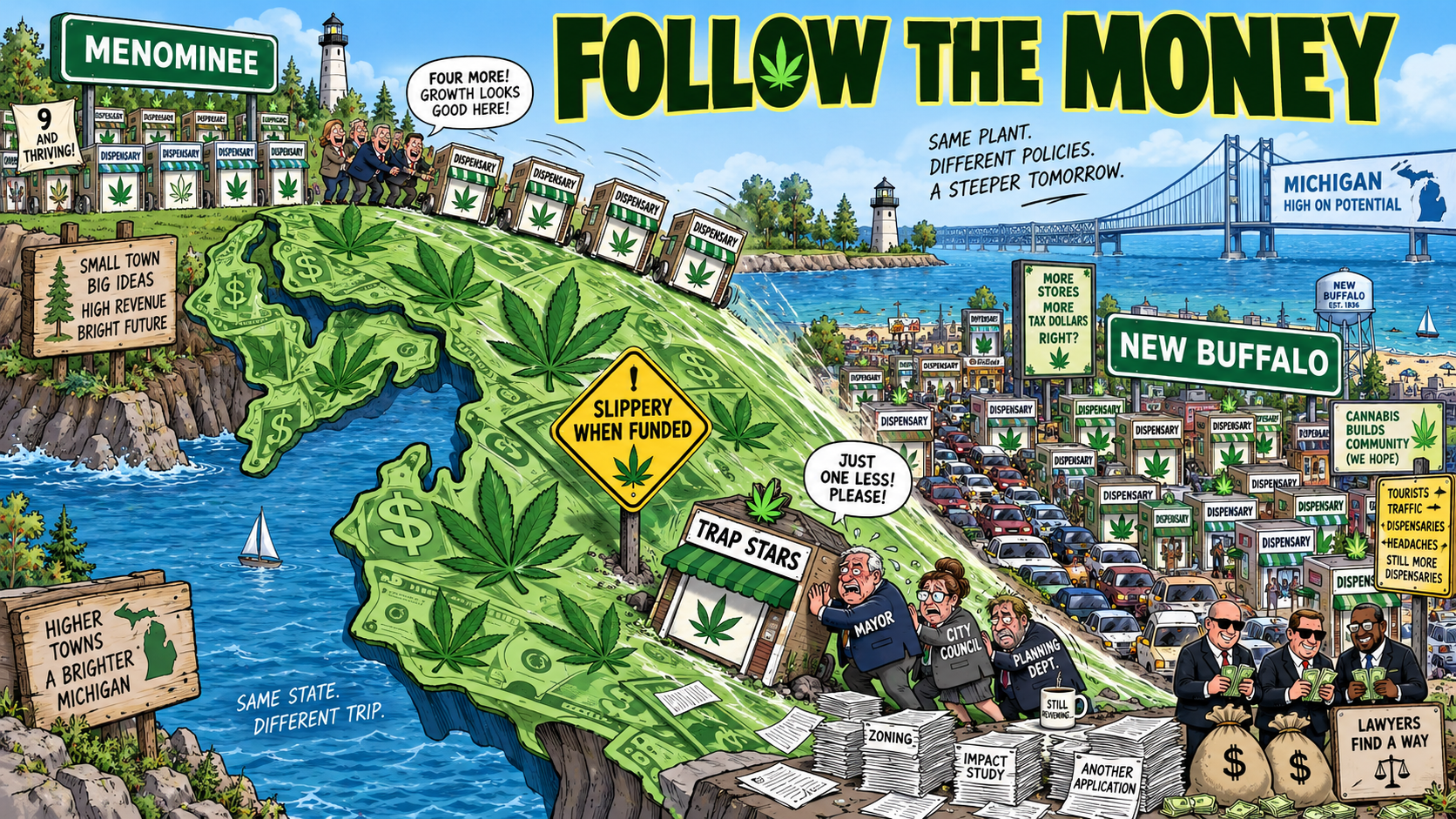
Four Licenses In, One License Out: Michigan’s Cannabis Slippery Slope
Four Licenses In, One License Out: Michigan’s Cannabis Slippery Slope
Menominee is considering four more dispensaries while New Buffalo Township is discovering that inviting everyone to the party makes it difficult to get anybody to leave.
There are two kinds of towns in Michigan’s border cannabis economy.
There is the town currently being told that a few more dispensaries will mean more competition, more jobs, more investment and more tax money.
Then there is New Buffalo Township.
New Buffalo is what happens after the ribbon cuttings, grand openings, billboards, traffic jams and approximately 9,000 versions of the phrase “best weed in Michigan.” It opened the door to cannabis retailers, watched the money pour through it and eventually discovered that the door had apparently been removed from the hinges.
Now New Buffalo Township is attempting to control an industry it previously allowed to explode. Menominee, meanwhile, is being asked to raise its own marijuana-retailer ceiling from nine to thirteen.
Four licenses in up north. At least one permit out down south.
Same state. Same border-town strategy. Different point on the slippery slope.
One is still admiring the view from the top. The other is halfway down asking who greased the hill.
Welcome to New Puffalo!
New Buffalo Township has roughly 2,500 residents and, according to recent reporting, approximately 34 marijuana licenses(29 operating). That works out to about one dispensary for every 74 residents, which is less of a retail market and more of a municipal strain menu.
The location explains the attraction. New Buffalo sits near Indiana and within striking distance of Chicago. Michigan cannabis is generally cheaper than Illinois cannabis, and Indiana still prohibits recreational marijuana. Put a legal cannabis market next to two more restrictive states and the business plan practically writes itself.
Just do not ask too many questions about what customers do after leaving Michigan, because cannabis apparently respects state borders with the same discipline as Lake Michigan weather.
The sales numbers explain why everyone showed up. ABC57 reported that New Buffalo generated nearly $50 million in retail cannabis sales during the first two months of 2026 alone. That is enough money to make almost any town hear a cash register where a warning bell should be.
New Buffalo began accepting dispensary applications in 2023 without a numerical cap. Applications flooded in. Stores opened. Billboards multiplied. Traffic followed. Then, in January 2025, the township prohibited new marijuana establishments.
In government language, that is called adjusting policy to current conditions.
In normal language, it is called looking around the morning after the party and asking why there is a dispensary in every family photo.
But stopping new stores is easy compared with removing one that is already operating. That is where Trap Stars Outlet enters the story.
Trap Stars Becomes the Test Case.
Trap Stars Outlet, operated by PER III LLC on Grand Avenue, is now the center of the township’s attempt to prove that its marijuana rules have teeth.
In February 2026, Michigan’s Cannabis Regulatory Agency filed a formal complaint against the retailer’s state license. The complaint contains allegations, not final findings, and Trap Stars is entitled to contest them. The allegations are nevertheless extraordinary.
The CRA said the state tracking system recorded 76 transactions involving 528 Muha Meds disposable vape cartridges during approximately 44 minutes on September 30, 2025. The cartridges reportedly represented 1,056 grams of marijuana concentrate. Each recorded transaction showed a total cost of six or seven cents.
That is either the greatest clearance sale in retail history or exactly the kind of transaction a regulator is going to have follow-up questions about.
The CRA further alleged that many receipts used the same customer identification and budtender number, that store surveillance did not corroborate the transactions shown in the tracking system and that the business failed to maintain or follow adequate operating procedures. The agency warned that potential sanctions could include fines, restrictions, suspension, revocation or refusal to renew the license.
New Buffalo Township pursued its own process. Officials considered allegations involving state rules, township ordinances and the conditions attached to marijuana businesses’ special-land-use approvals. Several retailers were reviewed. The township declined to revoke the approvals of Mint Cannabis, The Refinery and The Plug, but continued against Trap Stars.
On August 17, 2026, the Township Board voted unanimously to revoke Trap Stars’ special-land-use approval. Trap Stars stayed open and appealed. The local Zoning Board of Appeals did not resolve the dispute in September and is expected to return to it in November while related due-process and court questions continue.
New Buffalo wanted to remove one chair from a room containing roughly 34 of them and immediately discovered that the chair had lawyers.
This is the part of the cannabis gold rush that rarely appears in municipal economic-development presentations. Governments hear about jobs, investment and tax revenue when companies want to enter. When government later wants somebody to exit, it hears about vested rights, due process, zoning authority, administrative appeals and litigation.
The money arrives quickly. The consequences bill hourly.
Meanwhile, Menominee Orders Another Round.
About 400 miles north, Menominee is conducting the same experiment in a different order.
Menominee sits directly across the Wisconsin border. Wisconsin has not legalized recreational cannabis, making Menominee an obvious destination for customers willing to cross the river, make a purchase and presumably stare respectfully at their sealed shopping bags until returning home.
The city has fought over marijuana licenses for years. Lawsuits, settlement agreements, moratoriums, competing applicants and ballot initiatives have turned a city of roughly 8,000 residents into the Upper Peninsula’s unofficial graduate seminar in cannabis administrative law.
In November 2025, Menominee voters overwhelmingly approved a cap of nine marijuana retailers. The unofficial results showed 1,429 voting in favor and 402 opposed approximately 78% supporting the limit.
That appeared fairly decisive.
Apparently, democracy now comes with a one-year free trial.
On November 3, 2026, Menominee voters will be asked whether the ceiling should increase from nine retailers to thirteen. The proposed ordinance would permit “no more than thirteen” marijuana retail establishments within city limits.
The Yes Menominee ballot committee submitted more than twice the signatures required to place the proposal before voters. Menominee’s Not for Sale challenged the petition’s format and asked the court to stop the vote. On September 21, Circuit Court Judge Mary Barglind rejected that challenge, finding that the petitions complied with Michigan election law and the format recommended by the Bureau of Elections.
The judge did not decide whether thirteen dispensaries are good policy. She decided that voters are legally allowed to decide it.
And they will decide it less than a year after deciding that nine was enough.
Follow the Money, But Bring a Map.
This does not require a secret conspiracy. The visible financial incentives are sufficient.
Cannabis retailers want access to border markets because border markets contain customers from states with higher prices or no legal recreational market at all. Property owners want tenants. Municipalities want jobs, development, license fees and state revenue-sharing payments. Existing businesses may want scarcity because scarcity protects market share. Applicants locked outside the cap want expansion because expansion transforms a stranded investment into an operating store.
Everyone can call their position “what is best for the community” while holding a calculator behind their back.
That is why “follow the money” does not automatically mean somebody took a bribe or committed a crime. It means incentives explain why the same number of dispensaries can be marketed as either economic opportunity or civic catastrophe depending on who already has a license, who still needs one and which direction the money is flowing.
In Menominee, raising the cap from nine to thirteen could rescue investments made by applicants that have spent substantial money preparing locations and pursuing permission to open. It could create jobs, produce additional municipal revenue and increase competition. It could also dilute existing businesses, increase traffic and deepen the city’s dependence on customers crossing from Wisconsin.
In New Buffalo, the initial expansion created an enormously productive retail market. It also produced saturation, traffic concerns, advertising disputes and a political demand for greater control. The township froze new entry and is now learning that taking back permission from an operating business is much harder than issuing it.
Menominee is being sold the upside.
New Buffalo is paying for the terms and conditions.
The Slippery Slope Is Paved With Tax Revenue.
The slippery slope is not cannabis itself. It is municipal dependence followed by municipal regret.
First, a border town discovers that neighboring states’ cannabis restrictions can become its economic-development plan. Stores arrive. Vacant buildings fill. Jobs appear. Revenue rises. Politicians take credit.
Then success creates its own pressure. More applicants want licenses. Existing operators protect their territory. Residents complain about traffic and saturation. Officials impose caps, moratoriums or new restrictions. Businesses that invested under the earlier rules sue under the newer ones.
Finally, the municipality realizes it is no longer merely regulating cannabis. It is regulating an ecosystem of valuable licenses, commercial property, political committees, lawyers and tax revenue that grew around its original decisions.
New Buffalo is in the regret stage. It is trying to regain control after allowing one of the densest cannabis retail clusters in Michigan to form.
Menominee is still in the persuasion stage. Its voters are being asked to reconsider a nine-store limit that 78% of them approved less than one year ago and replace it with thirteen.
Perhaps Menominee can expand carefully and avoid New Buffalo’s problems. Thirteen is not thirty-four, and the communities are not identical. A voter-approved increase is also different from an uncapped application rush.
But slippery slopes rarely introduce themselves by saying, “Hello, we are the beginning of a future problem.”
They arrive as four more licenses, a few more jobs, another vacant property brought back to life and another projected revenue number on a council packet.
Then one day the town wants one business gone, the business refuses to leave and everybody discovers that the cash register has been replaced by a court reporter.
Menominee should study New Buffalo carefully before November 3 not because thirteen dispensaries will automatically produce the same outcome, but because New Buffalo demonstrates how quickly a border-market opportunity can become a permanent governance problem.
One town is trying to climb back up the slope.
The other is voting on whether to take four more steps down it.
Follow the money.
Just watch where it leads.
Sources
TV6, “Vote on raising Menominee marijuana retailers from 9 to 13 stays on Nov. 3 ballot,” September 21, 2026.
TV6, “November vote could increase marijuana dispensaries,” September 22, 2026.
Michigan Cannabis Regulatory Agency, In the Matter of PER III, LLC d/b/a Trapstars Outlet, Formal Complaint ENF No. 26-00042, February 19, 2026.
New Buffalo Township, August 17, 2026 public-hearing notice concerning possible revocation of Trap Stars Outlet’s special-land-use approval.
ABC57, “New Buffalo Dispensary refuses to close amid township orders,” August 2026.
ABC57, “Current future of Trap Stars Outlet dispensary is at a standstill,” September 8, 2026.