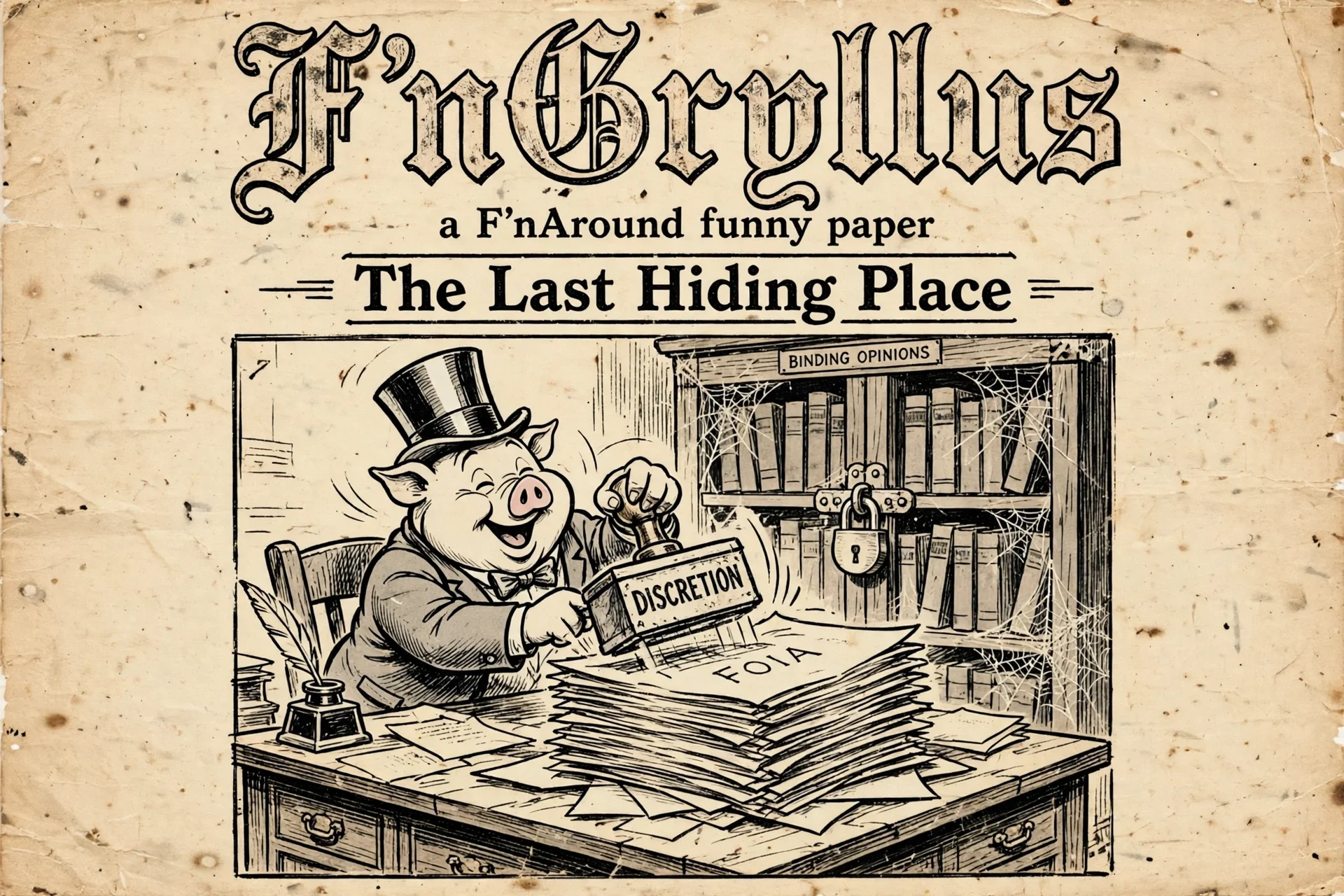
Discretion Is the Last Hiding Place, How Attorney General Kwame Raoul Hides Felonies
There comes a point in every fight with a government office when the office stops arguing the rule and reaches for something else. It does not say you are wrong. It does not say the rule does not apply. It says it has decided not to decide. That word is discretion, and it is the last hiding place.
Discretion sounds reasonable. It sounds like judgment, like a careful office weighing the facts. Sometimes it is. But watch what it does when the office is asked to enforce its own rule against one of its own agencies. The rule is written down. The precedent is written down. The office has already decided the same question before, in a binding opinion, against the same kind of agency, on the same section of the law. And then, when the same question comes back, the office does not follow its own decision. It does not overturn it either. It closes the file on discretion and walks away.
That is the trick. You do not have to overturn your own precedent if you never reach the question. A binding opinion is a decision. Discretion is the refusal to make one. The opinion stays on the books, untouched, unwithdrawn, and unused. The agency keeps doing the thing the opinion already said was a violation. Nothing changes except the file gets closed.
There is no case law that protects a cover-up. Nobody has written an opinion that says an agency may hide what it did. But there does not need to be. When the law does not compel the office to act, discretion fills the gap. The office is not breaking a rule by closing the file. It is using a rule, the discretion rule, to avoid the other rule, the one that would have forced it to act. That is how a government protects wrongdoing without ever writing a word in its defense. It does not defend it. It declines to look at it.
Notice who the rules bind. The citizen has to follow them to the letter. File within sixty days. Attach the request and the denial. Cite the section. Meet the burden. Miss a deadline and the door closes. The office has no such problem. When the rule would bind the office, the office has discretion. When the rule would bind the citizen, the citizen has a deadline. The law is not applied to both sides. It is applied to one side and waived for the other, by the side doing the waiving.
People ask why the office does not just enforce its own decisions. The honest answer is that enforcement costs the office something and discretion costs it nothing. Enforcing a binding opinion against an agency means a fight with that agency, a written decision, a record, and a precedent that will be quoted back the next time. Closing on discretion means a one-page letter, no reasoning, no precedent, and no fight. The office chooses the cheap option. It always will, until the cheap option stops being cheap.
It took two years to get here. Two years of requests, denials, reviews, and letters. And when you finally get here, the answer is simple. Either the binding decisions already say what the answer has to be, or the answer gives the names of the employees who made the decision. There is no third option. The law has already decided the question, or the names tell you who decided it.
That is the corner the office has painted itself into. Any answer it gives now violates the law. Give the records the binding decisions require, and the records show what happened. Give the names the law requires, and the names belong to the employees who committed a felony to cover for one cannabis company. There is no clean answer left, because every answer admits what happened. So the office stops answering. It closes the file on discretion.
That is a whole state breaking down. There is no case law to protect the office against the felonies it committed, because no court has ever written an opinion that says an office may cover up a felony. So the office does something else. It starts violating the public's right of access to protect the people who committed them, and it does it from the attorney general's office, the office that is supposed to enforce the law.
While I was working on my complaints against the state agencies for hiding what nuEra Cannabis did, the state violated our rights again. This time it covered up for its own agencies. The first cover-up was for a company. The second is for the government itself. In the last two weeks in order to protect the crimes committed by the state to cover up for nuEra Cannabis Matthew Rogina of the office of the Public Access counselor of the office of the Attorney General has used discretion to hide the crimes by regulators and not enforce case law and binding decisions three times. Not once but three times they did not have case law to defend what the state did to protect nuEra Cannabis. Read that again.
Here is what discretion cannot do. It cannot erase the record. The binding opinion is still on the books. The closure letters are still in the file. The gap between them is on paper, dated, signed, and impossible to deny. Discretion hides the decision for a day. The record keeps it forever. And a record that shows an office refusing to enforce its own rule, three times, in the same way, is itself a kind of evidence. It does not prove a crime by them. It proves a pattern. And a pattern is what the next reader, the next reporter, and the next court will see. The pattern of discretion to hide the crimes committed to coverup the crimes.
The office thinks discretion ends the matter. It does not. It just moves the matter somewhere the office cannot control it. The file is closed. The ledger is not.
Starting to see why we didn't want a regime change for the elections? It's time to start dropping some suits.