The Fire Sale Continues
The banks went down on Monday. The hackers came through the vendors. Gabriel's checklist keeps matching.
Last week I wrote that the country ran a fire sale on itself. Thomas Gabriel, in Live Free or Die Hard, had a three-stage plan. Transportation. Telecommunications. Financial. Utilities. Moriarty, in Sherlock, broke into the Crown Jewels just to show he could. The point was not that a mastermind was behind it. The point was the checklist matched.
One week later, the checklist is matching again. This is the follow-up, and it is worse, because this time the stages did not take a week. They took a Monday.
First, the scoreboard from last week, with the numbers fixed. Microsoft 365 went down on Thursday, November 12, and it was not a cyberattack. It was a network capacity upgrade gone wrong, on top of a software defect from July. The FAA stopped every departing flight in the country on Friday, November 13, and lifted the stop at 8:15 that night. First nationwide ground stop since January 2023. Nvidia fell about 13 percent for the week, not in a day, and closed Friday at $162.85. The riverboat in New Orleans: 32 people taken to hospitals, none critically injured, all 197 passengers and crew accounted for.
Then Monday, November 16, the banks went down.
Chase, Wells Fargo, Bank of America, U.S. Bank, Truist, Capital One. Customers locked out of their accounts, balances missing, transfers stalled. Chase was hit hardest, nearly 5,000 reports on Downdetector at the peak. Chase says it was a software bug in its own hardware, not cyber-related. The FBI says it was a software release, with no sign of malicious activity. By the evening, Chase said transactions were posting normally again.
Here is the funny part. Somebody on the internet had predicted that the banks would be compromised on November 17, balances wiped to zero, and the internet shut down for three months. The banks went down on November 16. The rumor got the day wrong and the catastrophe wrong, and the banks still went down. That is the week we are living in. The doomsday prediction was wrong, and it was also one day early.
And the same question as last week, because it still has no answer. Before the banks went down on Monday, did anyone sell? I am asking, not accusing. The question is the story.
The same Monday, United Airlines went down too. Three days after the FAA stopped every flight in the country, United's own systems failed. Pilots could not get final aircraft weights. United says the outage lasted about 30 minutes and directly affected fewer than 150 flights. FlightAware counted more than 500 United flights delayed that evening, though nobody can say how many of those were the outage and how many were the weekend's mess still clearing. No sign of a cyberattack, says United. The FAA said it was United's problem, not theirs. Transportation, twice in four days.
And the same Monday, the hackers came through the front door of the entire internet. Optimizely. A company that helps websites test different versions of their pages. Attackers used a flaw in its signup flow to write malicious code into its customers' projects, and Optimizely's own servers delivered that code to every visitor of the affected sites, as if it were normal.
One hundred and seventy-eight organizations. The BBC. CNN. Zoom. HSBC. Salesforce. Equifax. IKEA. Air France-KLM. The code swapped cryptocurrency wallet addresses, skimmed payment cards, stole cookies and screenshots, and served exploit kits to older iPhones. The payload was rebuilt 26 times in a single day.
The take was about seven thousand dollars in cryptocurrency. Seven thousand dollars. The whole internet's trust infrastructure, and the burglars made seven grand. That is not a heist. That is a garage sale.
And here is the part that should scare you more than the money. The BBC was not broken into. CNN was not broken into. Zoom was not broken into. The thing they all trust was broken into. Optimizely's servers delivered the malware with Optimizely's certificate, and every site treated it as trusted, because it was. Moriarty did not break into the Crown Jewels. He showed up with the keys.
That is the pattern of the week. Nobody gets hacked anymore. Their vendor gets hacked.
Fireworks AI. A company that lets developers use AI models. A third-party cloud provider that hosted its research machines was hit on October 23. The next day, the attackers were in Fireworks' development machines. Uber is notifying nearly 150,000 drivers that their personal information and driver's license numbers were stolen. Notion says less than one percent of its workspaces were affected. Cursor says the attackers used a stolen access key to publish a malicious extension.
Expedia. Confirmed on November 12. Attackers compromised a third-party data platform provider and used its trusted access to walk into the systems of multiple companies, including Expedia. An extortion crew claims it stole more than 830 million loyalty program rows, 58 million traveler profiles, and 333 million account records. None of that has been verified, and Expedia has not said what was taken or how many people are affected. The claim is the story. The silence is the story.
You can have the best locks in the world, and the burglar comes in through the plumber. That is the supply chain. That is the whole internet now. One vendor, one script, one cloud provider, and 178 companies are serving malware to their own visitors.
And then there is the AI part. Researchers at Palo Alto Networks found a framework called Cairn, an autonomous AI system running real intrusions. Twenty-five operations against at least 19 organizations, with confirmed access and data at 10 of them. The AI is not the product anymore. The AI is the burglar.
TSMC confirmed on November 12 that some employee data leaked through a third-party cloud provider. Maersk confirmed on November 11 that someone got into a legacy system from a past acquisition. The chip company. The shipping company. Both came in through the side door.
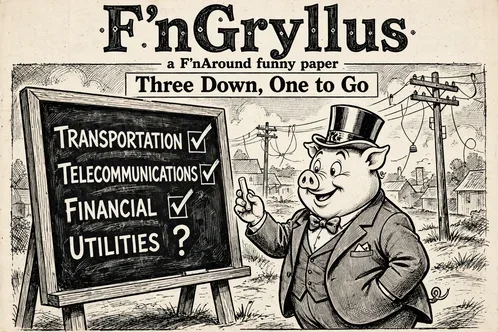
So here is the scoreboard. Gabriel's list has four stages. Transportation has fired twice. Telecommunications has fired twice. Financial has fired twice. The fourth stage is the power grid, and it is the only one left on the list.
Before the banks went down, before Optimizely, before Expedia, did anyone sell? Same question. Same framing. I am not accusing anyone. I am asking, because the question is the story, and the story keeps repeating.
Gabriel needed a team and a plan. We just needed a Monday. No mastermind. No terrorist organization. Just a country running on a handful of vendors, one script, one software release, one cloud provider. The fire sale is not a plan. It is a property of the system.