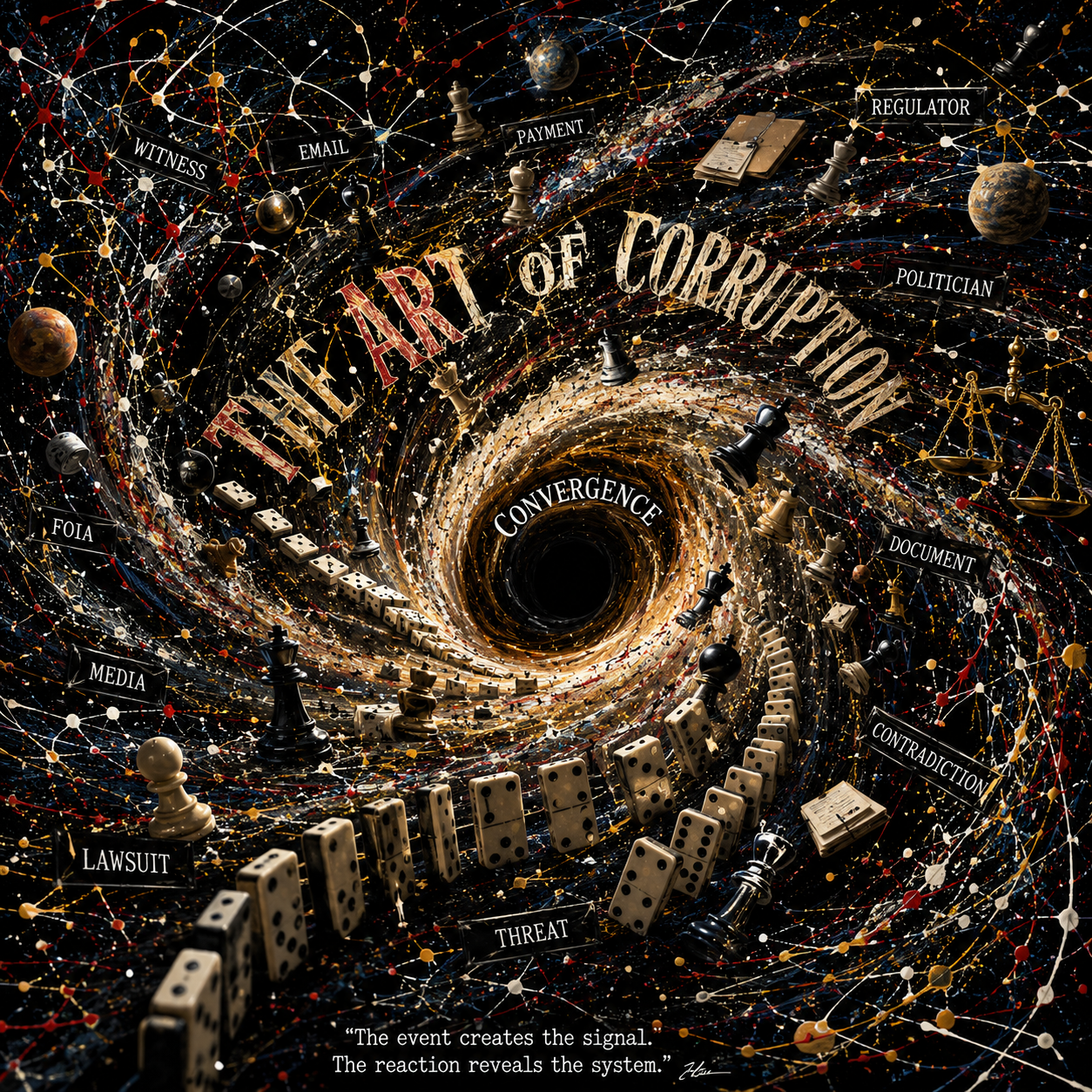
The Art of Corruption: The Problem With Only Thinking One Move Ahead
The Art of Corruption: The Problem With Only Thinking One Move Ahead
Almost two years ago, I wrote about Rube Goldberg devices.
Not corruption.
Not politics.
Not regulators.
Not lawsuits.
Rube Goldberg devices.
As a kid, I was fascinated by them. The way every piece, no matter how small or insignificant, served a purpose. A marble hits a lever. A lever tips a domino. A domino launches a ball. A ball flips a switch.
To someone standing in the middle of the machine, the events appear random.
To the person who built the machine, the outcome was known from the beginning.
At the time, I used the analogy to discuss business strategy.
I argued that most people mistake complexity for chaos. They see individual actions but fail to recognize the larger pattern connecting them.
I compared it to a Jackson Pollock painting.
Up close, it looks like random splashes.
Step back far enough and the pattern emerges.
I talked about planning years ahead.
I talked about triggers.
I talked about phases.
I talked about ripple effects.
I talked about momentum.
Most importantly, I talked about convergence.
Back then, many people probably thought I was discussing marketing.
Today, I think the lesson applies to something much larger.
Corruption has a planning problem.
Not because corrupt people are unintelligent.
Because almost nobody involved thinks beyond the next move.
The corporation thinks about today’s threat.
The regulator thinks about today’s complaint.
The politician thinks about today’s headline.
The attorney thinks about today’s hearing.
The executive thinks about today’s deposition.
Everyone is playing defense against the immediate problem sitting in front of them.
Nobody stops to ask a much more dangerous question:
What happens when every one of these moments eventually arrives at the same table?
That is where systems begin to fail.
A witness appears.
Pressure the witness.
They have kids.
Intimidate their kids.
A complaint appears.
Delay the complaint.
A plaintiff is stubborn.
Threaten his family.
A regulator receives information.
Ignore it.
A reporter asks questions.
Stonewall.
A lawsuit survives.
Change the explanation.
A document surfaces.
Create a new narrative.
A contradiction emerges.
Explain it away.
Need to end the case with a summary judgement.
Show you’ve committed perjury for years to change the story and validate the plaintiffs.
Get caught bribing a witness.
Call it money laundering.
Every response solves the immediate threat.
Very few people ask what happens when all of those responses become part of the same timeline.
That is the mistake.
Because time has a funny way of collecting things.
A statement made years ago.
A filing made months later.
A witness account.
A regulatory response.
An email.
A phone call.
A threat.
A payment.
A contradiction.
Individually, they appear small.
Viewed together, they begin telling a story.
This is why I eventually stopped thinking about Rube Goldberg devices and started thinking about gravity.
Every event has mass.
Every contradiction has mass.
Every witness has mass.
Every document has mass.
Every delay has mass.
Every explanation has mass.
Every attempt to avoid accountability has mass.
At first those pieces drift independently.
Then they begin pulling on one another.
A contradiction attracts another contradiction.
A witness attracts another witness.
A document attracts another document.
A filing attracts another filing.
A corporation becomes connected to a regulator.
A regulator becomes connected to a politician.
A politician becomes connected to a system.
Eventually enough mass accumulates that a gravity well forms.
That is where things become interesting.
Because intimidation only works in isolation.
Bribery only works in isolation.
Fraud only works in isolation.
Contradictions only work in isolation.
Regulatory failures only work in isolation.
The moment everything becomes visible at the same time, the discussion changes.
People stop asking:
“Did this specific thing happen?”
And start asking:
“Why did every institution respond the way it did when it happened?”
That is a much larger question.
It is also the question almost nobody plans for.
The irony is that the people involved often create the very outcome they are trying to avoid.
A small problem addressed honestly remains small.
A small problem hidden becomes larger.
A larger problem requires more explanations.
More explanations create more contradictions.
More contradictions create more gravity.
Eventually, everything gets pulled together.
Looking back at those posts from two years ago, I realize the lesson was never really about marketing.
It was never about social media.
It was never even about business.
It was about understanding systems.
The people inside the machine believe they are responding to isolated events.
The person standing outside the machine can see where every domino eventually lands.
That is where we find ourselves today.
The machine is no longer being built.
The dominoes are no longer being placed.
The triggers have already occurred.
The pieces have already begun converging.
And as they converge, the picture that once looked like chaos begins to look exactly like what it always was:
A pattern.
And that pattern is important.
Because this pattern eventually became the cornerstone of my doctoral work.
It is now the foundation of my ongoing PhD research into systems, power structures, institutional behavior, and corruption.
The reason is simple.
Most people view corruption, regulation, litigation, politics, and organizational behavior as isolated events. They examine individual decisions while ignoring the larger system producing those decisions.
I became interested in something different.
The pattern.
Not the individual dominoes.
The machine itself.
What happens when institutions are placed under pressure?
How do organizations respond when exposed to risk?
How do delays compound?
How do contradictions accumulate?
How do systems attempt to protect themselves?
And perhaps most importantly, can those responses be measured?
The answer appears to be yes.
Patterns emerge.
Timelines form.
Behaviors repeat.
Institutions react in surprisingly predictable ways.
What appears random at the individual level often becomes measurable when observed at scale and over time.
The pattern becomes observable.
The pattern becomes trackable.
The pattern becomes quantifiable.
The pattern becomes predictable.
Once the pattern becomes predictable, something else happens.
You stop focusing exclusively on the event.
You start watching the reaction.
Once the pattern becomes predictable, your focus changes.
You stop asking whether something happened.
You stop arguing about individual facts.
You stop chasing individual events.
Instead, you begin watching how people react to information.
Because if institutions follow patterns, then reactions are often more revealing than the event itself.
Over time, I found myself paying less attention to what I wrote and more attention to who reacted when I wrote it.
Who suddenly became interested?
Who stopped reading?
Who started reading?
Who shared it?
Who ignored it?
Who contacted someone afterward?
Who suddenly changed positions?
Who became uncomfortable?
Who attempted to redirect attention?
Who appeared seemingly out of nowhere the moment a specific topic was mentioned?
Most people view those reactions as noise.
I began viewing them as data.
Every view was data.
Every response was data.
Every silence was data.
Every overreaction was data.
Every attempt to suppress information was data.
Every attempt to amplify information was data.
When viewed individually, none of those observations mean much.
When viewed over months and years, patterns begin to emerge.
You start identifying pressure points.
You start identifying interests.
You start identifying relationships.
You start identifying incentives.
You start identifying the invisible connections between people, organizations, institutions, and events.
Eventually, the article, the FOIA request, the filing, the witness statement, or the public record becomes less important than the reaction it generates.
Because reactions reveal priorities.
Reactions reveal concerns.
Reactions reveal exposure.
And reactions often reveal where the next move is likely to come from.
In many ways, that became the most valuable lesson of all.
The event creates the signal.
The reaction reveals the system.
Once enough data points exist, the question shifts from “What happened?” to “What is likely to happen next?”
That is where systems analysis becomes powerful.
Because understanding a pattern is not simply about explaining the past.
It is about forecasting the future.
The same way a meteorologist studies pressure systems to predict a storm, systems researchers can study institutional behavior to predict reactions before they occur.
The gravity well forms long before most people notice it.
The convergence begins long before the public sees the result.
The signals are usually there.
Most people simply are not looking for them.
That is what fascinates me.
Not the scandal.
Not the controversy.
Not even the corruption itself.
The pattern behind it.
Because once you understand the pattern, you stop predicting events and start recognizing inevitabilities.