F’nAround Double Feature Review: Sgt. Bilko (1996) & The Pentagon Wars (1998)
The Two Funniest Movies About Bureaucracy Ever Made… That Somehow Became More Accurate With Age
Some movies age like milk.
Some age like fine wine.
And then there are Sgt. Bilko and The Pentagon Wars, two military comedies that somehow transformed into accidental documentaries.
On paper, they’re completely different movies.
One stars Steve Martin as the smoothest con artist the U.S. Army ever accidentally promoted.
The other follows an Air Force colonel desperately trying to convince the Pentagon that maybe just maybe a combat vehicle should survive combat.
One is pure slapstick.
The other is political satire.
Yet they’re secretly telling the exact same story.
Not about the military.
About bureaucracy.
And that’s why they’re arguably funnier today than they were nearly thirty years ago.
Sgt. Bilko
Released in 1996, Sgt. Bilko stars Steve Martin as Master Sergeant Ernest G. Bilko, a fast-talking hustler whose greatest weapon isn’t a rifle…
It’s confidence.
Joining Martin is an incredible supporting cast featuring Phil Hartman as the perpetually frustrated Major Thorn, Glenne Headly, Dan Aykroyd, Daryl Mitchell, Max Casella, and an ensemble that somehow manages to make military paperwork feel like organized crime.
Steve Martin doesn’t play Bilko as a criminal.
He plays him as the guy who genuinely believes every scam somehow improves morale.
Running gambling pools?
Team building.
Selling Army equipment?
Resource management.
Rigging football games?
Leadership development.
If Bilko got caught insider trading today, he’d probably explain it as “leveraging strategic market efficiencies.”
And somehow…
you’d almost believe him.
Then There’s Phil Hartman
Comedy fans already know this, but it deserves repeating.
Phil Hartman was one of the greatest comedy has ever produced.
He never looked like he was trying to be funny.
He simply existed.
Everyone else became funnier around him.
Half of his jokes aren’t even dialogue.
They’re sighs.
Eye rolls.
The thousand-yard stare of a man realizing he’s once again responsible for cleaning up Bilko’s latest disaster.
It’s comedy so effortless that you almost miss how technically perfect it is.
The Pentagon Wars
Then came The Pentagon Wars.
Released in 1998 and based on a true story which somehow makes it even funnier it stars Cary Elwes as Colonel James Burton alongside Kelsey Grammer, Viola Davis, John C. McGinley, Tom Wright, and an outstanding supporting cast.
If Bilko is about gaming the Army…
The Pentagon Wars is about gaming the procurement process.
And that’s somehow even scarier.
The premise is wonderfully simple.
Design a troop fighting vehicle.
That’s it.
One job.
Then bureaucracy arrives.
Someone wants more armor.
Someone wants missiles.
Someone wants it lighter.
Someone wants it heavier.
Someone wants it faster.
Someone wants more seats.
Someone wants it to float.
Someone wants it to fight tanks.
Someone wants it to carry infantry.
Someone wants it to satisfy Congress.
Someone wants it to satisfy contractors.
By the end, the Bradley Fighting Vehicle resembles something designed by seventeen committees who all thought someone else was in charge.
Sound familiar?
It should.
These Aren’t Military Movies
Here’s the part that makes both films brilliant.
They’re not making fun of soldiers.
They’re making fun of organizations.
Government.
Corporations.
Universities.
Hospitals.
Nonprofits.
State agencies.
HOAs.
Anywhere a simple decision somehow requires six departments, twelve committees, three consultants, seventeen PowerPoint presentations, and one guy named Greg whose entire job is scheduling follow-up meetings.
Replace the uniforms with polo shirts and ID badges.
The jokes still work.
Replace the Pentagon with a Fortune 500 headquarters.
Still works.
Replace the base with your local DMV.
Still funny.
Because bureaucracy is bureaucracy.
The logo on the building just changes.
Bilko in 2026
People always ask what Bilko would be doing today.
Easy.
He wouldn’t be running poker games.
He’d have:
Three LLCs.
Two podcasts.
A Patreon.
An AI assistant.
A consulting company that somehow has no employees.
A TikTok account with 2.4 million followers.
A fantasy football league funded entirely by “office morale initiatives.”
His expense reports would still be written in crayon.
Finance would reject every receipt…
…until they realized Bilko somehow finished the fiscal year under budget.
HR would investigate him six times.
Every investigation would conclude with:
“We’re honestly not sure how he’s doing this.”
He’d accidentally become Employee of the Month while simultaneously being the reason three new compliance policies exist.
Pentagon Wars in 2026
Now imagine The Pentagon Wars getting remade today.
Only this time…
It isn’t about a fighting vehicle.
It’s about software.
Meeting One:
“We need a secure communication app.”
Meeting Twenty:
“It should also include AI.”
Meeting Forty:
“And blockchain.”
Meeting Sixty:
“Can we integrate drones?”
Meeting Eighty:
“Marketing says Gen Z wants social features.”
Meeting One Hundred:
“We should add quantum encryption.”
Meeting One Hundred Fifty:
“Legal wants paper backups.”
Meeting Two Hundred:
“It should also make coffee.”
Budget?
$18.4 billion.
Launch day arrives.
The login screen crashes.
Everyone gets promoted.
Mission Creep Is the Funniest Villain Ever Written
The Bradley Fighting Vehicle is basically every workplace project ever.
“We just need a new website.”
Three months later…
“It should include AI.”
“And predictive analytics.”
“And machine learning.”
“And a customer portal.”
“And augmented reality.”
“And sustainability metrics.”
“And a podcast.”
“And somehow integrate the coffee machine.”
The original objective quietly dies somewhere around Meeting #47.
No one notices.
Everyone applauds the roadmap.
Every Office Has a Bilko
Think about your own workplace.
Every company has one.
The employee who somehow:
Never seems stressed.
Misses half the meetings.
Knows everyone.
Fixes impossible problems.
Leaves early.
Gets amazing performance reviews.
Nobody understands how.
Management can’t explain it.
HR has a folder dedicated to them.
Accounting hates them.
IT fears them.
Everyone else loves them.
That’s Bilko.
Every Organization Has a Pentagon Wars
Likewise, every organization has that project.
It started with one sentence.
“We just need…”
Those are the three most expensive words in any language.
“We just need…”
A new website.
A new policy.
A new building.
A new reporting system.
Five years later…
No one remembers the original goal.
But there are now four vice presidents overseeing it.
The Real Joke
The funniest thing about both movies isn’t that they’re unrealistic.
It’s that reality caught up.
When these films came out, they felt exaggerated.
Today?
You’ve probably lived them.
You’ve sat through meetings where ten intelligent people somehow made a simple problem infinitely more complicated
You’ve watched committees schedule meetings to discuss whether another committee should be formed.
You’ve seen projects become so bloated they forgot why they existed.
You’ve heard presentations packed with buzzwords that somehow explained nothing.
“Our AI-powered, cloud-native, decentralized, blockchain-enabled strategic ecosystem leverages predictive synergy.”
Translation?
“It still catches fire.”
Why We Need Movies Like This Again
People love saying,
“They couldn’t make these movies today.”
I disagree.
They absolutely could.
The problem isn’t that audiences would be offended.
The problem is audiences wouldn’t know whether they were watching satire…
…or a documentary.
That’s what makes both Sgt. Bilko and The Pentagon Wars timeless.
Neither movie is really about the military.
They’re about human nature.
About ego.
About committees.
About mission creep.
About incentives.
About organizations becoming so obsessed with process that they forget the purpose.
Those themes never get old because people never stop being people.
Technology changes.
Buzzwords change.
PowerPoint templates get fancier.
But bureaucracy?
Bureaucracy is forever.
Final Verdict
Sgt. Bilko is organized chaos.
The Pentagon Wars is institutional chaos.
One celebrates the lovable rule-bender who somehow keeps the wheels turning.
The other exposes what happens when nobody remembers why the wheels existed in the first place.
Together, they’re one of the funniest double features you can watch because they explain virtually every large organization in America without ever mentioning one by name.
Watch them back-to-back.
You’ll laugh.
Then you’ll slowly stop laughing…
…because somewhere, right now, there’s a committee scheduling another committee to determine whether a committee should be formed to evaluate the first committee’s recommendations.
And if Bilko were there…
He’d already be selling them coffee, charging for parking, and somehow convincing everyone it was a morale-building exercise.
One Last Thought…
Now picture this…
It’s 2026.
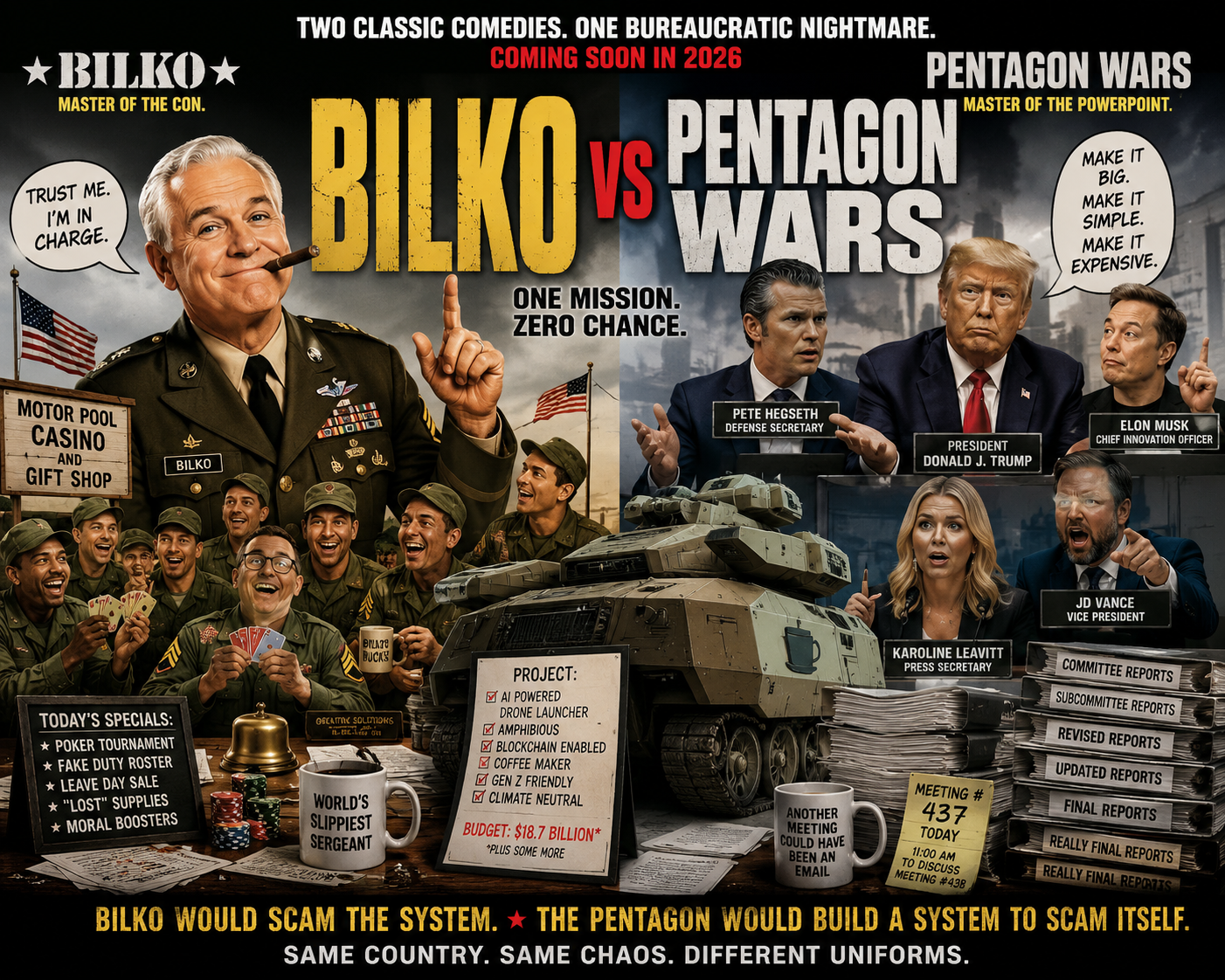
Hollywood announces they’re finally making Bilko vs. The Pentagon Wars.
Steve Martin’s Bilko has somehow become a “Senior Strategic Efficiency Consultant” after accidentally saving the government millions by exploiting loopholes nobody knew existed.
The mission?
Design the military’s next-generation AI-powered, blockchain-enabled, quantum-ready, cloud-native, amphibious, drone-launching, coffee-brewing combat vehicle.
The kickoff meeting begins.
Defense Secretary Pete Hegseth says,
“Let’s keep this simple.”
Thirty-seven meetings later…
Someone suggests adding cryptocurrency integration.
Someone else wants it to moderate social media.
Another person asks if it can be environmentally sustainable while towing a tank.
A consultant explains it should include AI because “our competitors are doing AI.”
Nobody knows who the competitors are.
A procurement officer suggests adding a subscription model.
Someone from marketing insists the camouflage should be available in matte black because it “tests well with younger audiences.”
The budget doubles before lunch.
Meanwhile, Bilko quietly slips out of the meeting.
An hour later he’s back.
He’s sold naming rights to the cup holders.
Negotiated a sponsorship deal with an energy drink company.
Started a fantasy football league for the Joint Chiefs.
And somehow convinced Congress that poker night qualifies as “morale readiness.”
Then President Trump walks into the room.
Looks at the prototype.
Looks at the budget.
Looks at the 1,200-page PowerPoint presentation.
Pauses.
“…Does it work?”
The room falls silent.
Someone finally clears their throat.
“Well… define ‘work.’”
Bilko smiles.
“Depends.”
“If we’re measuring mission success…”
“…absolutely not.”
“If we’re measuring promotions…”
“We’re all getting medals.”
And somewhere…
Phil Hartman’s ghost slowly looks into the camera, sighs one last time, and every American who’s ever sat through a meeting that should’ve been an email immediately understands the joke.
Because the funniest part about Sgt. Bilko and The Pentagon Wars was never the Army.
It was us.