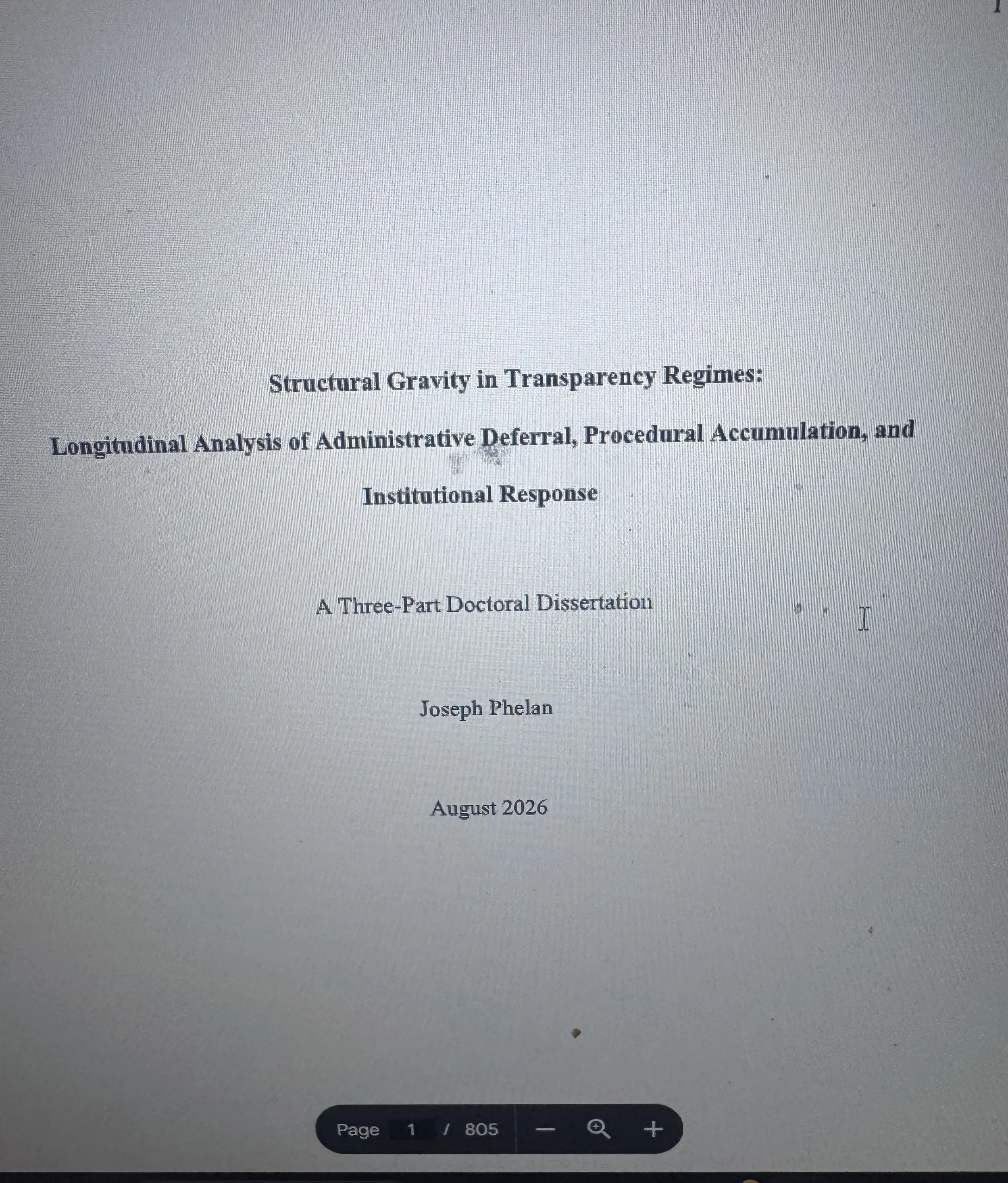
805 pages and years of work
This is what years of F’nAround looks like when you keep asking “why?”
It started with a business dispute with nuEra Cannabis.
Then came the regulators.
Then the FOIAs.
Then the records behind the regulators.
Then the watchmen responsible for watching the regulators.
Then the delays, referrals, contradictions, missing answers, court filings, public records, and thousands of data points that kept creating more questions than they answered.
Somewhere along the way, I stopped looking at individual events and started looking at the system.
What happens when government accountability obligations don’t disappear, but remain unresolved?
What happens when another obligation arrives? And another? What happens when the pressure crosses agencies, oversight bodies, courts, litigation, and public scrutiny?
Can that accumulation actually be measured?
That question eventually became Structural Gravity Theory.
The original cannabis case became the point of origin. The FOIA work became data. Administrative delay became a variable. PAC review led me further upstream, to the people charged with watching the watchmen. Litigation created another independent evidentiary record. And a unanimous jury verdict in my favor on the breach-of-contract claim and against the defamation-related counterclaims became part of a much larger story about the difference between allegation, evidence, process, and adjudication.
Now I’m staring at 805 pages titled:
Structural Gravity in Transparency Regimes: Longitudinal Analysis of Administrative Deferral, Procedural Accumulation, and Institutional Response.
That’s the strange part about research.
You can begin by trying to understand what happened to you and eventually find yourself asking a question that has almost nothing to do with you:
Do institutions behave differently when unresolved accountability obligations accumulate over time?
That’s what I do.
I follow the record.
I keep asking questions.
I measure what happens.
And when the existing explanations aren’t enough, I try to build a framework capable of being tested, challenged, disproven, replicated, and if it survives all of that used by somebody I’ll probably never meet.
A lawsuit eventually ends.
A news cycle disappears.
A FOIA closes.
People move on.
Research doesn’t have to.
If Structural Gravity ultimately survives academic scrutiny, something that began with one cannabis case in Illinois will have traveled from a business dispute, through regulators and transparency systems, into a theory other researchers can test long after every person involved in the original dispute is gone.
From point of origin → records → litigation → data → pattern → hypothesis → theory → academia.
That’s a pretty fucking wild journey for asking one simple question:
Why?