
Raids vs. Reviews: When Crime Gets Prosecuted and When It Gets Processed
Raids vs. Reviews: When Crime Gets Prosecuted and When It Gets Processed
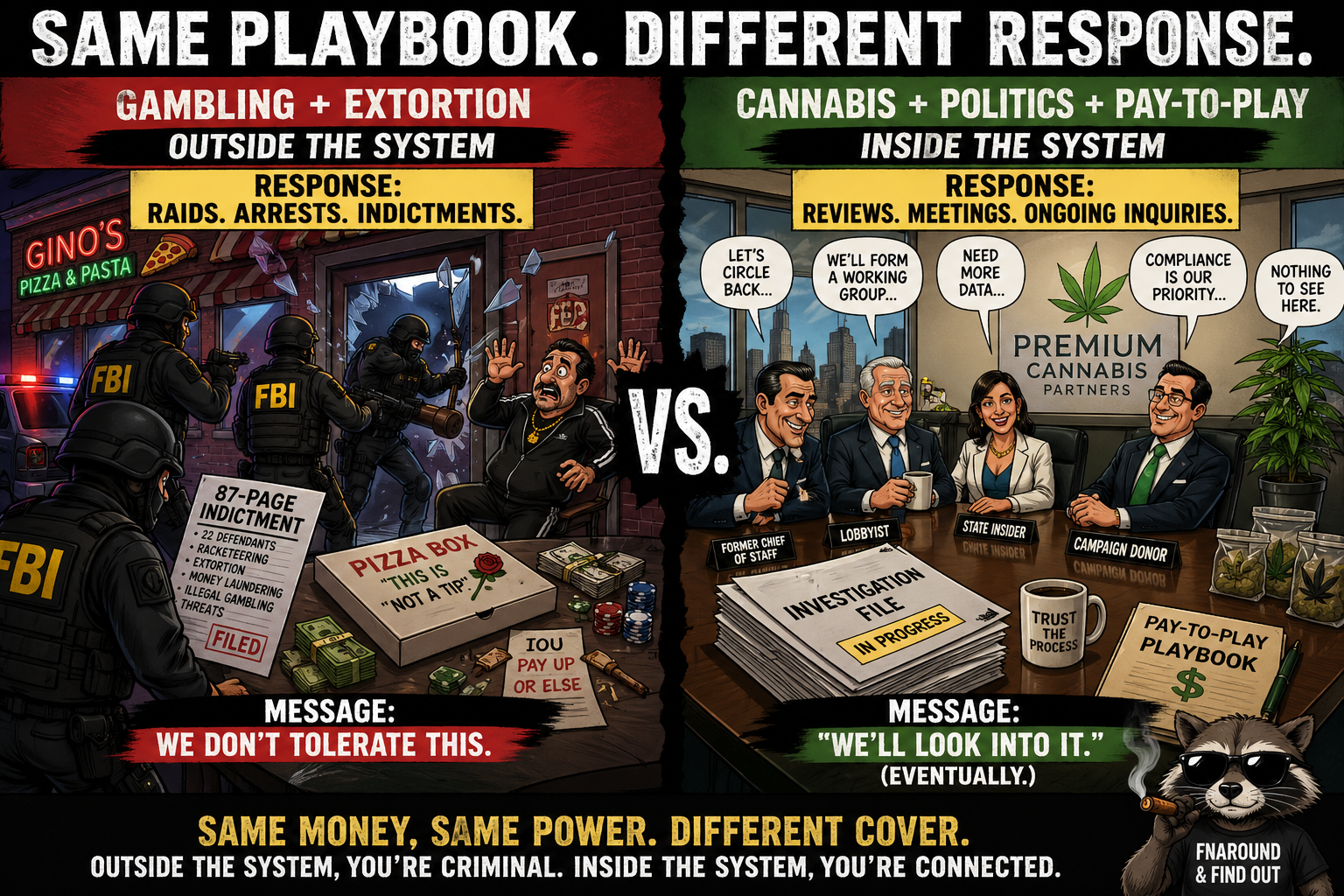
Right now in April 2026, federal authorities unsealed an 87-page indictment charging 22 individuals tied to a multi-state gambling and extortion network operating out of Northwest Indiana. The allegations were direct: illegal betting, coordinated debt collection, intimidation, and the use of local restaurants as fronts.
The response was just as direct.
Raids.
Arrests.
Named leadership.
A full narrative handed to the public.
The system saw something outside itself, and moved to eliminate it.
Now look at Illinois.
For years, reporting has outlined allegations tied to the state’s cannabis industry: pay-to-play hiring, politically connected actors, licensing irregularities, police intimidation, death threats by politicians, bribery, and financial questions that don’t sit clean. In some instances, parties involved in litigation have also alleged intimidation tied to disputes within the industry.
The information exists.
The reporting exists.
The patterns exist.
But the response does not.
No coordinated indictments.
No unified narrative.
No moment where the public is shown how the system works from top to bottom.
Instead, there are reviews. Clarifications. Ongoing inquiries. Administrative movement that stretches across years while the underlying structure remains intact.
This Isn’t About Crime. It’s About Position.
The easy take is cultural. Old-school gambling ring versus modern cannabis corporation.
That’s not the difference.
The difference is whether the activity sits outside the system or inside it.
The Indiana operation used legitimate businesses as cover, but it didn’t depend on regulatory approval to exist. It had no formal relationship with the structure governing it. When identified, it could be isolated and removed without consequence to the system itself.
The cannabis industry in Illinois is different by design. It is licensed, regulated, and politically mediated. Entry into the market is controlled. Oversight is institutional. The system doesn’t just observe the industry, it creates and maintains it.
So when allegations surface, the system is not confronting something external.
It is confronting something embedded.
And embedded problems are not handled the same way as external threats.
One Gets Raided. The Other Gets Reviewed.
In Indiana, the response was decisive because the risk was simple: an external operation violating the law.
In Illinois, the risk is layered. Any serious enforcement action touches licensing decisions, regulatory oversight, and the political networks that shaped both. The question is no longer just whether something happened, it’s what happens next if it’s fully acknowledged.
That’s where enforcement changes.
When the system can act without implicating itself, it acts fast.
When it can’t, it slows everything down.
So instead of raids, you get process.
Instead of indictments, you get investigations that never seem to converge into a single, coherent outcome.
Instead of a public narrative, you get fragments, each accurate on its own, none assembled into a full picture.
Fragmentation Is a Feature, Not a Bug
The Indiana indictment tells a complete story: who did what, how it worked, and why it matters.
The Illinois situation is distributed across time and outlets: One report on political hiring, Another on licensing questions, Another on financial concerns, and Another on disputes and allegations between parties.
Each piece stands alone. Together, they suggest a system. But that system is never formally described in one place.
That’s not accidental.
A fragmented narrative is easier to manage than a unified one.
Because once it’s unified, it stops being a series of issues and starts being a structure.
The Question No One Wants to Answer
Are the underlying behaviors fundamentally different?
Or is the difference in how they’re categorized, and who would be exposed if they were treated the same?
That’s the line the system doesn’t cross easily.
Because in one case, enforcement targets individuals.
In the other, enforcement risks exposing the framework those individuals operate within. How do you prosecute actors you committed crimes to protect?
Do Some Industries Get a Pass?
Not exactly.
What they get is more useful than a pass: Time, Procedure, and Ambiguity
Enough of each, and the outcome starts to look the same.
The Real Divide
This isn’t about whether one group is more criminal than another.
It’s about how institutions respond depending on where the activity sits.
Outside the system → eliminate.
Inside the system → manage.
In Northwest Indiana, allegations turned into an 87-page indictment.
In Illinois, similar patterns turn into years of process.
Not because one is simpler.
But because one is safer to expose.
And one requires exposing oneself to the weight of their own actions so it’s easier to manage the corruption internally.
Gino’s steakhouse paragon restaurant owned by James “Jimmy the Greek” Gerodemos and Dean “Dean Gem” Gialamas in Indiana Gti pay to play ChicagoMoney launderer cannabis licenses owner hidden in ivy hall political death threats and bribery attempts tied to nuEra Cannabis, prairie cannabis, and Botany BayFilippo "Gigi" Rovito, owner of the popular Burr Ridge eatery "Capri,"Political corruption, police intimidation, and cover upIndictment shows According to the indictment, others charged include: Chris Gerodemos, Basam “Donny Brasco” Ibrahim, Sanad “Sanad Taka” Ibrahim, Peter “Pete Goodys” Pavlopoulos, Filippo “Gigi” Rovito, Michael “Michael Way Out” or “Chuckie Hoffa” Campbell, the aforementioned Ehab “Eddie” Mustafa, Steve Armenta, Samuel Nuzzo, Alexander “Alex Gyros” Gagianas, Gus “Deans Runner” Kaporis, Rami “Rami Straight Flush” Mansour, Nenad “Butch Hunkee” Radoja, Marcus “Vladimir Ganz” Ganz, Paul “Paulie Scarf” Franze, Athena Gerodemos, Elias Gerodemos, James “Jim Macedonian” Strezovski, Andrew “Ceasers Andrew” Nguyen, and Giuseppe “Joe Polozzo” Manzi.