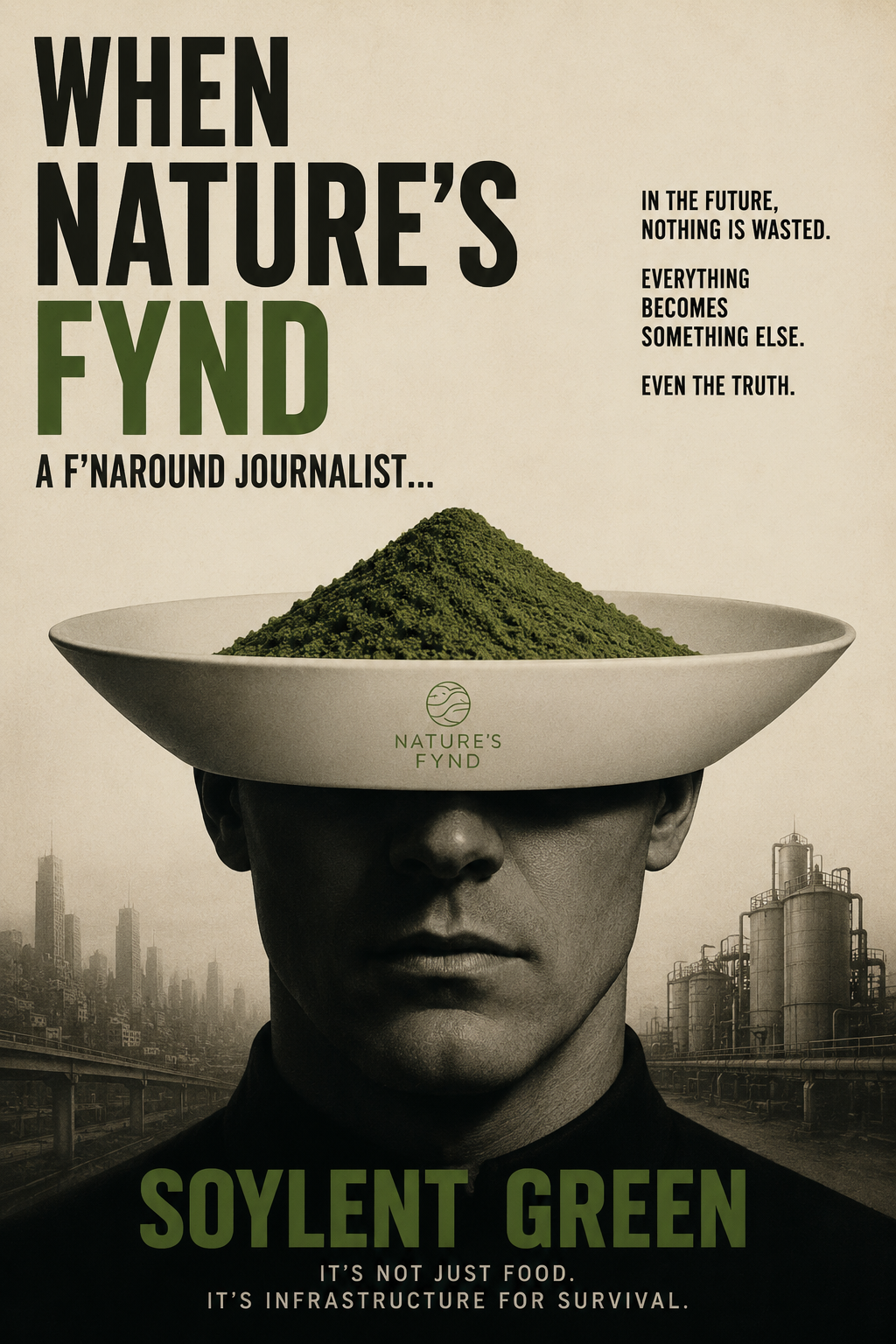
When Nature’s Fynd a F’nAround Journalist
When Nature’s Fynd an F’nAround Journalist
For the last few weeks, something strange kept happening.
One of our correspondents kept getting repeated profile-view alerts from a company called Nature’s Fynd.
Once? Coincidence.
Twice? Marketing team maybe.
But over and over again?
That’s when my brain did what it always does:
it started pulling threads.
Now before anyone panics, no, this is not an accusation. No, this is not some “they’re turning people into protein bars” conspiracy article. Relax. Take a breath. Eat your mushroom breakfast sandwich in peace.
But the question still stuck in my head:
Why is a fungal biotech company tied to NASA research, Yellowstone extremophiles, space-based food systems, closed-loop sustainability models, textile development, and harsh-environment survival technology repeatedly checking out the work of an F’nAround journalist?
Curiosity triggered curiosity.
So I started digging.
Not back through Yellowstone geothermal vents looking for ancient organisms, though admittedly that would’ve made a better intro but through: grants, research papers, FDA filings, spaceflight projects, fermentation systems, fungal protein history, closed-loop ecological systems, and the strange overlap between biotech, survival infrastructure, and science fiction.
And then it hit me.
Not as a fact.
Not as a revelation.
But as a pattern.
A cultural one.
Because the deeper I went into fungal bioreactors, nutrient recovery systems, and long-duration survival ecosystems, the more my brain kept whispering the same thing:
“This feels like the first chapter of a sci-fi movie.”
Not because Nature’s Fynd is secretly building Soylent Green.
They’re not.
But because the underlying technology category forces you to confront a weird reality most people never think about:
Life itself is already a recycling system.
Fungi decompose.
Microbes convert waste into biomass.
Plants grow from death.
Nature endlessly rebuilds itself from previous matter.
Now imagine taking that ancient biological process… and industrializing it.
Miniaturizing it.
Launching it into orbit.
Testing it aboard the International Space Station.
Designing it for harsh environments, limited-resource zones, long-duration missions, and eventually maybe even multi-generational travel systems where every ounce of water, carbon, and nitrogen matters.
Suddenly this stops feeling like “vegan breakfast patties.”
And starts sounding more like infrastructure for the future of survival itself.
That’s where pop culture kicked in for me.
Because science fiction has always asked the same question before science catches up:
What happens when civilization can no longer afford waste?
And that’s when the rabbit hole really began.
Because once you understand what fungal fermentation systems are actually capable of doing biologically, converting nutrients into entirely new biomass structures, you start realizing this isn’t just a food story.
It’s a systems story.
A closed-loop story.
A survival story.
And maybe one of the clearest examples yet of how the future quietly arrives disguised as something mundane enough to fit in the refrigerated aisle at Whole Foods.
And this is where the conversation gets uncomfortable.
Not because anyone is secretly feeding people to people.
But because the deeper you go into fungal systems, microbial fermentation, and closed-loop survival science, the more you realize humanity has spent thousands of years pretending we are separate from the recycling systems that already govern life itself.
Earth has always been a closed-loop ecosystem.
Everything becomes something else eventually.
Forests grow from decay.
Fungi feed on death.
Soil is built from previous life.
Water is endlessly recycled.
Carbon continuously changes form.
Civilization just insulated itself from seeing it.
Traditional farming keeps the process emotionally distant: fields, animals, soil, and sunlight.
But modern bioreactors strip away the illusion.
Once food becomes: nutrient inputs, microbial conversion, biomass engineering, and controlled fermentation, people suddenly confront biology in its rawest form:
Matter is constantly being transformed.
That’s why technologies like Nature’s Fynd feel psychologically bigger than “alternative protein.”
They challenge the visual and emotional framework humans associate with food itself.
And in harsh environments like space stations, submarines, disaster zones, isolated colonies, future long-duration missions, the math changes completely.
Waste stops being waste.
It becomes stored nutrients.
That’s not dystopian.
That’s thermodynamics.
Which is why NASA, climate investors, food conglomerates, biotech researchers, and survival-system engineers are all circling the same category of technology at the same time.
Because the future may not belong to the civilization that produces the most.
It may belong to the civilization that wastes the least.
And maybe that’s why this entire thing feels less like a food startup…
…and more like humanity quietly prototyping the biological infrastructure of a post-scarcity survival system before most people even realize what they’re looking at.
Organizations, Investors, Agencies, Universities, and Major Players Connected to Nature’s Fynd / Sustainable Bioproducts
Nature’s Fynd
Sustainable Bioproducts
NASA
National Science Foundation
United States Department of Agriculture
Environmental Protection Agency
Montana State University
University of Chicago
Polsky Center for Entrepreneurship and Innovation
Breakthrough Energy Ventures
Bill and Melinda Gates Foundation
1955 Capital
ADM
Danone
Generation Investment Management
SoftBank
Mark Kozubal
SpaceX
SpaceX CRS-25
International Space Station
Yellowstone National Park
Astrobiology
Geomicrobiology
Synthetic Biology
Industrial Biotechnology
Fermentation Science
Food Science
Environmental Engineering
Check them out yourselves “a Chicago-based food company producing sustainable meat and dairy alternatives using a unique protein called "Fy," derived from a microbe found in Yellowstone National Park's geothermal springs. Founded in 2012, they create products like breakfast patties, dairy-free cream cheese, and yogurt using a nutrient-efficient, high-protein fungi-based fermentation process”: www.naturesfynd.com
According to Wikipedia: Nature's Fynd (formerly known as Sustainable Bioproducts LLC and focused on biofuel)