When Gravity Stops Bending: A Structural Test of IDFPR Enforcement and Ethics
When Gravity Stops Bending: A Structural Test of IDFPR Enforcement and Ethics
Over the past year, F’nAround has not focused on individuals. It has focused on systems.
Not motives. Not intent. Not personalities.
Processes.
Because processes don’t lie. They accumulate.
And when mapped correctly, they reveal something far more powerful than any allegation: consistency or the lack of it.
What began as a series of FOIA requests evolved into something else entirely. Not by design, but by response. Each delay, each exemption, each deferral wasn’t just a denial, it was data. A procedural footprint. A measurable deviation from statutory expectation.
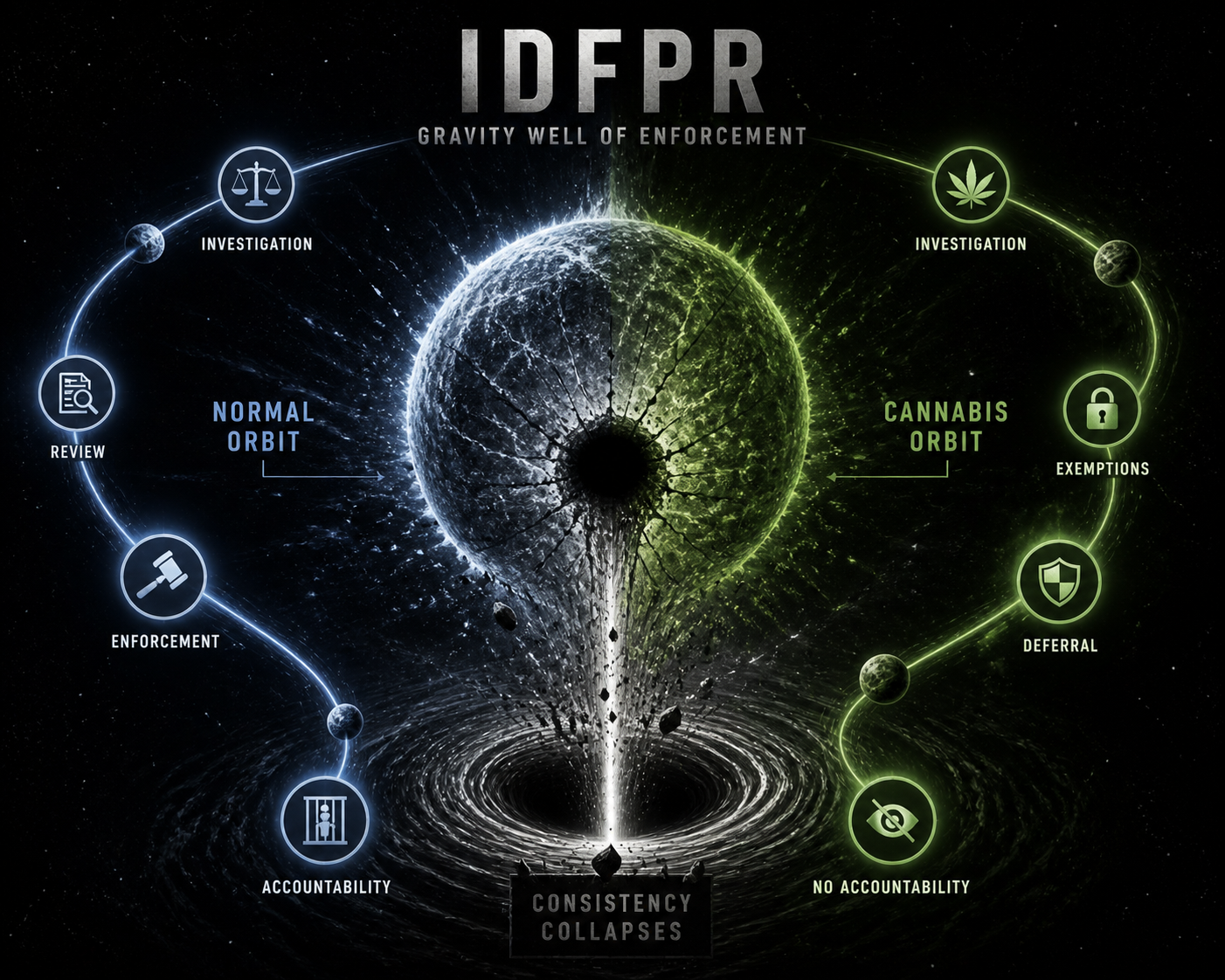
In structural terms, this is what we refer to as a gravity well.
A point in a system where decisions, once made, begin to pull future outcomes toward them. Not because anyone intends it, but because systems like physics favor consistency over correction.
And in Illinois, one of the clearest gravity wells identified through this process sits at the intersection of regulatory enforcement and disclosure: the repeated use of privacy exemptions, retaliation avoidance failures, and what has been described as “top drawer” handling at the Attorney General level.
At first glance, each instance appears isolated. A denied request here. A redacted record there. A delayed response justified by administrative burden.
Individually, none of it proves anything.
Collectively, it becomes pattern.
Under Illinois law, money laundering is not ambiguous.
It is not conditional.
It is not industry-specific.
It is not discretionary.
It is a felony.
That matters, not because of the statute itself, but because of what it represents: a fixed point in the system. A non-negotiable boundary.
Everything else,
regulatory oversight, licensing, enforcement, must operate around that fixed point.
Or it stops being a system.
The tension now isn’t theoretical. It’s procedural.
On one side, you have prior instances where ownership information tied to regulated entities was withheld under claims of privacy, later contradicted by publicly available reporting indicating regulatory inconsistencies and potential disqualifying factors.
On the other, you now have a separate, unrelated pathway, an unsealed document, where sworn testimony reportedly includes admissions describing conduct that would fall within the same statutory framework.
Two independent inputs.
Same fixed legal boundary.
In the unsealed record, testimony describes an Illinois cannabis executive, license holder, and owner outlining a payment structure in which funds from multiple dispensaries were routed to a construction LLC not authorized to perform cannabis-related work in Illinois, with the explanation that payments were made to whichever entity was designated by the party performing the work. Framed one way, it is characterized as operational convenience. Framed under existing statutory definitions, the same structure raises questions of improper financial routing, regulatory circumvention, and whether such conduct falls within Illinois’ felony treatment of money laundering, an area the state maintains is subject to zero tolerance.
At this point, structural gravity becomes observable, as the system is left with only two options:
They can correct toward consistency. Apply the same statutory framework regardless of industry, entity, or exposure. Treat the admission as it would be treated in any other context. Enforce.
Or they can reinforce the existing gravity well. Maintain prior patterns of deferral, shielding, or segmentation. Treat the scenario as exceptional. Absorb the inconsistency rather than resolve it.
There is no third option that preserves systemic integrity.
This will matter beyond one case.
This isn’t about cannabis.
It isn’t about one company.
It isn’t even about one agency.
It’s about whether a regulated market operates inside the law or adjacent to it.
Because once a system demonstrates that enforcement is conditional, the law stops functioning as a boundary and starts functioning as a variable.
And variables can be managed.
Boundaries cannot.
This problem is now irreversibile.
There’s a principle in systems analysis: once information enters the system, it cannot be removed, only responded to.
“Ignorance is bliss” works only until the moment the system knows.
After that, every non-response becomes a response.
Every delay becomes a position.
Every exemption becomes part of the record.
That’s where Illinois now sits.
Not at the point of allegation.
At the point of acknowledgment.
The actual questions can now be asked.
The question is no longer whether a violation could occur within a regulated framework.
The question is simpler and more dangerous:
Does the system respond to a known felony classification the same way every time?
Or does it respond differently when the variables change?
Because if it’s the latter, then what’s being tested isn’t a company.
It’s the system itself.
The outcome isn’t speculative.
If the system corrects, the gravity well collapses.
If it doesn’t, it deepens.
And once it deepens past a certain point, it stops being a regulatory environment and starts being something else entirely, one where enforcement isn’t absent, but selective.
At that point, the issue is no longer legal.
It’s structural.
Remember…
One instance can be explained.
Two instances create a pattern.
Three instances define a system.
Illinois is no longer at one.
F’nAround Media
Testing gravity where systems claim it doesn’t exist