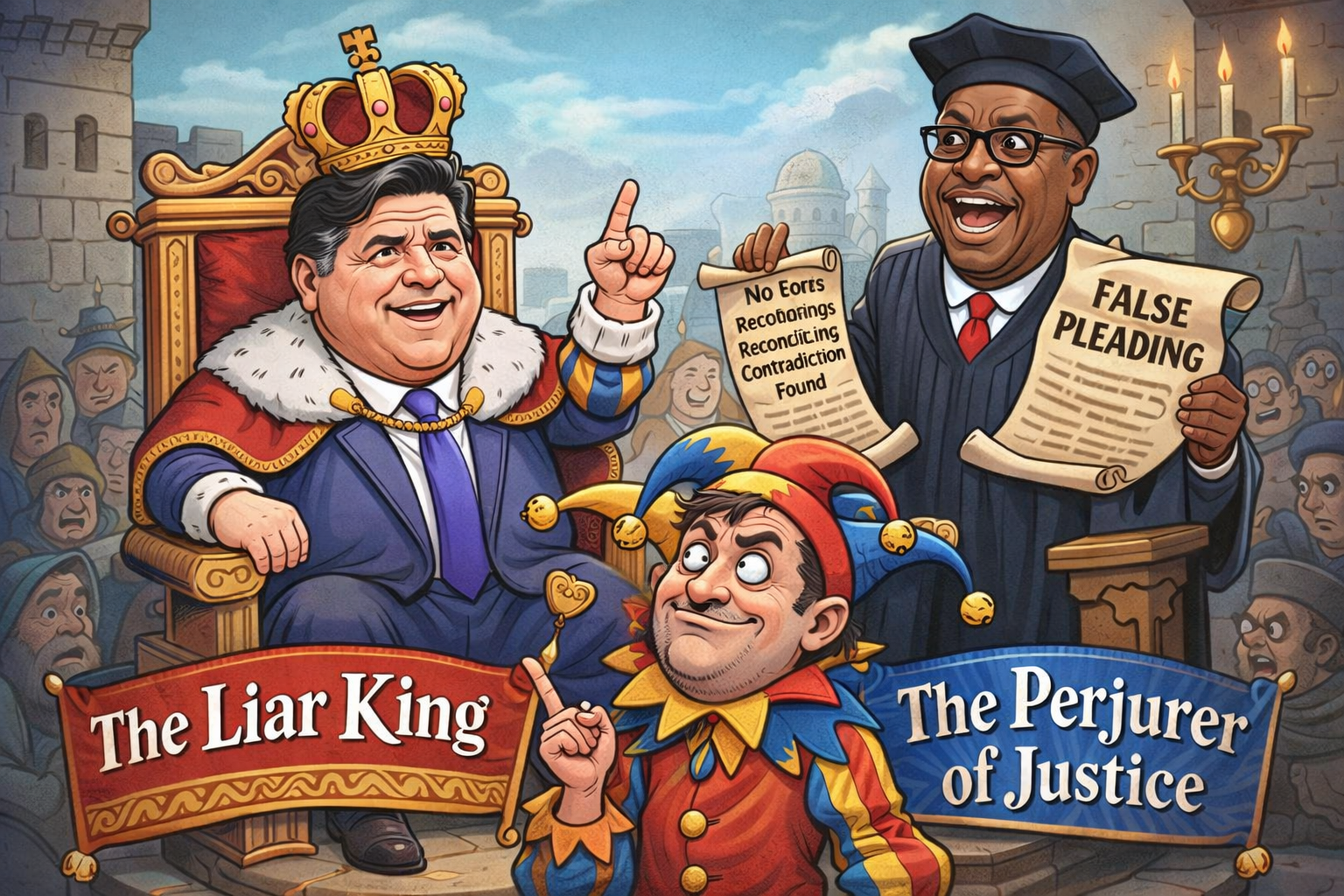
Is it a Liar King or a Perjurer of Justice?
Is it a Liar King or a Perjurer of Justice?
A Courtly Fable in One Unresolved Act
Long ago or possibly just a few filing deadlines ago there existed a grand kingdom that prided itself on justice, equity, and well-crafted press releases.
At the center of this kingdom sat The King, robed in virtue, proclaiming from balconies and podiums that the realm’s great laws were forged for the people. For the overlooked. For the marginalized. For those long denied a seat at the banquet table.
Across the hall stood The High Justice, keeper of scrolls, wielder of sworn parchment, defender of the realm in formal contests of law. When challengers appeared, the High Justice spoke not in speeches, but in pleadings, solemn documents sealed with oath and consequence.
And here is where the court grew… awkward.
Because while the King declared one truth to the public square, the High Justice advanced another truth before the bench.
Not shouted.
Not announced.
Simply… filed.
Two truths.
Same kingdom.
Same time.
Same law.
And no one, absolutely no one, explained how both could stand.
Enter the Jester
Now, every good medieval court has a fool.
Not a fool by intellect, but by license.
A jester is the only one allowed to ask the forbidden question without losing his head.
And this jester, weary of applause and proclamations, did something profoundly un-jesterlike:
He asked for the paperwork.
Not rumors.
Not motives.
Not whispers in corridors.
Just the records.
He filed formal requests to the royal offices, politely asking:
“Surely, somewhere in the castle, there must be a memorandum.
A letter.
A discussion.
A meeting note.
Something explaining how the King’s public truth and the Justice’s sworn truth were reconciled.”
Weeks passed.
Then months.
The reply finally arrived.
It read, in essence:
There are no such records.
No reconciliation.
No discussion.
No strategy.
No explanation.
Just silence, stamped and certified.
A Thought That Wouldn’t Leave
And that’s the thing about unanswered contradictions.
They don’t explode.
They echo.
Months later, the jester still found himself awake at night, staring at the rafters, wondering:
“How is this allowed to exist?”
“How can two arms of the same kingdom swear opposing truths and never resolve the difference?”
“Is this how justice works, not by deciding, but by never concluding?”
The court, meanwhile, carried on.
The King continued speaking.
The Justice continued filing.
And the contradiction sat between them like an unclaimed crown.
The Ghost of Triboulet
History remembers a jester named Triboulet, who served kings by saying what no one else dared. He mocked power not to destroy it, but to expose its fractures.
Triboulet knew something courts often forget:
When truth cannot be reconciled, laughter becomes evidence.
Not because it’s unserious
but because it reveals what everyone else is pretending not to see.
So the modern jester did not accuse.
Did not declare liars.
Did not shout “perjury” into the hall.
He simply held up the empty scroll and said:
“Behold. This is where the explanation should be.”
The Unfinished Act
This tale has no verdict.
No execution.
No dramatic downfall.
Only an unresolved question, preserved in the public record:
When sworn law and proclaimed policy diverge
and no one documents why
is that justice… or just very good stagecraft?
The jester keeps score, not out of malice, but out of habit.
Because someone must.
After all, in every kingdom that claims righteousness, the most dangerous figure is not the rebel…
It’s the fool who asks for the receipts.
Fin
Footnote: What This Article Refers To
This article refers to a documented conflict identified through formal Freedom of Information Act (FOIA) requests and public court filings involving the State of Illinois.
Specifically:
In litigation where the Illinois Attorney General’s Office represented the Illinois Department of Agriculture, sworn pleadings were filed asserting that certain cannabis licenses issued under the Cannabis Regulation and Tax Act (CRTA) were not intended to benefit minorities or disproportionately impacted communities.
These sworn litigation positions conflicted with public statements and policy representations made by the Governor of Illinois and the executive branch, which consistently characterized the CRTA and its licensing framework as explicitly designed to promote equity and minority participation.
To determine whether this contradiction had been internally addressed, reconciled, or discussed, a FOIA request was submitted to the Governor’s Office seeking any records, correspondence, memoranda, or strategy documents analyzing or resolving the inconsistency between:
the Attorney General’s sworn court filings, and the Governor’s publicly stated policy positions.
On November 10, 2025, the Governor’s Office formally responded that no such records exist.
No documents were produced showing any internal analysis, reconciliation, clarification, or policy alignment addressing the contradiction between sworn legal statements and executive policy declarations.
This article does not allege criminal conduct, intent, or motive.
It examines a documented procedural and institutional inconsistency, and the absence of any recorded effort to reconcile it, as reflected in official records obtained through lawful public records requests.
Rather than speculate, the author asked the Attorney Registration and Disciplinary Commission to decide which official statement reflects the law. That determination is pending.