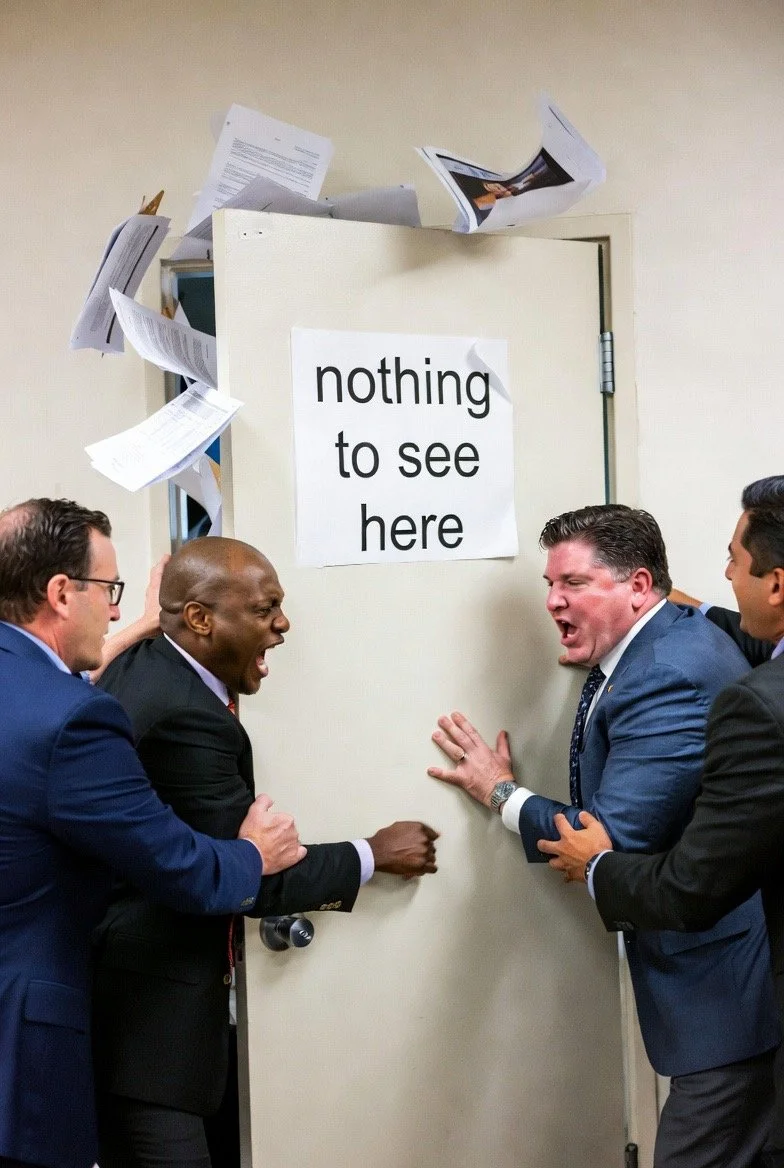
The Weight of Oversight Deferred
The Weight of Oversight Deferred
While discussing my dissertation on Gravitas Satanae, the theory that institutional decisions accumulate measurable weight over time until they force collapse or correction, a friend said something that stuck with me:
“This is what Illinois does. You aren’t the first, and you won’t be the last. They have procedures that allow unresolved issues to persist without formal resolution.”
At first, I agreed. In theory, that statement tracks with lived experience. But something about it bothered me.
Not the cynicism, the mechanics.
If Illinois truly has procedures to hide misconduct, the question isn’t whether corruption exists. The question is how it is operationalized in plain sight. Not through dramatic coverups, but through administrative processes that appear lawful, neutral, and routine.
That’s when I asked myself a different question:
What if the cover-up isn’t denial, but delay?
The Unresolvable Decision
Since September, I have had a matter pending before the Illinois Public Access Counselor (PAC) involving records tied to sworn testimony and documented conduct that regulators permitted to occur.
The conflict is obvious to anyone familiar with administrative law:
On one side: claims of corporate privacy
On the other: public records concerning regulatory conduct, sworn admissions, and oversight failures that statutes explicitly require to be transparent
There is no clean resolution.
Any decision necessarily harms either: a regulated industry, a state agency, or elected oversight itself.
Two Assistant Attorneys General informed me in November that the matter was complete and awaiting final approval. That response, I was told, was imminent.
It is now February.
There is still no decision.
And that delay is what led me to the dataset.
The List That Shouldn’t Exist
So I requested the PAC status records. While reviewing PAC records, I noticed something extraordinary: Thousands of PAC matters remain marked “open”, some dating back years, not weeks, not months, but multiple administrations.
Cases that were: argued, briefed, reviewed, and in many instances functionally decided,
yet never formally closed.
That’s not backlog.
That’s a pattern.
A Hypothesis Forms
What if when the PAC is placed in a position where a final decision would: expose regulatory failure, contradict agency testimony, create political liability, or force corrective action against the state itself,
the solution is neither approval nor denial?
What if the solution is permanent deferral?
A case left “open” requires: no enforcement, no appeal, no disclosure, Or no accountability.
It exists in administrative limbo,
legally alive, functionally buried.
If true, this would not be corruption in the cinematic sense.
It would be corruption by procedure.
What Gravitas Satanae Predicts
Gravitas Satanae does not ask whether institutions are inherently corrupt.
It asks whether their decisions compound measurable weight over time.
Every delayed ruling.
Every unresolved record.
Every “pending” file that should have been resolved.
Individually, these acts appear insignificant.
Collectively, they create structural gravity.
And gravity does not care about intent.
It only cares about accumulation.
The theory predicts that systems relying on deferral instead of resolution do not remain stable. They become more legible, not less. Patterns emerge. Outside observers begin to notice what insiders normalize.
The very mechanism designed to avoid consequence becomes the evidence of dysfunction.
The Inevitable Question
So the question is no longer:
“Is Illinois corrupt?”
The question is:
“How many unresolved records does it take before the system proves it cannot correct itself?”
Because records that never close do not disappear.
They wait.
And weight, once accumulated, does not dissipate quietly.
This is not outrage.
This is not conjecture.
This is what the paperwork says when it’s allowed to speak for itself.
Gravitas Satanae was never about exposing wrongdoing through volume or noise.
It was about measuring what happens when institutions refuse to conclude their own decisions.
And Illinois, it turns out, has been keeping score the entire time.
Accordingly, we requested the underlying FOIA requests and agency responses corresponding to these open PAC matters.
When oversight is deferred through unresolved records, the only way to evaluate the system is to examine the records themselves as the primary evidence of system behavior.
Why were these thousands of records deferred in limbo for eternity?
If you want to see the list… just ask.