Kentucky's Cannabis Regulators Had an Answer. Then They Stopped Answering.
Kentucky's Cannabis Regulators Had an Answer. Then They Stopped Answering.
F’nAround Media Investigation | October 10, 2026
Kentucky's young medical cannabis program faces questions about ownership, vertical integration, and regulatory oversight after internal government emails reveal officials preparing a response to F’nAround Media's investigation. Nearly seven weeks later, the promised explanation still hasn't arrived.
Kentucky hasn't even had time to become a seasoned medical cannabis market, and already its regulators are facing questions that sound remarkably familiar to anyone who has followed the cannabis industry in Illinois.
Who owns what? Who approved it? Who investigated it? And when regulators possess information that could affect licensing compliance, who makes sure anyone actually does something about it?
For Kentucky's Office of Medical Cannabis (OMC), those questions have become particularly uncomfortable in connection with Armory Kentucky, LLC, and its reported relationship to the nuEra cannabis business network.
F’nAround Media has been investigating whether ownership arrangements involving nuEra Cannabis affiliated businesses created vertical-integration concerns under Kentucky's medical cannabis regulations.
The investigation involves ownership records, regulatory approvals, sworn testimony in Illinois litigation, and Kentucky government correspondence.
And now, internal emails identify the government officials who were involved in discussing how to respond.
The problem?
The agency prepared an explanation. Its public affairs office promised to get back to us. Then the substantive answer never came.
The Question Kentucky Didn't Want to Leave Unanswered
On August 21, 2026, F’nAround Media contacted Georgiana Ledford, general counsel for Kentucky's Office of Medical Cannabis, seeking clarification about the agency's handling of ownership information involving Armory Kentucky.
The question was straightforward.
OMC's supplemental records response, as described in the correspondence, indicated that the agency possessed correspondence, preliminary notes, analyses, and recommendations concerning relevant applications.
But it also reported having no responsive records documenting communications or referrals to Kentucky's Office of Inspector General concerning the specified ownership and vertical-integration issues.
That presented an obvious question:
Did OMC possess and analyze ownership information relevant to potential vertical integration without communicating it to the inspector general or referring it for investigation?
F’nAround asked Ledford to identify anything inaccurate about that characterization before publication.
This was an opportunity for the agency to explain its own records.
Instead, the question traveled through Kentucky's government.
Meet the People on the Email Chain
On August 21, Oran "Scotty" McFarlan, deputy executive director of the Office of Medical Cannabis, forwarded the inquiry to Kendra Steele, executive director of public affairs for the Kentucky Cabinet for Health and Family Services.
The correspondence included Cannon Armstrong of OMC, Georgiana Ledford of the agency's legal office, and Sam Flynn of the Governor's Office.
McFarlan explained that Ledford had prepared a proposed response for consideration.
That draft contained an important statement:
"OMC continually monitors licensee compliance with governing law."
It cited Kentucky Revised Statutes Chapter 218B and 915 KAR Chapter 1.
The draft also acknowledged that OMC conducts internal ownership analyses as part of its application-review responsibilities.
And then came the most significant passage.
According to the proposed response:
"OMC does not refer licensee compliance issues to the Office of Inspector General (OIG)."
The draft explained that OMC itself has responsibility for investigations and appropriate action involving licensees and applicants.
That's quite a distinction.
Because if OMC is responsible for investigating compliance, the agency cannot simply point to the inspector general's absence from the record as an explanation of what happened.
The relevant question becomes whether OMC conducted the necessary compliance review itself and what it concluded.
To be clear, this was a proposed internal response, not a final agency determination delivered to F’nAround. The correspondence does not establish that the draft was formally adopted.
But it does establish that senior officials were discussing the question and had a substantive response available for consideration.
The Governor's Office Was Included
The correspondence also identifies Sam Flynn of the Kentucky Governor's Office among the recipients of the internal discussion.
That matters because the inquiry had moved beyond a routine open-records exchange.
It involved agency counsel, OMC leadership, cabinet public affairs officials, and a Governor's Office representative.
On August 24, Kendra Steele responded:
"Thank you, Scotty. I am adding Beth to assist with this response."
That brought Elizabeth "Beth" Fisher, deputy executive director of public affairs for the Cabinet for Health and Family Services, into the matter.
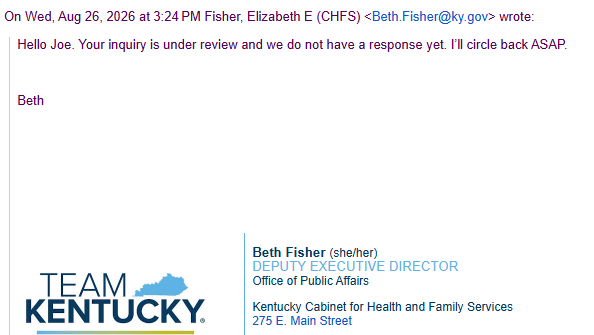
Two days later, Fisher contacted F’nAround Media.
Her first question was whether the publication was on deadline.
She subsequently wrote:
"Your inquiry is under review and we do not have a response yet. I'll circle back ASAP."
F’nAround supplied additional context, including the Kentucky investigation timeline and related research materials.
Fisher acknowledged the correspondence. She even spoke with us on the phone letting us know a follow-up would come.
As of October 10, 2026, F’nAround Media reports receiving no substantive follow-up from Fisher answering the original question.
The agency had identified the question, circulated it internally, prepared a proposed response, and assigned public affairs personnel to assist.
But the promised clarification never materialized.
Meanwhile, nuEra's Ownership Became the Bigger Question
The unanswered correspondence is only one part of the investigation.
F’nAround's reporting concerns the relationship between Armory Kentucky and businesses associated with nuEra, including the significance of ownership arrangements for Kentucky's restrictions on vertical integration.
The broader investigation includes sworn testimony from Illinois litigation in which, according to F’nAround's account of the proceedings, nuEra Cannabis associated ownership interests in Kentucky were acknowledged under oath. Rumor has it they intend to appeal all their losses, when that occurs we’ll post the testimony by Laura Jaramillo Bernal and open a civil rights suit in Kentucky for violation and coverup of regulation violations. As we learned in Illinois, when cannabis regulators face credible allegations of concealing misconduct and enabling potential federal crimes to protect industry operators, it may take a federal civil rights investigation to force meaningful scrutiny and begin restoring integrity to a regulatory system that has failed to hold itself accountable.
That testimony raises a question that Kentucky's regulators should be able to answer with licensing records:
What ownership information did OMC have when it reviewed and approved the relevant applications or transactions?
Kentucky's rules require ownership disclosures. OMC's own proposed response acknowledged that such disclosures are reviewed for compliance.
But the correspondence supplied to F’nAround does not reveal the contents of the withheld analyses, establish that a prohibited vertical-integration arrangement existed, or demonstrate that any specific official knowingly approved an unlawful arrangement.
Those distinctions matter.
An ownership interest in multiple businesses does not automatically establish prohibited vertical integration. The precise license categories, ownership percentages, control arrangements, timing, and applicable regulatory exceptions must be examined.
What the documents do establish is that OMC recognized the regulatory significance of ownership review and had internal records that were not fully released.
The public still deserves to know what those records showed and how the agency applied its own rules.
What Did the Inspector General Know?
F’nAround's August 21 inquiry also raised questions about the information available to Kentucky's Office of Inspector General.
OMC's supplemental response, as described in the emails, identified no responsive records of communications or referrals concerning the specified Armory Kentucky ownership issues.
Yet OMC acknowledged the existence of internal application-related materials.
That leaves an important information gap.
If one part of Kentucky government possessed relevant ownership information while another office did not receive it, what effect did that have on any oversight findings?
Was the information outside the inspector general's jurisdiction? Was it reviewed entirely within OMC? Did the agency find the ownership structure compliant? Or did the agency identify concerns and resolve them without creating records responsive to the request?
The proposed response offered one explanation: OMC believed licensee compliance investigations were its own responsibility, not the inspector general's.
That explanation makes OMC's internal review and decision-making especially important.
A lack of referral is not, by itself, proof of a cover-up. But it also is not evidence that the underlying ownership arrangement was lawful.
And What About the Governor's Office?
F’nAround has separately sought clarification from the Governor's Office concerning the state's treatment of vertical integration.
According to F’nAround's account of that exchange, the Governor's Office has not provided a statement endorsing or explaining approval of the disputed ownership arrangement.
That absence should not be mistaken for an official finding of wrongdoing.
It does, however, leave the regulatory agency responsible for explaining how its licensing decisions complied with Kentucky law.
The August correspondence shows that a Governor's Office representative was copied on the internal discussion. It does not establish that the governor personally reviewed the matter, approved the transaction, or directed the agency's response.
The distinction is important because public accountability should follow documented decisions not assumptions about who knew what.
A New Cannabis Program, an Old Regulatory Problem
Kentucky's medical cannabis industry is still developing.
That makes the questions surrounding its early ownership approvals particularly significant.
A state establishing a regulated market has an opportunity to create a transparent record of how applications are evaluated, how ownership restrictions are enforced, and how potential conflicts are resolved.
Instead, this investigation has produced a familiar pattern:
An agency acknowledges internal analyses. A journalist asks what those analyses mean. Senior officials discuss a response. Public affairs promises clarification. The explanation never arrives.
In the meantime, the agency's licensing decisions remain in place.
None of that alone establishes misconduct.
But it does create an accountability problem.
If Kentucky's regulators determined that the Armory Kentucky arrangements complied with the law, the public should be able to understand the legal and factual basis for that determination.
If the agency found problems, the public should be able to determine what corrective actions followed.
And if the agency never evaluated the specific relationship now being questioned, that deserves an explanation too.
The Gravity of an Unanswered Question
In F’nAround's ongoing research into institutional behavior, this is an example of what we call structural gravity: the cumulative pressure created when government institutions leave substantive questions unresolved while continuing to carry out their administrative responsibilities.
An unanswered question doesn't necessarily disappear when an official stops responding.
Sometimes it becomes more consequential as additional records, testimony, and agency decisions accumulate.
Kentucky's Office of Medical Cannabis now has an opportunity to explain the ownership review, the applicable vertical-integration requirements, and the absence of responsive inspector-general referral records.
Georgiana Ledford, Scotty McFarlan, Kendra Steele, and Beth Fisher all appear in the documented correspondence concerning the inquiry. Sam Flynn of the Governor's Office was copied on the internal discussion.
Their inclusion in the correspondence does not establish individual wrongdoing. It does establish that the questions reached identifiable officials. It shows they knew what they approved and what they hid.
And nearly seven weeks after Fisher promised to circle back, F’nAround still has no substantive answer.
Because sadly in the end if they followed their own regulations and didn’t violate them for a company they would be able to answer.
Kentucky's medical cannabis program is young. The public's expectation that regulators explain their decisions should not have to wait for the industry to grow up.
The question remains the same as it was on August 21:
What did OMC know about the ownership arrangements, what did it determine, and why hasn't it explained that determination? Or fixed like their regulations dictate?
F’nAround Media will continue reviewing Kentucky's medical cannabis licensing records, ownership disclosures, sworn testimony, and agency correspondence as additional documentation becomes available.
Source documentation: Kentucky Cabinet for Health and Family Services and Office of Medical Cannabis email correspondence, August 21–26, 2026; F’nAround Media open-records correspondence and reporting. The internal proposed response is distinguished from an officially issued agency statement. The sworn-testimony and Governor's Office accounts are available upon request.