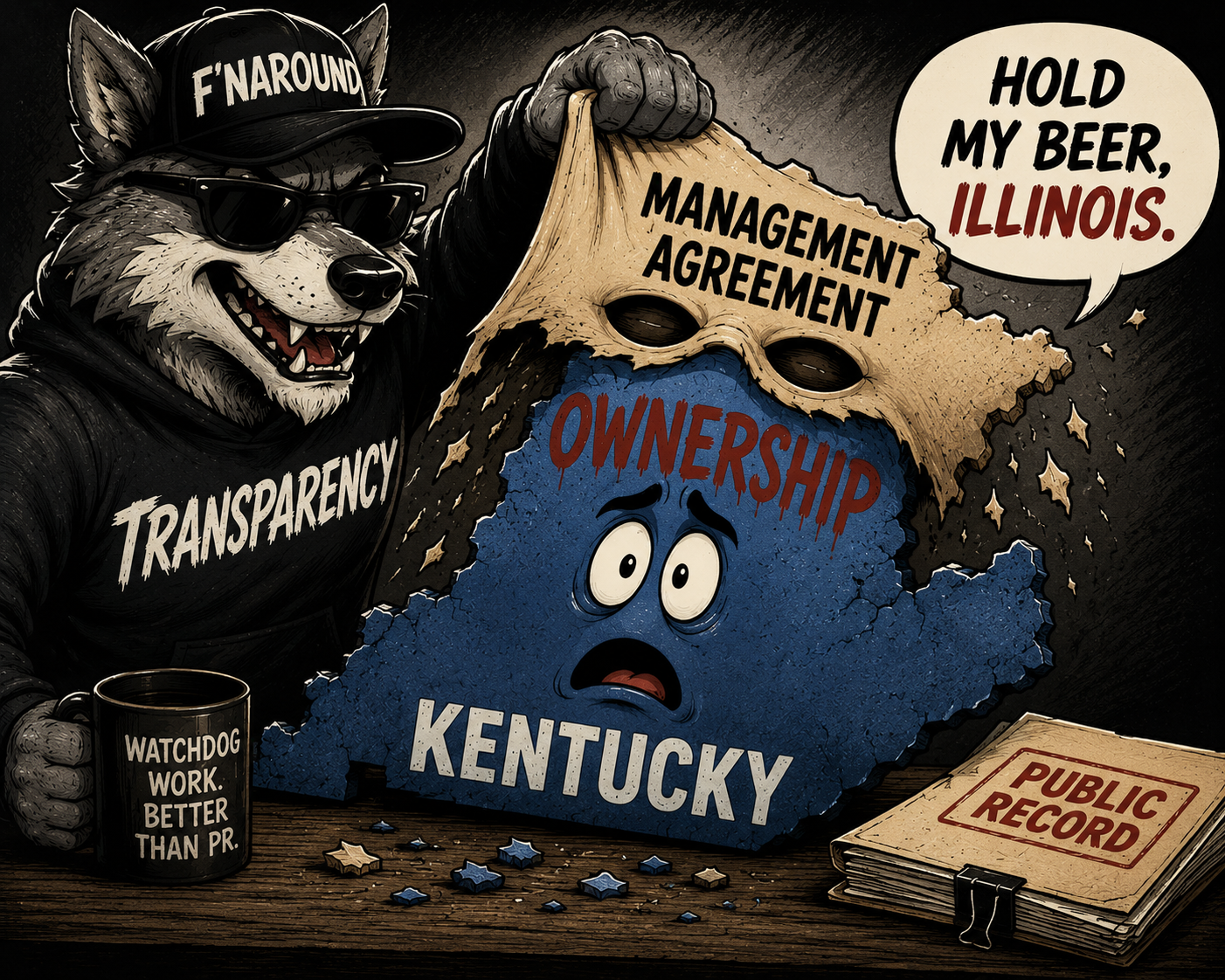
The Facts Didn’t Change. Kentucky’s Answer Did.
The Facts Didn’t Change. Kentucky’s Answer Did.
There is a difference between discovering new facts and changing an explanation.
One is normal.
The other deserves scrutiny.
Over the past several months, I have been filing open records requests with Kentucky’s medical cannabis regulators seeking information about ownership, control, management relationships, operational authority, and compliance with Kentucky’s cannabis laws.
The question never changed.
Who owns what?
That question matters because ownership is not a technicality in cannabis regulation.
Ownership determines control.
Control determines influence.
Influence determines whether a market remains competitive or whether it slowly consolidates behind a handful of operators connected through management agreements, financial interests, operational control, or ownership structures.
That is why states spend years building cannabis regulations around ownership disclosures, beneficial interests, transfer approvals, operational control reviews, and restrictions designed to prevent improper consolidation.
Without transparency regarding ownership, the entire regulatory framework becomes little more than paperwork.
Which is why Kentucky’s recent responses are so difficult to reconcile.
On May 22, Kentucky’s response centered on management agreements.
The explanation was straightforward.
Management agreements existed.
Management agreements were reviewed.
Management agreements did not appear to create the issue being alleged.
That was the answer.
Then seven days later, on May 29, Kentucky released records that shifted the discussion entirely.
Suddenly the record included ownership reviews.
Transfer approvals.
Operational control reviews.
License sale applications.
Internal analyses.
Regulatory reviews of ownership structures.
Most importantly, the events reflected in those records did not occur between May 22 and May 29.
Many existed months earlier.
Some trace back to January.
The facts did not change.
The records did not suddenly appear.
The transactions were not newly created.
The underlying timeline already existed.
Which raises an uncomfortable question.
How does a regulator spend months discussing management relationships only to release records days later showing ownership reviews, transfer approvals, operational control analyses, and internal reviews that had already existed the entire time?
That question becomes even more important when viewed in the context of Kentucky’s broader cannabis program.
Kentucky’s medical cannabis market is not a mature program with decades of regulatory history.
It is brand new.
Less than two years old.
And already the program finds itself facing public scrutiny over licensing procedures, lawsuits challenging aspects of the licensing process, and public debate over transparency and fairness. News coverage this month highlighted both ongoing litigation challenging parts of the program and state findings defending the licensing process as fair and transparent.
That makes transparency more important, not less.
When a new regulatory program faces criticism, the solution is not confusion.
The solution is clarity.
Yet the timeline here moves in the opposite direction.
A watchdog asks ownership questions.
The state responds with management explanations.
The watchdog asks follow-up questions.
The state responds with ownership reviews.
The watchdog asks for clarification.
The state acknowledges additional internal ownership analyses, operational control reviews, transfer evaluations, and compliance reviews exist but declines to release them.
At some point the issue stops being cannabis.
It becomes credibility.
Because regulators do not get judged solely by whether they follow the law.
They get judged by whether their explanations remain consistent.
The public can accept bad news.
The public can accept mistakes.
The public can even accept that a regulator changed its position because new facts emerged.
What the public struggles to accept is when the facts remain constant while the explanation changes around them.
That is the question Kentucky now faces.
Not whether management agreements existed.
Not whether ownership reviews occurred.
Not whether transfer approvals were issued.
The records establish all of those things.
The question is why the public was hearing one explanation while the agency’s own files contained a much larger story.
And that question matters because cannabis regulation depends on public confidence.
Every license.
Every approval.
Every ownership disclosure.
Every transfer.
Every enforcement action.
Every denial.
Every approval.
All of it ultimately rests on one assumption:
That regulators are applying the rules consistently and explaining their decisions honestly.
Kentucky’s cannabis program is still young enough to earn that confidence.
But confidence is not created by asking the public to trust the answer.
Confidence is created by showing the public the records that produced it.
If Kentucky’s ownership reviews, operational control analyses, transfer approvals, and compliance determinations fully support the conclusions regulators reached, then releasing a clearer explanation should be easy.
Until then, the most important fact in this story remains unchanged.
The facts did not change.
The answer did.
Thankfully for the commonwealth of Kentucky, The Kentucky Finance and Administration Cabinet Office of the Inspector General (OIG), and Governor Andy Beshear they issued their reporting on transparency about their investigation into the Kentucky Office of Medical Cannabis (OMC) May 9 just five days before an agency response that would later appear difficult to reconcile with records already in the state’s possession.…
FOIA timeline for the commonwealth of Kentucky
Article on Kentucky verifying vertical integration happening