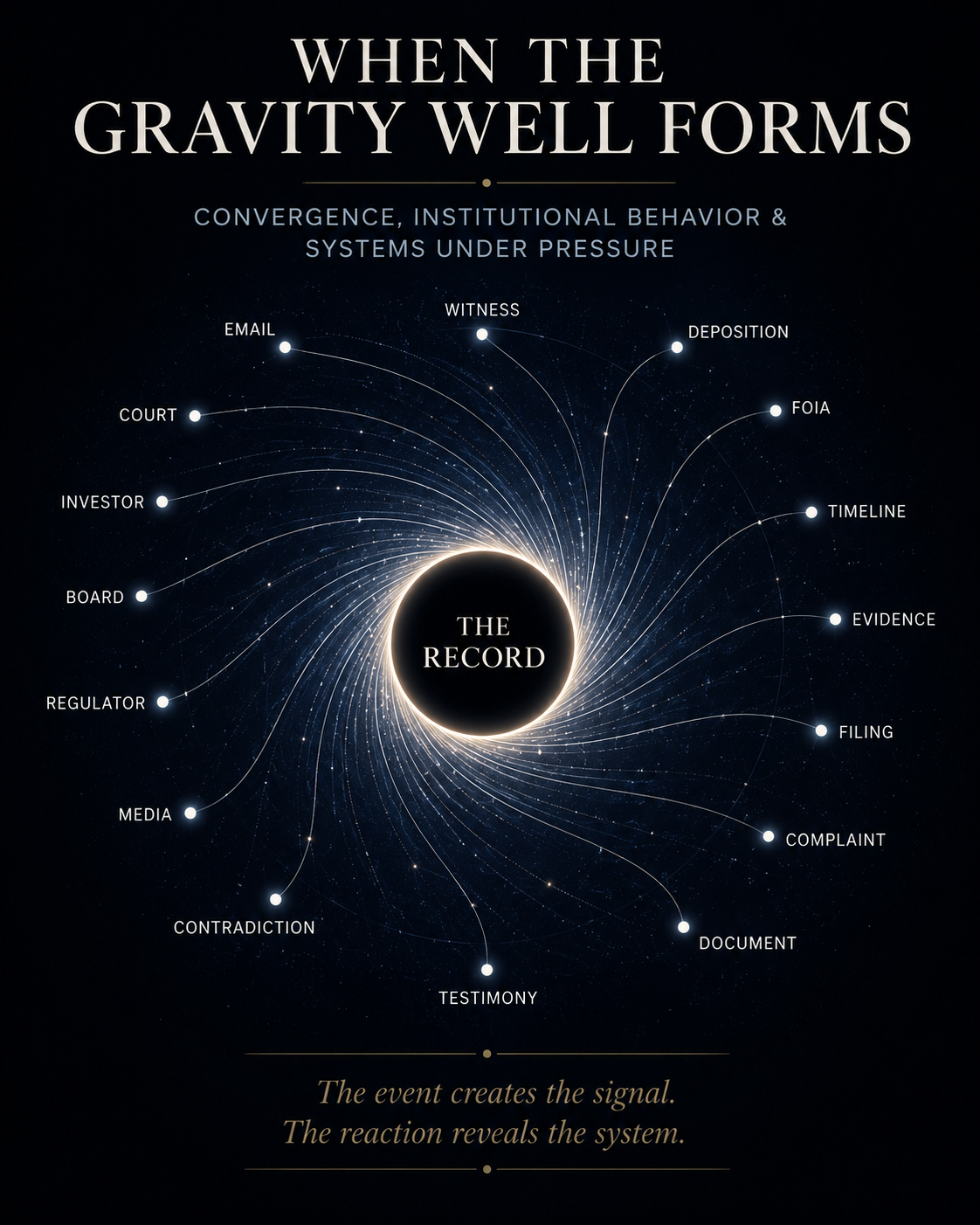
When the Gravity Well Forms
When the Gravity Well Forms
Convergence, Institutional Behavior, and the Moment a Theory Meets Observation
Editor’s Note: This article explores a broader framework for understanding institutional behavior under pressure. While inspired by years of observing litigation, public records, regulatory actions, and organizational responses, its purpose is not to revisit a single dispute. It is an attempt to describe a recurring pattern that may extend far beyond any one case.
Nearly two years ago, I wrote an article that had nothing to do with litigation.
At least, that is how it appeared.
The article discussed Rube Goldberg machines.
It discussed Jackson Pollock paintings.
It discussed business strategy.
It discussed convergence.
Most readers probably assumed it was another piece about organizational planning.
It wasn’t.
It was the beginning of a research question.
Every doctoral dissertation begins the same way.
Not with an answer.
With curiosity.
Mine began with an observation.
Organizations rarely collapse because of a single catastrophic decision.
Instead, they accumulate hundreds of seemingly rational decisions, each made in response to immediate pressure.
Viewed individually, every decision appears defensible.
Viewed collectively, they often reveal something entirely different.
The problem was finding a way to describe that process.
A Rube Goldberg machine provided the first analogy.
Every lever makes sense by itself.
Every marble appears insignificant.
Every domino falls because of the one before it.
No single event explains the outcome.
Only the completed machine does.
As useful as that analogy was, it eventually became insufficient.
Because Rube Goldberg machines require intention.
Someone builds them.
Someone places every piece.
Institutional behavior is rarely that organized.
Large organizations behave less like machines and more like galaxies.
Independent actors make independent decisions.
Executives respond to business risk.
Attorneys respond to litigation.
Regulators respond to complaints.
Politicians respond to public pressure.
Journalists respond to information.
Employees respond to culture.
None of them necessarily coordinate.
Yet, over time, their actions begin influencing one another.
The better analogy was not engineering.
It was gravity.
The Gravity Hypothesis
The hypothesis was straightforward.
Every institutional event creates informational mass.
An email creates mass.
A deposition creates mass.
A witness statement creates mass.
A public records response creates mass.
A delayed investigation creates mass.
A revised explanation creates mass.
A corporate filing creates mass.
Initially, these events exist independently.
Like distant stars.
Separated.
Unrelated.
Easy to dismiss.
Over time, however, something remarkable appears to happen.
Events begin attracting one another.
A witness corroborates another witness.
A document explains another document.
A later explanation contradicts an earlier explanation.
Independent timelines begin intersecting.
Regulatory actions intersect with litigation.
Corporate governance intersects with public records.
Media coverage intersects with sworn testimony.
The greater the accumulation of information, the stronger the apparent pull between previously unrelated events.
Eventually a threshold is reached.
Physicists refer to this as gravitational collapse.
The point at which accumulated mass fundamentally changes the behavior of everything surrounding it.
Legal proceedings have a similar point of convergence. Discovery concludes. Testimony is complete. Evidence enters the record. Arguments end. A fact-finder deliberates. Information that once existed as separate pieces now exists as a single evidentiary record.
For years, the information existed as separate objects.
Now the previously separate information exists within a single evidentiary framework. That is the gravity well.
From Theory to Observation
Every research project eventually reaches an uncomfortable point.
The theory encounters reality.
Until then, it remains speculative.
The question is no longer whether the theory is elegant.
The question is whether observation resembles prediction.
The purpose of research is not to prove oneself correct.
It is to determine whether a framework possesses explanatory value.
Over the past several years, I have observed an unusual sequence of institutional reactions.
Organizations modified explanations.
Positions evolved.
Public statements changed.
Documents emerged.
Regulatory responses accumulated.
Litigation created additional records.
Media reporting generated further public information.
Each event, viewed independently, appeared ordinary.
Viewed longitudinally, patterns became increasingly visible.
The framework suggested that once sufficient informational mass accumulated, institutions would no longer respond primarily to individual allegations.
They would begin responding to the complete record.
This matter appears to present an opportunity to observe that transition.
The Event Horizon
Astrophysicists describe the event horizon as the boundary beyond which nothing can escape the gravitational pull of a black hole.
The analogy is imperfect, but useful.
Institutionally, an equivalent boundary seems to exist.
There comes a point where no additional narrative can outrun the accumulated record.
Not because any single document is decisive.
Not because one witness changes everything.
But because the volume of interconnected information becomes the dominant feature of the system.
At that point, the conversation changes.
Earlier questions become less important.
People stop asking:
“Did this particular event occur?”
Instead they begin asking:
“Given everything now known, how should institutions respond?”
That is an entirely different inquiry.
It shifts the focus from events to governance.
From allegations to accountability.
From individual actors to institutional behavior.
The Second Machine
Many assume that litigation represents the end of institutional analysis.
In reality, it often represents the beginning.
A courtroom resolves only the legal questions before it.
The surrounding institutions then confront their own.
Corporate boards evaluate governance.
Shareholders evaluate oversight.
Employees reassess organizational culture.
Professional licensing authorities consider professional obligations within their jurisdiction.
Regulators determine whether additional review is appropriate under applicable law.
Financial institutions reassess risk.
Business partners reconsider exposure.
Researchers evaluate patterns.
Journalists examine the historical record.
Each institution performs a different function.
Each applies a different standard.
Each reaches independent conclusions.
The legal proceeding becomes one data point among many.
Beyond The Present
If this framework has value, it extends well beyond any single dispute.
That has always been the objective.
The purpose was never to explain one lawsuit.
It was to understand institutional behavior itself.
Can the accumulation of contradictions be measured?
Can organizational reactions be observed systematically?
Can informational convergence be modeled?
Can institutional responses become predictable?
Those remain empirical questions.
They deserve empirical answers.
Regardless of how any individual proceeding concluded, the larger research continues.
Because the interesting question was never simply what happened inside one courtroom.
The more important question is what institutions do once the gravity well has formed.
That, ultimately, is the hypothesis.
The trial was never the conclusion of that research.
It was the first opportunity to observe it in real time.
The original article ended by suggesting that gravity wells form long before most observers recognize them. Looking back, I no longer think that was simply a metaphor. Institutions generate records. Records accumulate. Independent decisions become interconnected systems. Eventually, enough informational mass exists that attention shifts from individual events to the behavior of the system itself. Whether this framework ultimately proves broadly useful remains a question for future observation. But if it does, then the most important finding will not be what happened in any single dispute. It will be that institutional behavior, when observed over sufficient time and scale, may be far more predictable than it first appears.
The theory predicts convergence. The next phase belongs to the institutions that now occupy the same gravitational field.
Convergence was never the objective. It was the observable condition required to evaluate the framework.
The question now is no longer whether the gravity well exists. It is how institutions behave once they begin operating within it.