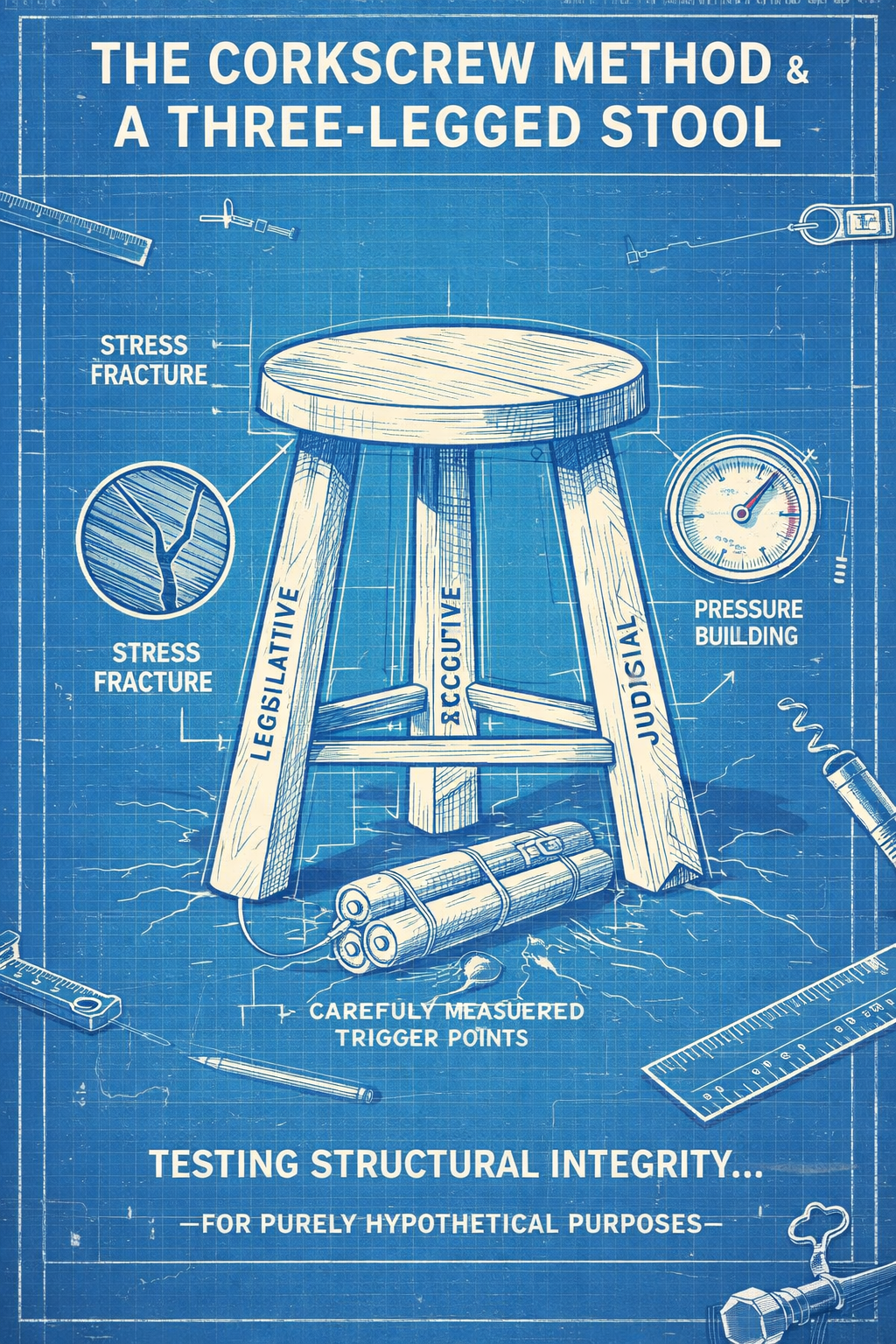
The Three-Legged Stool and the Corkscrew
The Three-Legged Stool and the Corkscrew
A Completely Hypothetical, Entirely Academic, Structural Inquiry
When I first got into sales, I was taught two things.
The first was the corkscrew method.
You don’t kick down doors.
You enter at one point and spiral outward.
One client becomes a referral.
One referral becomes a network.
One network becomes a system.
You don’t force expansion.
You rotate.
You widen.
You follow the grain.
It’s patient. It’s polite. It’s devastatingly effective.
The second lesson was the three-legged stool method.
A stool with one leg? Falls over.
Two legs? Cute. Also falls over.
Three legs? Stable.
In cross-selling, you secure three integrations. Three services. Three relational anchors. Once a client has three points of connection, you don’t chase them they stabilize themselves.
Trust builds duration.
Duration builds mass.
Mass builds gravity.
Now let’s reverse engineer that.
If stability requires three legs…
what actually makes it stable?
Is it the number?
Is it the symmetry?
Is it distribution of weight?
Or is it trust in the structure?
Because here’s the fun question no one asks:
Once a stool is stabilized, how many legs must be removed before it destabilizes?
One?
All three?
Or just enough pressure applied at the right angle?
And what happens when the weight shifts?
In sales, the three-legged method works because integration creates resilience. Remove one leg, the relationship may wobble but survive. Remove two, and things get interesting. Remove all three, and gravity does what gravity does.
But what if someone reverse engineers the method?
What if instead of building the stool, someone analyzes it?
What if someone asks:
Where does the weight sit?
How evenly is it distributed?
Is one leg carrying more than the others?
What happens under stress?
Because every structure commercial, institutional, governmental, relational claims stability.
The real test isn’t whether it stands on a showroom floor.
The real test is what happens when:
trust is tested
weight increases
pressure becomes asymmetrical
and observers start measuring load instead of admiring design
Does the stool reinforce itself?
Does it redistribute weight?
Does it tighten its joints?
Or does it wobble quietly and hope no one notices?
And here’s where the corkscrew returns.
The corkscrew doesn’t smash the structure.
It rotates inside it.
It widens gently.
It applies torque without spectacle.
Which raises a purely academic curiosity:
If a system’s stability depends on three points of reinforcement,
and someone calmly tests each one
not aggressively, not emotionally just structurally
How does it stand up?
Does stability come from integrity?
Or from the assumption no one will test it?
How many legs can a “stable” stool afford to lose before gravity makes the decision for it?
Just random musings.
Entirely theoretical.
Definitely not personal.
Sometimes the most interesting thing about a structure
isn’t how it’s built.
It’s how it behaves
when someone measures it.
Not with a wrecking ball.
Not with fireworks.
Not with spectacle.
But like an old city building scheduled for controlled deconstruction.
Engineers don’t just “bring it down.”
They study load-bearing walls.
They calculate stress lines.
They map fracture points.
They observe how weight travels through the frame.
They don’t create chaos.
They reveal physics.
Controlled implosions are quiet.
They fold inward along lines that were always there.
They follow math that was always true.
Which raises a purely academic curiosity:
What happens when a structure that claims stability
is measured the same way?
Not attacked.
Measured.
Cracks documented.
Load calculated.
Stress observed incrementally over time.
No noise.
Just patience.
Does the structure reinforce itself once it realizes it’s being evaluated?
Does it redistribute weight?
Does it quietly strengthen weak joints before pressure increases?
Or does it continue presenting symmetry at street level
while internal strain compounds beneath the surface?
Because gravity doesn’t respond to statements.
It responds to mass.
And mass accumulates whether acknowledged or not.
Controlled collapses are not dramatic because they are angry.
They are precise because they are understood.
And if someone were to reverse engineer a “stable” system
the way engineers study aging architecture…
Mapping joints.
Measuring torque.
Watching load transfer over time.
Then the question isn’t whether it stands today.
The question is whether it was designed
to withstand measurement.
Totally hypothetical.
Just structural curiosity.
After all
Every stable stool
looks perfectly balanced…
Right up until someone checks the legs.