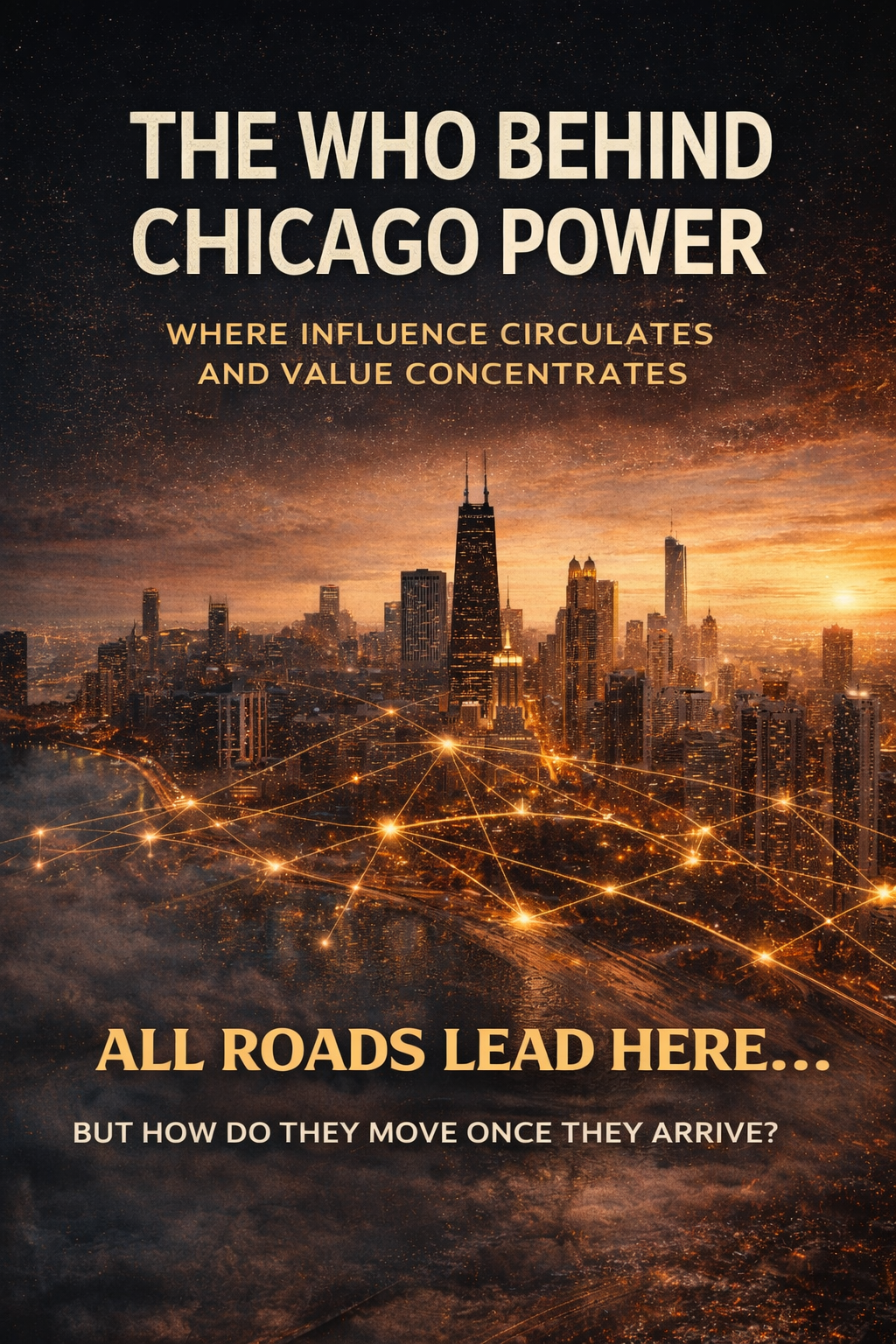
The Who Behind Chicago Power - an investigative commentary & public interest analysis
Editor's Note: This work constitutes investigative commentary and public interest analysis grounded in public records, court filings, verified news reporting, and firsthand observation. It is published as constitutionally protected press activity under the First Amendment to the U.S. Constitution, Article 19 of the Universal Declaration of Human Rights, and applicable international press freedom provisions.
Publication Notice
This investigative commentary is protected under established First Amendment doctrine governing press freedom, public interest analysis, and commentary on matters of public concern. All statements herein are categorized as follows:
Documented Facts — drawn from public records, official government filings, and verified news reporting.
Analytical Conclusions — the author's professional interpretation of documented public events and structural patterns.
Identified Allegations — explicitly labeled, with all individuals presumed innocent unless adjudicated otherwise.
Truth is an absolute defense. Commentary on documented public facts is protected expression. This work meets the standards for protected journalistic activity under controlling constitutional doctrine.
John 1:5 (KJV) — "And the light shineth in darkness; and the darkness comprehended it not."
All roads don't lead to Chicago.
They lead to Rome.
Chicago is loud. Visible. Aggressive. It looks like the epicenter because that's where force surfaces. Where pressure becomes visible. Where you can point at a map and say: there.
But visibility isn't origin.
Rome was never loud.
The cities that move without headlines — the ones operating quietly, structurally, methodically — push harder than Chicago ever could. Without the spotlight. Without the noise.
Chicago isn't the origin.
It's the amplifier.
It's where movement becomes visible. Where influence concentrates long enough to feel. Where strategy surfaces before it travels again.
Don't mistake volume for power.
Don't mistake visibility for control.
The loudest city isn't the throne.
It's the corridor.
Start local.
Charles Williams spent roughly three decades inside the Chicago Police Department. Public record. CPD confirms the tenure, the assignments, the timeline.
He was appointed Commissioner of the Chicago Department of Streets and Sanitation by then-Mayor Rahm Emanuel. Formally announced by the City of Chicago.
Streets and Sanitation sounds administrative.
It isn't.
That department controls municipal fleet logistics — including salt trucks. The same equipment deployed as physical barriers during events like Lollapalooza. The same assets positioned during protests and large-scale public gatherings. The physical infrastructure of crowd and movement management.
Law enforcement background. Municipal logistics authority. Operational control over public-space infrastructure.
Different titles. One ecosystem.
Now zoom out.
Illinois cannabis was not built as an open market. It was built as a limited-license system.
Scarcity creates value. Value creates leverage. Leverage attracts political gravity. Regulatory discretion determines survivability.
Who enforces compliance? Law enforcement.
Who influences zoning and permitting? Municipal leadership.
Who holds relationships inside both systems? Career insiders.
Charles Williams is publicly identified as the majority owner of MariWorks — operating inside that same limited-license cannabis market.
Law enforcement background.
Municipal logistics authority.
Ownership inside a scarcity-based regulated industry.
Different chapters. Same city. Same structural lane.
The public record goes further.
In documentary commentary surrounding the F'nDiddlers episode (YouTube link below), the names Charles Williams, Derail Easter, and Jeffrey Gougis surfaced in documented proximity. CPD records confirm overlapping timelines among those individuals within the Chicago Police Department ecosystem.
The overlap is verifiable.
https://www.youtube.com/watch?v=ooakubibA_c
When enforcement discretion intersects with licensing scarcity and documented personnel overlap, the public record demands scrutiny — not silence.
Now widen the lens.
Rahm Emanuel moved from Mayor of Chicago to U.S. Ambassador to Japan. During his diplomatic tenure, he publicly discussed deploying political capital in strategic industrial coordination between the United States and Japan. National reporting covered his remarks on leverage and industrial alignment.
Defense contractors — Raytheon Technologies, Lockheed Martin, Boeing, Northrop Grumman — operate within highly regulated procurement frameworks. Emanuel publicly advocated strengthening the Quad and deepening industrial coordination.
Municipal governance and defense diplomacy are not the same arena.
But they operate on identical mechanics: networks, leverage, trusted continuity.
Different scale.
Same architecture.
Place the layers side by side.
A 30-year CPD veteran.
Appointed to oversee the city's physical operational assets.
Holding ownership in a limited-license regulated industry.
Inside a city whose former mayor transitioned directly into global industrial diplomacy.
This is documented public record — layered, structured, and concentrated.
Call it structural gravity.
Call it institutional continuity.
Call it Chicago.
The questions are direct.
Illinois cannabis represents billions in projected economic activity. Limited licenses concentrate value. Concentrated value demands accountability.
When enforcement networks, municipal logistics, and scarcity-based licensing exist within the same documented ecosystem, transparency is not a courtesy.
It is a legal and civic obligation.
Are cannabis licenses insulated from prior enforcement relationships?
Are compliance actions applied uniformly across operators?
Are transitions between public authority and private ownership fully documented and audited?
Are the compliance walls strong enough to withstand independent scrutiny?
The City of Chicago and the State of Illinois will answer these questions.
Publicly or otherwise.
The light is already shining.
The question is whether those in the dark will comprehend it.
Sources & References
City of Chicago — Streets and Sanitation (Department Overview) https://www.chicago.gov/city/en/depts/streets.html
City of Chicago Press Releases — Mayoral Appointments Archivehttps://www.chicago.gov/city/en/depts/mayor/press_room.html
Chicago Police Department Personnel Records — CPDP Database https://cpdp.co (https://cpdp.co/)
Illinois Cannabis Regulation and Tax Act (Full Legislative Text) https://www.ilga.gov/legislation/ilcs/ilcs3.asp?ActID=3992
Illinois Department of Financial and Professional Regulation — Adult Use Cannabis Oversighthttps://idfpr.illinois.gov/profs/adultusecan.html
The Hill — Rahm Emanuel on U.S.–Japan Coordination & Political Capital https://thehill.com (https://thehill.com/) (Search: "Rahm Emanuel Japan political capital")
U.S. Embassy & Consulates in Japan — Ambassador Remarks Archive https://jp.usembassy.gov (https://jp.usembassy.gov/)
Quad Leaders' Joint Statements — U.S. Department of State https://www.state.gov (https://www.state.gov/) (Search: "Quad Leaders Joint Statement")
AUKUS Fact Sheet — The White House https://www.whitehouse.gov (https://www.whitehouse.gov/) (Search: "AUKUS fact sheet")
Public Reporting on Lollapalooza Security Infrastructure — Chicago Tribune https://www.chicagotribune.com (https://www.chicagotribune.com/) (Search: "Lollapalooza salt trucks security Chicago")
Editorial Correction & Revision Notice Published by Brittini Flatley — 2/23/26
The original version of this investigative work, published February 19, was revised but no facts were changed. This notice exists as part of the public record of this publication.
This revision was made in the interest of accuracy, journalistic integrity, and legal clarity. The public record this piece draws from has not changed. The author's analytical conclusions have not changed. What changed is the precision with which this work identifies itself — and the confidence with which it stands behind documented public facts.
This correction notice is itself part of the published record of this work.
— Brittini Flatley [The Who Behind Chicago Power/ Fnaround] Revised: 2/23/26