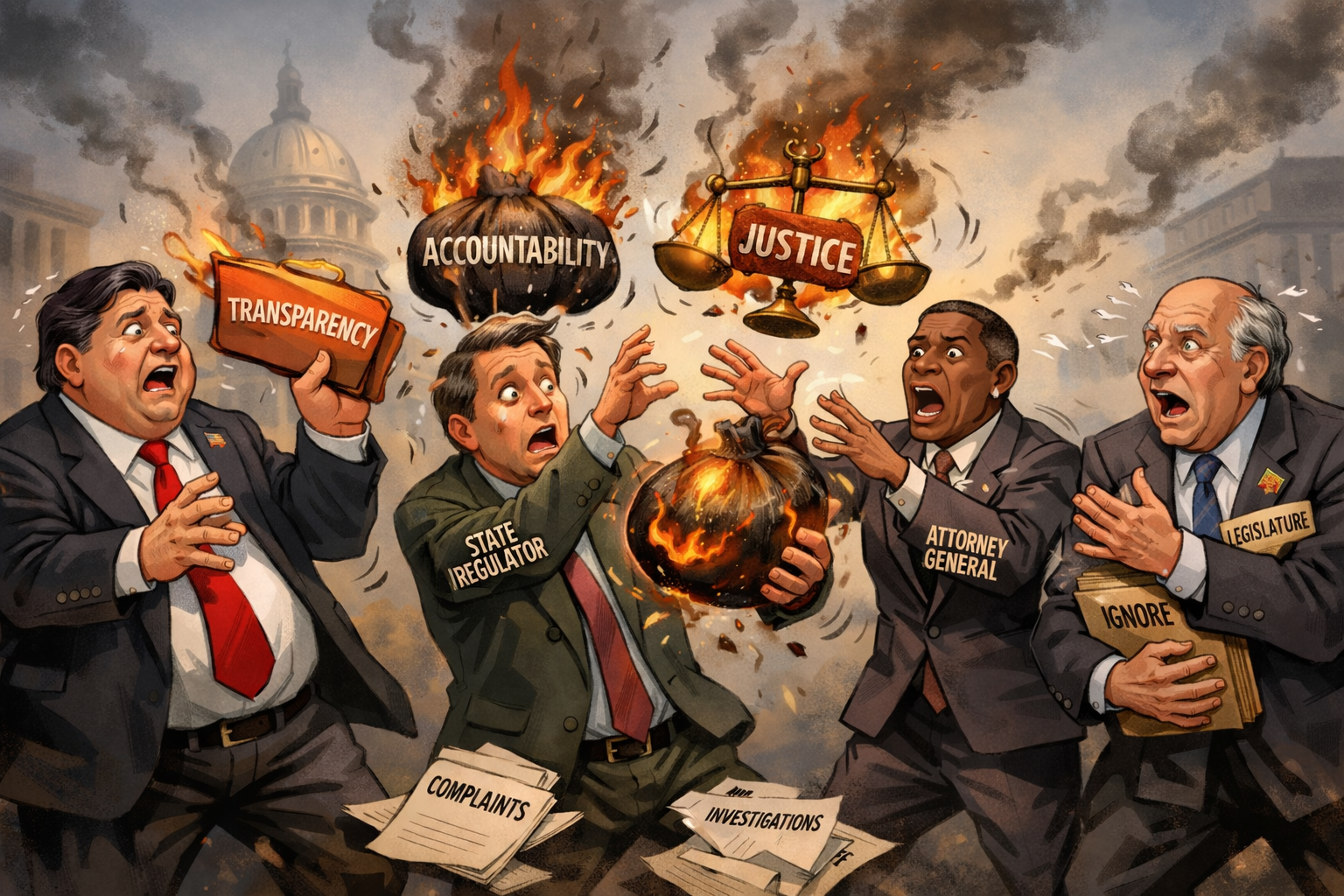
When the Paperwork Starts Talking Back
When the Paperwork Starts Talking Back
How a Cannabis Dispute Turned Into a Lesson the State Didn’t Mean to Teach
By F’nAround Media
December 2025
This was supposed to be a boring case.
A private civil dispute involving a state-licensed cannabis company. Equity disagreements, a failed buyout, lawyers doing what lawyers do. The kind of case regulators quietly appreciate because it comes with a built-in excuse: ongoing litigation.
Hands off.
Wait it out.
Let the court absorb the mess.
For a while, that strategy worked exactly as intended.
Then the paperwork started talking back.
Not leaks. Not whistleblowers. Not shadowy sources. Just official records doing the one thing they’re very good at when left alone long enough: contradicting each other.
What emerged wasn’t a dramatic revelation or a smoking gun. It was something much more inconvenient. Silence. Repeated. Documented. Procedural silence that stretched across years, agencies, and licenses while complaints piled up and red flags waved themselves tired.
At first, the silence looked like discretion. Then it looked like habit. Eventually, it started to resemble policy.
Throughout 2023 and 2024, regulators were not unaware. They were informed. They were copied. They were notified through complaints, statements, filings, and direct communications. Yet approvals continued. Licenses moved. Ownership structures shifted. Assets were transferred during active litigation as if gravity itself had taken the day off.
Each step forward relied on the same quiet assumption: someone else would deal with it.
Whenever questions surfaced, the answers followed a familiar rhythm. No records. Wrong office. Confidential. Too broad. Too narrow. Wrong window. Bad timing. Ongoing litigation.
The system didn’t malfunction.
It perfected delay.
In 2025, the approach changed. Not because anyone suddenly found courage, but because accusations stopped being useful. The questions became boring on purpose. Who received the complaints? What duties were triggered once they were received? What does the statute require when those triggers are met?
Freedom of Information requests went out, not to prove misconduct, but to trace motion. Or the lack of it.
The responses didn’t align. Agencies contradicted one another. Some swore no records existed while others quietly produced overlapping communications. Extensions were granted selectively. Denials were rewritten mid-stream. Explanations evolved. And still, no one could identify a single mandatory referral, escalation, or external report even where the law explicitly removes discretion.
Somewhere along the way, another story wandered into view.
While state leadership publicly framed new restrictions as necessary to “protect children from intoxicating hemp,” the records suggested a less wholesome motivation. The focus wasn’t hemp. It was cannabis. More specifically, cannabis revenue.
At the same time the state warned parents about gummies, state-licensed cannabis companies were permitted to market and advertise directly to children at public, all-ages events complete with branded packaging within restricted distances of schools and libraries. When asked for records explaining the distinction, agencies produced none. When asked whether enforcement followed, the silence did.
Apparently, the paperwork couldn’t find the children.
The contradictions didn’t stop there.
Through sworn FOIA responses, the Attorney General’s Office and the Department of Agriculture showed that Illinois’ social-equity licensing program was never intended to benefit minorities or their communities a position that sat awkwardly beside years of campaign speeches, press conferences, and legislative branding.
On paper, the equity promise didn’t evolve.
It vanished.
Not revised.
Disclaimed.
That alone should have triggered questions. It didn’t.
Instead, regulators continued approving licenses, transfers, and expansions for the same operators, even as complaints alleged fraud, intimidation, and misuse of social-equity frameworks. No mandatory referrals. No external reporting. No escalation.
Even more revealing was what happened when complaints involving cannabis marketing to minors finally reached the regulator. Investigations were acknowledged. Evidence was requested. Then everything went quiet again. FOIA responses later confirmed that despite open investigations, no disclosures were made to other agencies, no enforcement actions were logged, and no mandatory reporting occurred.
The state knew.
The state recorded knowing.
The state chose not to tell anyone else.
This is where the story stops being about delay and starts looking like design.
Because when a state publicly claims to protect children, privately disavows the equity purpose of its own licensing program, and quietly shields licensed operators from scrutiny the issue isn’t cannabis.
It’s governance.
When the state admits, in writing, that it failed to perform duties required by law while corporations continued operating, expanding, and benefiting from regulatory protection, the question stops being administrative.
It becomes civil.
Process is how rights exist in the real world. When process fails selectively, rights don’t disappear evenly. They disappear where it’s most convenient.
That’s why the escalation to the Office of the Executive Inspector General wasn’t dramatic. It was inevitable. Not because anyone raised their voice, but because the record ran out of excuses.
The paperwork is patient.
It waits.
It lets people explain themselves.
Then, eventually, it explains them.
On December 18, 2025, Illinois’ primary cannabis regulator confirmed in writing to the Public Access Counselor what the documents had been suggesting all along: no mandatory referrals or external reports had been made.
Not delayed.
Not pending.
Not overlooked and fixed later.
None.
That sentence didn’t accuse a company. It didn’t resolve a lawsuit. It acknowledged something far more serious a failure of duty.
Under the law, certain triggers remove choice. When they’re met, reporting is mandatory. Inaction stops being policy and starts being conduct.
Within an hour, the matter moved from FOIA review to the Office of the Executive Inspector General. Not because of outrage, but because procedure finally insisted on being taken seriously.
Inspector General reviews are quiet. They’re methodical. They don’t care about spin. They ask uncomfortable questions like who knew, when, and why nothing happened afterward.
And that’s where this stops being about one company, one license, or one lawsuit.
Cannabis is licensed, not exempt. Every state promises oversight. Every state promises enforcement. Every state promises that the rules mean what they say.
Illinois just produced a written record showing what happens when those promises bend for long enough.
The paperwork didn’t uncover a conspiracy.
It exposed a routine.
And routines are very hard to defend once they’re written down.
The next phase won’t be loud. Inspector General reviews rarely are. But the record is complete now. The notices were sent. The responses were logged. The admission was made.
This is no longer a dispute over what happened.
It’s a question of what happens when the state knows and decides not to act anyway.
And now that the process has been mapped not abstractly, but in practice there is nothing particularly mysterious left about it.
We understand how complaints move, how they stall, how discretion replaces obligation, and how silence becomes policy once enough people participate in it. We understand which offices speak publicly, which respond privately, which deny by default, and which simply stop keeping records altogether. The architecture is visible now. It is not complex. It is coordinated.
That knowledge does not expire with this case.
As 2026 begins, the work does not expand outward in theory. It expands sideways in evidence. Other states already sit on similar records, similar licensing frameworks, similar promises, and similar gaps between what the law requires and what regulators choose to do. The question is no longer whether these patterns exist elsewhere. It is how consistently they repeat once the same procedural pressure is applied.
This is not activism. It is replication.
When a state admits, in writing, that it failed to perform mandatory duties designed to protect the public while licensed corporations benefited from that failure, the issue is no longer regulatory. It is constitutional. Dereliction of duty in service of corporate protection is not neutral conduct. It is a civil rights problem, because process is how rights are enforced and selectively broken process is how they are denied.
Illinois is not finished. Far from it. Oversight does not end at acknowledgment, and accountability does not stop at administrative review. There are other channels. Some are quieter. Some are federal. Some do not involve requests at all but a loud courtroom.
Those plans are already underway.
The only remaining variable is how many other states discover, the hard way, that paperwork remembers everything even when regulators prefer not to.
Which state should we start a timeline with next?
Read the timeline for yourself on the timeline tab or read the FOIA filings for yourself on our active FOIA tab.