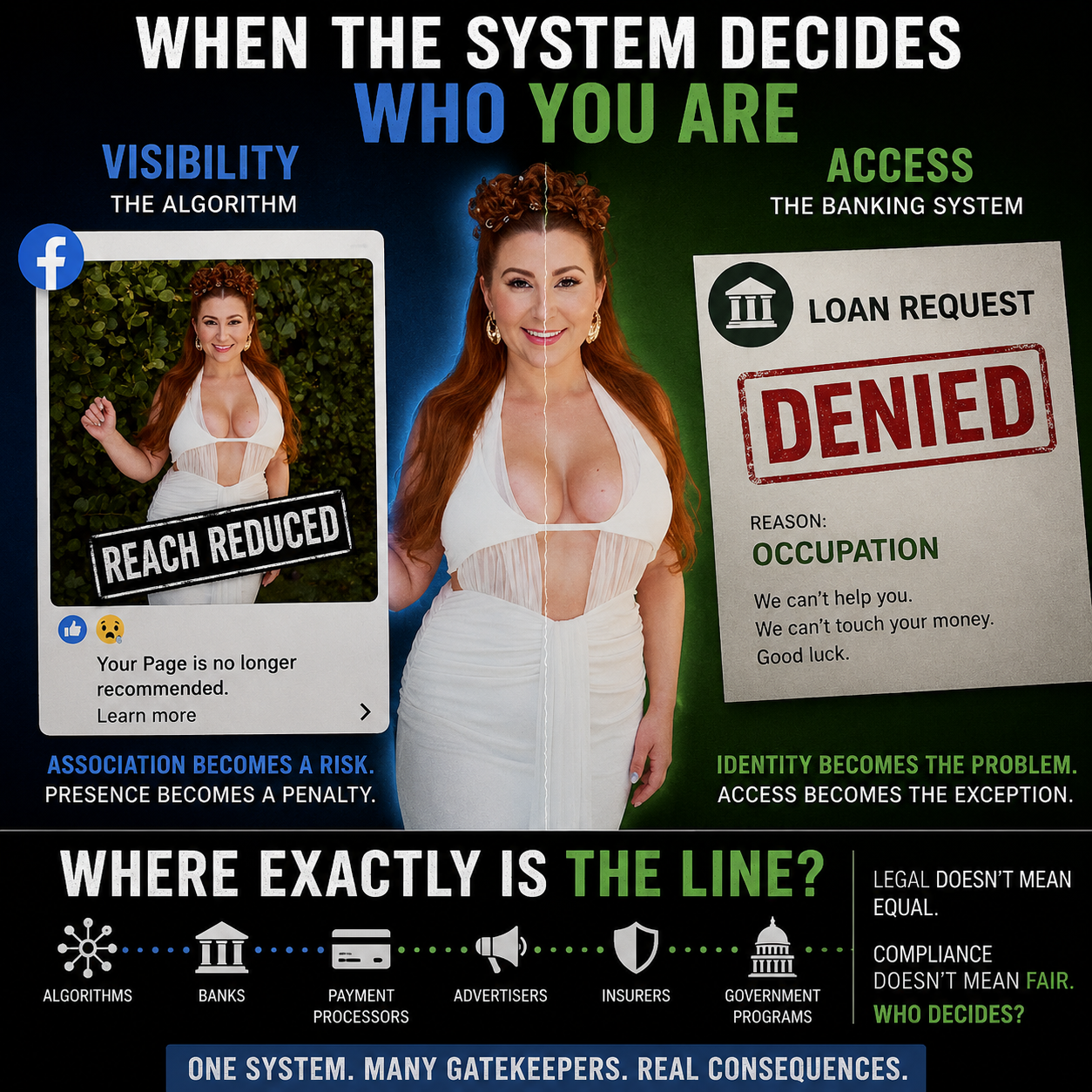
First the algorithm decides you should not be seen. Then the bank decides your money should not be treated the same.
First the algorithm decides you should not be seen. Then the bank decides your money should not be treated the same.
A Lesson from EXXXOTICA Chicago 2026, Part II: When the System Decides Who You Are
In Part I of our examination of EXXXOTICA Chicago 2026, we walked into the adult entertainment industry expecting to cover a convention and walked out asking a considerably larger question.
What happens when an algorithm stops evaluating what you actually posted and begins evaluating who you are associated with?
Our experiment was remarkably simple.
F’nAround Media attended EXXXOTICA Chicago as credentialed press. We interviewed performers, documented the convention and began learning an industry that was relatively new territory for us. During that coverage, we met adult performer Ellie Stockholm.
Later, with permission, we posted a completely ordinary photograph with her.
No nudity.
No sexual activity.
No explicit language.
Nothing that would make the photograph particularly remarkable if you removed the names of the people standing in it.
We tagged her.
Then Facebook informed us that our page would no longer be recommended.
The appeal didn’t provide a meaningful explanation that resolved the obvious contradiction: if the photograph itself wasn’t prohibited, why did distribution change?
That experience led us to a hypothesis.
Perhaps the system wasn’t simply evaluating content.
Perhaps it was evaluating association.
In other words:
The problem wasn’t necessarily what was in the photograph.
The problem may have been who was in it.
That was Part I.
Then another story crossed our feed.
And suddenly our little social-media experiment started looking like one piece of a much larger economic system.
Meet Isla Moon
Isla Moon is an adult content creator and the producer behind Reel Rivals, a reality fishing competition featuring social-media personalities, including creators known for adult content.
And whatever assumptions someone might make after hearing the words “adult creator,” the underlying business story doesn’t fit neatly into them.
Reel Rivals isn’t pornography.
It’s a fishing reality show.
It was filmed around Miami, involved a substantial professional production operation and went on to win Best New Show at the 2025 National Reality TV Awards.
Moon has described employing more than 60 people in the production and ultimately putting more than $4.5 million of her own money into Reel Rivals.
Then came the financing problem.
In an August 2026 interview reported by Where Is The Buzz, Moon described having approximately $2 million invested when she suddenly needed additional production capital immediately before filming.
She wasn’t describing walking into a bank with nothing and asking it to gamble on an idea.
According to Moon, she wanted to borrow against her existing investments rather than sell them.
Then the bank apparently learned what she did for a living.
Moon says the answer changed.
According to her account, after her investment adviser disclosed the nature of her work, the bank would no longer provide the financial solution she needed.
With production approaching and approximately $250,000 needed for payroll alone, Moon says she liquidated investments, including retirement assets, to keep the production alive.
The distinction here is critical.
These remain Moon’s allegations about what occurred. We have not seen the bank’s underwriting file, denial communication or explanation, and the financial institution has not been publicly identified in the reporting we reviewed.
But her account isn’t particularly interesting because one person says a bank treated her unfairly.
It’s interesting because once we started looking beyond her story, the same structural pattern appeared again.
And again.
And again.
From Your Feed to Your Bank Account
Our EXXXOTICA experience raised a question about digital classification.
If a person has been categorized by a platform as belonging to a sensitive industry, can that classification affect otherwise compliant material simply because that person appears in it?
Moon’s experience raises the financial version of precisely the same question.
If someone’s occupation is lawful, their income legitimate and their assets real, should the origin or social classification of that income determine whether they have normal access to financial infrastructure?
Put the two examples beside each other.
On a social platform:
The photograph may be acceptable, but the person in it may affect its distribution.
In banking:
The money may be legitimate, but the person who earned it may affect access to financial services.
Different institutions.
Different technologies.
Different consequences.
Remarkably similar logic.
Identity becomes risk.
And once identity becomes risk, individual behavior can become secondary.
This Isn’t Just an Isla Moon Story
The Free Speech Coalition has been documenting financial discrimination within the adult industry for years.
Its research found nearly two-thirds of surveyed people earning money in adult entertainment reported losing access to a bank account or other financial tool at some point.
Nearly 40% reported an account closure during the preceding year.
Those experiences weren’t confined to checking accounts. Respondents reported problems involving payment processors, lending, credit and insurance.
Then researchers studying financial exclusion among people working in sex trades found another disturbing pattern.
In research released in 2026, 32% of respondents reported having been banned from a bank account, payment application or payment processor.
Twenty-three percent reported having funds seized.
And the longer someone participated in the industry, the greater their reported exposure to financial discrimination became.
Those findings don’t prove every individual denial was discriminatory. Financial institutions have legitimate obligations involving fraud, creditworthiness, anti-money-laundering compliance, sanctions and other measurable risks.
But collectively, the numbers make something difficult to dismiss:
Financial exclusion in the adult industry isn’t merely an occasional complaint on social media.
It’s measurable.
Apparently You Don’t Even Have to Make Porn
One of the strangest examples involves someone who isn’t an adult performer at all.
Keily Blair is the CEO of OnlyFans.
Before leading OnlyFans, Blair was an attorney specializing in privacy, cybersecurity and related legal matters.
Yet Blair has publicly described being rejected by a bank because of her association with OnlyFans.
Think about the implications of that for a moment.
She wasn’t asking the bank to finance pornography.
She wasn’t being evaluated because she personally produced explicit material.
Her professional association with a company connected to adult content was apparently enough to create a problem.
That should sound familiar.
Because association was exactly what caught our attention after EXXXOTICA.
At some point, the system stops asking:
“What did this person do?”
and starts asking:
“What category does this person belong to?”
That difference is enormous.
Then the Federal Government Found Something
This is where the story becomes much harder to dismiss as industry frustration.
In December 2025, the Office of the Comptroller of the Currency released preliminary findings from its examination of the nine largest national banks under its supervision.
The OCC examined JPMorgan Chase, Bank of America, Citibank, Wells Fargo, U.S. Bank, Capital One, PNC, TD Bank and BMO.
The regulator found that, between 2020 and 2023, banks had maintained policies restricting financial services or requiring elevated approval for certain customers based upon otherwise lawful business activities.
The list of affected industries included firearms.
Oil and gas.
Coal.
Tobacco and electronic cigarettes.
Private prisons.
Digital assets.
And, explicitly:
Adult entertainment.
That matters.
Because now we aren’t relying solely on adult creators saying the financial system treats them differently.
A federal banking regulator examined major financial institutions and identified policies affecting lawful but controversial industries.
Adult entertainment was one of them.
In 2026, Regulators Started Removing “Reputation Risk”
Then something even more significant happened.
Federal banking regulators began dismantling the supervisory concept of reputation risk.
In April 2026, the OCC and FDIC finalized a rule removing reputation risk from their supervisory programs.
In June, the Federal Reserve, FDIC and OCC jointly removed additional references to reputation risk from interagency materials.
The underlying concern is remarkably relevant to this story: regulators acknowledged that reputation-risk concepts could potentially be used to pressure financial institutions to restrict lawful customers because their businesses, activities, beliefs or associations were unpopular.
That doesn’t mean a bank is now required to lend money to Isla Moon.
Banks remain entitled to make legitimate underwriting decisions.
A borrower can still be declined because of collateral, credit history, income volatility, fraud exposure, concentration risk, anti-money-laundering obligations or countless other conventional financial considerations.
And the regulatory changes primarily govern how regulators supervise banks, rather than creating an automatic right to a loan.
But something fundamental has changed.
The federal government is now explicitly confronting the possibility that access to financial infrastructure can be affected by something other than conventional financial risk.
And adult entertainment is already documented within that history.
The Algorithm and the Banker Have Something in Common.
This is where Part II connects directly to Part I.
A recommendation algorithm and a bank underwriting department seem completely unrelated.
One determines what appears in your Facebook feed.
The other determines who receives access to capital.
But both increasingly depend upon classification systems.
Every large institution has to classify risk.
Platforms classify content.
Banks classify customers.
Payment processors classify merchants.
Insurance companies classify businesses.
Governments classify applicants.
Advertisers classify audiences.
Search engines classify information.
Classification itself isn’t sinister.
At sufficient scale, it’s unavoidable.
The problem begins when classification overwhelms context.
Consider our EXXXOTICA experience.
Three clothed adults standing together in a convention photograph aren’t inherently adult content.
Yet if one person’s identity causes the photograph to inherit an adult-content classification, context becomes secondary to association.
Now apply the same logic to money.
A dollar earned by an adult performer isn’t chemically different from a dollar earned by an accountant.
It buys the same groceries.
Pays the same electric bill.
Pays the same employee.
Pays the same taxes.
Yet if the occupational classification attached to the person earning that dollar changes their access to financial products, identity has followed the money.
The classification has escaped its original context.
And Then There Is Florida
Moon makes another allegation that deserves considerably more investigation.
She says Florida denied production incentives for Reel Rivals because the show featured OnlyFans creators.
Again, we want to be precise.
We have not reviewed Moon’s application, the government’s denial letter or the complete administrative record. Until those documents are obtained, this should be presented as Moon’s account, not an independently established government finding.
But the allegation creates an extraordinary policy question.
Florida has historically excluded pornographic or obscene productions from certain entertainment incentives.
That isn’t particularly surprising.
But Reel Rivals is publicly presented as a fishing reality competition.
So the question isn’t necessarily:
Should taxpayers subsidize pornography?
It’s potentially:
Does a non-pornographic production become functionally classified as adult entertainment because some of its cast members make adult content somewhere else?
Those are profoundly different questions.
If a performer appears in an explicit production Monday and a fishing competition Tuesday, does Tuesday’s production inherit Monday’s classification?
If so, where does it stop?
Can the same person appear in a restaurant advertisement?
A mainstream movie?
A podcast?
A charity event?
A documentary?
A news interview?
And if those projects contain nothing explicit, what exactly is being regulated?
The content?
Or the person?
We’ve heard that question somewhere before.
The Creator Economy Already Has a Financing Problem.
There is another important piece of context.
Adult creators aren’t entering a financial system particularly well designed for creators in the first place.
Visa commissioned Morning Consult to survey more than 1,000 creators across five countries in 2025.
Sixty-eight percent considered themselves small-business owners.
Yet 86% financed their businesses through personal money, savings or personal credit cards.
Only 19% reported using business credit or debit cards.
So the modern creator economy has built an unusual contradiction.
Platforms tell creators:
You’re entrepreneurs.
Tax systems often treat them like businesses.
They buy equipment like businesses.
Hire employees and contractors like businesses.
Purchase advertising like businesses.
Produce intellectual property like businesses.
Pay taxes like businesses.
But traditional finance can still struggle to treat them like businesses.
Now place an adult-industry classification on top of that existing structural disadvantage.
The friction compounds.
And Friction Has a Price.
This is perhaps the most overlooked part of Moon’s story.
Being denied financing doesn’t simply mean:
No loan.
Imagine an entrepreneur has $2 million invested and needs $250,000 temporarily.
With access to appropriate financing, the entrepreneur might borrow against assets, fund the immediate obligation and preserve the underlying investment portfolio.
Without financing, the entrepreneur may need to liquidate assets.
That can potentially create taxable events.
It eliminates future investment returns on those assets.
It can affect retirement savings.
It reduces liquidity.
It increases exposure to subsequent emergencies.
And if another unexpected expense arrives tomorrow, there are fewer assets available to absorb it.
The original disadvantage can therefore create another disadvantage.
Then another.
Eventually something fascinating happens.
The customer denied conventional financial services because the institution considers them risky may become objectively financially riskier because conventional financial services were unavailable to them.
The cycle begins to reinforce itself:
Classification → reduced access to capital → personal financing → reduced liquidity → increased volatility → weaker conventional underwriting profile → reduced access to capital.
The classification can begin producing some of the very risk it supposedly measures.
This Is What Structural Weight Looks Like
No single event necessarily destroys someone’s business.
A Facebook recommendation restriction doesn’t end a career.
A payment processor termination doesn’t necessarily end one.
A loan rejection doesn’t.
An advertising restriction doesn’t.
An insurance problem doesn’t.
A production-incentive rejection doesn’t.
A search-ranking change doesn’t.
Individually, each institution can explain its decision as a policy, a model, a risk assessment or an eligibility determination.
But systems aren’t experienced individually.
They’re experienced cumulatively.
Imagine trying to operate a completely legal business while simultaneously confronting:
Reduced social distribution.
Advertising limitations.
Payment-processing restrictions.
Banking friction.
Lending difficulties.
Insurance complications.
Government-program exclusions.
Higher compliance costs.
And then being told your business simply needs to compete harder.
At some point, we’re no longer measuring competition on a level marketplace.
We’re measuring someone’s ability to carry structural weight.
We’ve Seen This Movie Before.
There is an almost comical cultural reference hiding inside this supposedly modern problem.
Boogie Nights came out in 1997.
In the movie, Buck Swope earns money working in pornography and wants to open a legitimate stereo store.
He seeks financing.
The bank rejects him because of his connection to the adult industry.
That was fiction depicting the late 1970s and early 1980s.
Nearly three decades after the movie was released, adult-industry advocates are still pointing to that scene because the underlying problem remains recognizable.
Only the technology changed.
Buck had a loan officer.
Modern creators have loan officers, automated underwriting, payment processors, risk-scoring systems and algorithms.
Which raises an uncomfortable possibility:
We didn’t eliminate subjective gatekeeping.
We automated portions of it.
OnlyFans Already Showed Us How Powerful Financial Infrastructure Can Be.
In 2021, OnlyFans announced that it would prohibit sexually explicit material.
The announcement seemed absurd.
A platform synonymous with adult creators was apparently preparing to restrict the very content responsible for much of its identity.
Why?
Financial institutions and payment infrastructure were central to the controversy.
OnlyFans reversed course shortly afterward.
But the episode demonstrated something extraordinarily important.
Government doesn’t necessarily have to make an industry illegal to make operating that industry extraordinarily difficult.
Congress doesn’t have to ban something.
A state legislature doesn’t necessarily have to prohibit it.
Sometimes access to essential infrastructure determines what remains commercially viable.
Payment processors.
Banks.
Advertising networks.
App stores.
Hosting providers.
Social platforms.
Search engines.
Each can independently say:
We’re a private institution making a risk decision.
And that can be true.
But when enough independent systems arrive at similar classifications, the cumulative outcome begins functioning remarkably like regulation.
The Invisible Regulator.
That may be the larger lesson from EXXXOTICA.
We usually think regulation comes from government.
A legislature passes a law.
An agency writes a rule.
A court interprets it.
Someone enforces it.
Modern digital economies have introduced something different.
Private infrastructure can regulate behavior without formally regulating anything.
Facebook doesn’t need to prohibit an adult creator from existing.
It can simply recommend that creator less.
A bank doesn’t need to declare adult entertainment illegal.
It can decide certain customers don’t fit its risk appetite.
A payment processor doesn’t need criminal authority.
It can terminate merchant access.
An advertising platform doesn’t have to ban someone’s business.
It can make reaching customers prohibitively difficult.
None of these decisions alone necessarily constitute censorship or unlawful discrimination.
That’s important.
But examining each decision independently can also obscure the cumulative result.
Because to the person standing in the middle of all those systems, the distinction becomes academic.
They are still less visible.
They still have less access.
They still pay more.
They still carry additional operational risk.
And they still have to overcome barriers their competitors may never encounter.
The Question Isn’t Whether You Like Porn.
That is probably the least interesting question in this entire discussion.
You can dislike pornography.
You can object to OnlyFans.
You can oppose public incentives for entertainment productions.
You can decide you never want adult content appearing anywhere near your social-media feed.
None of those positions resolve the institutional question.
The more important question is:
How should lawful activity be treated by the infrastructure necessary to participate in a modern economy?
Because classifications don’t remain neatly confined forever.
Today the unpopular category may be adult entertainment.
Another institution might classify cannabis.
Another might classify firearms.
Another cryptocurrency.
Another controversial political speech.
Another investigative journalism.
Another emerging technology.
Another industry nobody has invented yet.
Once we’ve accepted the principle that lawful activity can receive materially different access based substantially upon institutional judgments about reputation or association, the debate is no longer about pornography.
It’s about who gets to make those judgments.
And how much power those judgments should carry.
Part I Was About Visibility. Part II Is About Participation.
EXXXOTICA taught us something we didn’t expect.
Initially, we thought the adult industry would be an interesting new area for F’nAround to cover.
Instead, it became a useful lens through which to examine systems we’ve been studying all along.
Classification.
Institutional behavior.
Risk.
Access.
Regulation.
Algorithms.
And the cumulative consequences of thousands of individually defensible decisions interacting with one another.
Part I began with a photograph.
Part II ends with a bank account.
But they may actually be examining the same phenomenon.
What happens when institutions stop evaluating what you’re doing and begin evaluating what they believe you are?
For Ellie Stockholm, we wondered whether association affected visibility.
For Isla Moon, her account raises the question of whether association affected access to capital.
The OCC has now documented restrictions involving lawful industries, including adult entertainment.
Federal banking regulators have begun removing reputation risk from supervisory frameworks.
Creator-economy research shows entrepreneurs already rely disproportionately on personal financing.
Adult-industry research reports extraordinarily high levels of financial exclusion.
Different datasets.
Different institutions.
Different consequences.
Same question.
Because the algorithm doesn’t simply decide what you see.
The financial system doesn’t simply decide who qualifies for a loan.
The payment processor doesn’t simply decide which transaction clears.
And government programs don’t simply decide which application checks the correct boxes.
Together, these systems determine something much larger:
Who gets visibility.
Who gets capital.
Who gets infrastructure.
Who gets opportunity.
And ultimately, who gets to participate normally in the economy.
In Part I, we asked who gets to exist within visibility.
After looking at Isla Moon’s story, the question has evolved.
What happens when the algorithm decides who you are and the rest of the system believes it?
Where Exactly Is the Line?
And perhaps this is where the contradiction becomes impossible for F’nAround to ignore.
We came into this investigation from cannabis.
So we already know what happens when an industry exists in the uncomfortable space between legality, finance, regulation, and institutional risk.
Cannabis remains federally illegal in the United States. Marijuana remains a Schedule I controlled substance under federal law as of this writing, even while dozens of states have constructed legal medical or adult-use markets around it.
Yet cannabis businesses still obtain buildings.
They still finance acquisitions.
They still raise capital.
They still lease equipment.
They still construct cultivation facilities.
They still purchase dispensaries.
They still move millions of dollars through increasingly sophisticated financial structures.
Banks and investors have developed ways to participate while attempting to remain within whatever legal and regulatory boundaries apply to them: real-estate financing, equipment arrangements, management agreements, sale-leasebacks, private credit, ancillary-company structures and other forms of creative financing.
To be precise, that doesn’t necessarily mean banks are simply “violating federal law” by lending to cannabis companies. Financial institutions face significant federal legal and compliance risks when servicing marijuana-related businesses, particularly under the Bank Secrecy Act and anti-money-laundering framework, and federal guidance has historically established enhanced reporting and due-diligence expectations rather than a simple universal rule that every cannabis loan itself is automatically criminal.
But that’s exactly what makes the comparison so interesting.
Cannabis is federally illegal.
Adult entertainment, when lawfully produced and distributed, is not.
And somehow we’ve reached a world in which financial professionals can spend enormous amounts of time figuring out how to structure capital around the federal illegality of marijuana while some adult creators say they struggle to obtain ordinary financial services precisely because of their perfectly legal occupation.
That deserves a question.
Actually, several.
What risk are we really measuring?
Is it whether the underlying activity is legal?
Apparently that cannot be the entire answer.
Is it the probability the bank gets repaid?
Then why should a lawful occupation, standing alone, matter when sufficient assets and otherwise acceptable underwriting exist?
Is it regulatory exposure?
Reputational exposure?
Political pressure?
Payment-processing rules?
The identity of the borrower?
The source of the borrower’s money?
Or is it something even more uncomfortable:
Who institutions are comfortable making money from and who they’re comfortable allowing to make money?
Because there is a fascinating distinction between financing the cannabis industry and financing an adult creator.
In one case, sophisticated financial structures can sometimes transform an extraordinarily complicated regulatory problem into a manageable transaction.
In the other, a lawful occupation can apparently become the complication itself.
And that turns this entire investigation on its head.
Maybe the dividing line isn’t simply legal versus illegal.
Maybe it’s acceptable versus unacceptable.
Bankable versus unbankable.
Institutionally desirable versus institutionally inconvenient.
And if that’s true, who draws that line?
A legislature?
A regulator?
A bank’s compliance department?
An insurance carrier?
Visa or Mastercard?
A social-media platform?
An algorithm?
Or an invisible combination of all of them?
Because once private infrastructure can determine that one federally prohibited industry is financially workable while participants in another lawful industry remain commercially undesirable, legality alone no longer explains the system.
Classification does.
Which brings us right back to EXXXOTICA.
We started with an ordinary photograph and wondered whether Facebook was evaluating what was in the picture or who was standing in it.
Now we’re asking essentially the same question about money.
Is the system evaluating the transaction?
Or the person making it?
Is it evaluating where the money is going?
Or who earned it?
And at what point does legitimate risk management quietly become something else?
We don’t have the answer yet.
That’s precisely why the question matters.
Because somewhere between an algorithm deciding who should be recommended, a bank deciding who should receive capital, a payment processor deciding whose transactions are acceptable, and a government deciding which lawful businesses deserve access to public programs, there is a line.
We’d just like someone to show us exactly where it is.